c# any vs count: Which One to Use
c# any vs count: Understand when to use Any() vs Count() in C# for checking if a collection has elements. Learn performance implications and correct usage.
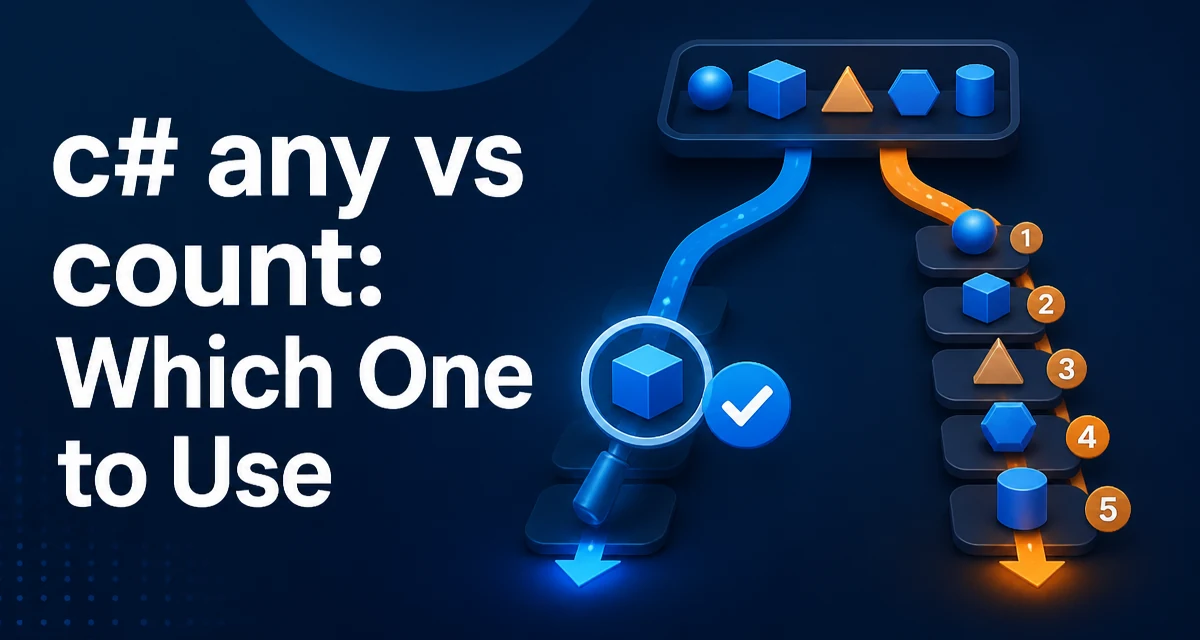
c# any vs count requires a clear understanding of the core syntax, runtime behavior, and practical implementation patterns demonstrated in the examples below.
Checking for Elements: The Core Difference
When working with collections in C#, a common task is to determine whether a collection contains any elements. The choice between Any() and Count() > 0 might seem trivial, but it can have significant performance implications, especially with IEnumerable<T> sequences that are not materialized collections like arrays or List<T>.
Any() returns a bool indicating whether the sequence contains any elements. It short-circuits as soon as it finds the first element. Count() enumerates the entire sequence and returns an int. Comparing Count() > 0 forces the full enumeration even if the first element already confirms that the collection is non-empty.
IEnumerable<int> numbers = GetNumbers(); // Some lazy sequence

bool hasAny = numbers.Any();          // Short-circuits after first element
bool hasCount = numbers.Count() > 0;  // Enumerates the entire sequence
In the first call, Any() stops after accessing the first element. In the second, Count() must traverse every element to produce a total count. For an infinite sequence, Count() would never return, while Any() would return true immediately. This fundamental difference in the enumeration behavior is the primary reason to prefer Any() for emptiness checks.
Performance Considerations
Performance is the most cited reason to prefer Any() over Count() > 0, but the magnitude of the difference depends on the underlying collection type.
For collections that implement ICollection<T> (like List<T> or T[]), the LINQ Count() method has an optimization. It checks if the source implements ICollection<T> and, if so, returns the Count property directly without enumerating. In those cases, Count() and Any() have comparable performance because Count() does not actually enumerate the collection.
However, for any IEnumerable<T> that does not implement ICollection<T>—such as the result of a Select() projection, Where() filter, or a custom iterator—Count() must iterate through the entire sequence. The difference becomes more pronounced as the sequence grows. Any() only needs to see one element, so its cost is constant (assuming the first element is readily available). Count() is O(n) for non-materialized sequences.
To illustrate, consider a lazy sequence that generates many elements:
IEnumerable<int> largeSequence = Enumerable.Range(0, 1_000_000);

bool isEmpty = !largeSequence.Any();       // Fast: stops after first element
bool isNotEmpty = largeSequence.Count() > 0; // Slow: iterates a million elements
While the Enumerable.Range example might be contrived, the same principle applies to filtered sequences:
IEnumerable<Order> matchingOrders = allOrders.Where(o => o.Status == "Pending");

bool hasPending = matchingOrders.Any();      // Efficient: stops at first match
bool hasPendingCount = matchingOrders.Count() > 0; // May iterate all orders if no matches
If there are no pending orders, Where() must iterate through the entire allOrders collection to produce an empty result, and Count() will also iterate that same sequence, causing the enumeration to happen twice. Any() will also iterate to the end in this worst-case scenario, but it avoids the unnecessary count aggregation afterward. In practice, for large or lazily-evaluated sequences, Any() is consistently the safer choice.
Correctness in Edge Cases
Beyond performance, there are correctness concerns when using Count() to check for emptiness, especially if the sequence is infinite or has side effects.
An infinite sequence is a classic edge case. Consider:
IEnumerable<int> infinite = InfiniteSequence(); // Hypothetical infinite iterator

bool hasAny = infinite.Any();      // Returns true instantly
bool hasCount = infinite.Count() > 0; // Never terminates
While most production code does not use infinite sequences directly, it's important to be aware that Count() assumes a finite sequence. Any() does not.
Additionally, enumerating a collection can have side effects if the source is a generator that performs I/O or state changes. Using Count() to check for emptiness might trigger those side effects for the entire sequence, whereas Any() only triggers them until the first element is produced. For this reason, always use Any() when you only need to know if there is at least one element, regardless of the total count.
Best Practices for Empty Collection Checks
The consensus in the C# community is clear: use Any() to determine whether a collection has elements. This is both a performance best practice and a readability improvement. if (collection.Any()) reads more naturally than if (collection.Count() > 0). It communicates intent directly: “do something if the collection is not empty.”
On the other hand, use Count() when you actually need the number of elements. For example, you might need to display the count to a user, allocate an array of that size, or validate a business rule that requires a specific number of items. In those cases, Count() is appropriate.
| Scenario | Recommended Method | Reason |
|---|---|---|
| Check if collection is non-empty | Any() | Short-circuits, performance-friendly |
| Check if collection is empty | !Any() | Same as above, negated |
| Get number of items | Count() | Returns an integer count |
| Compare against a threshold (e.g., > 5) | Count() | Requires the actual count |
Remember that these recommendations apply to LINQ extension methods. If you are working with a concrete collection type like List<T>, you can also use the Count property (e.g., list.Count > 0) which is O(1) and does not cause enumeration. Similarly, for arrays, array.Length > 0 is direct. However, when you are programming against an IEnumerable<T> interface, which is common in method parameters, Any() is the standard.
Choosing Between Count Property and Count() Method
It's essential to distinguish between the Count property and the Count() LINQ method. The property is a fast, O(1) operation on collection types like List<T> or Dictionary<TKey, TValue>. The method is a LINQ extension that may or may not be optimized depending on the underlying type.
Consider this:
List<int> list = new List<int>();

bool hasItems = list.Count > 0;   // Property access—fast
bool hasItemsLinq = list.Any();   // LINQ - also fast
For List<T>, both are acceptable. However, when a method accepts IEnumerable<T>, you cannot access the Count property because it's not defined on the interface. You are forced to use either Count() or Any(). In that context, Any() is the preferred choice to avoid enumeration and to signal that you only need a truthiness check.
Advanced Scenarios and Limitations
There are a few advanced scenarios where the choice between Any() and Count() becomes more nuanced.
Parallel LINQ (PLINQ). If you are using AsParallel(), both methods work, but Any() may short-circuit more efficiently in a parallel environment because it can stop as soon as any thread finds an element. Count() must aggregate results from all threads, which takes longer.
Custom Iterators. If you implement your own iterator, be aware that Any() will call MoveNext() once and stop. Count() will call MoveNext() until the enumeration is complete. This means that if your iterator has side effects (e.g., consuming a stream), using Count() to check for emptiness might consume the entire stream, making subsequent enumeration impossible. Always use Any() to gate further processing in such cases.
Query Composition. When building LINQ queries, avoid calling Count() just to check if a result set is empty. Instead, structure the query to use Any() at the terminal point. This not only saves CPU cycles but also can simplify the query logic.
// Inefficient: count all then compare
var total = db.Orders.Where(o => o.Status == "New").Count();
if (total > 0) { ... }

// Efficient: short-circuit with Any
if (db.Orders.Any(o => o.Status == "New")) { ... }
Even in LINQ-to-Entities (Entity Framework), Any() is translated to an EXISTS query, which is often more efficient than a SELECT COUNT(*) query followed by a comparison. This pattern is not just a C# consideration; it also impacts database performance.
In summary, the general rule is to use Any() for emptiness checks, and Count() only when the actual numeric count is required. This rule holds for both in-memory collections and database-backed LINQ queries. Following this guidance helps you write code that is both faster and more semantically accurate.