C# Bitwise Operators: Syntax, Use Cases, and Pitfalls
c# bitwise operators: Understand C# bitwise operators: &, |, ^, ~, <<, >>, with practical examples for flags, bit manipulation, and common pitfalls.
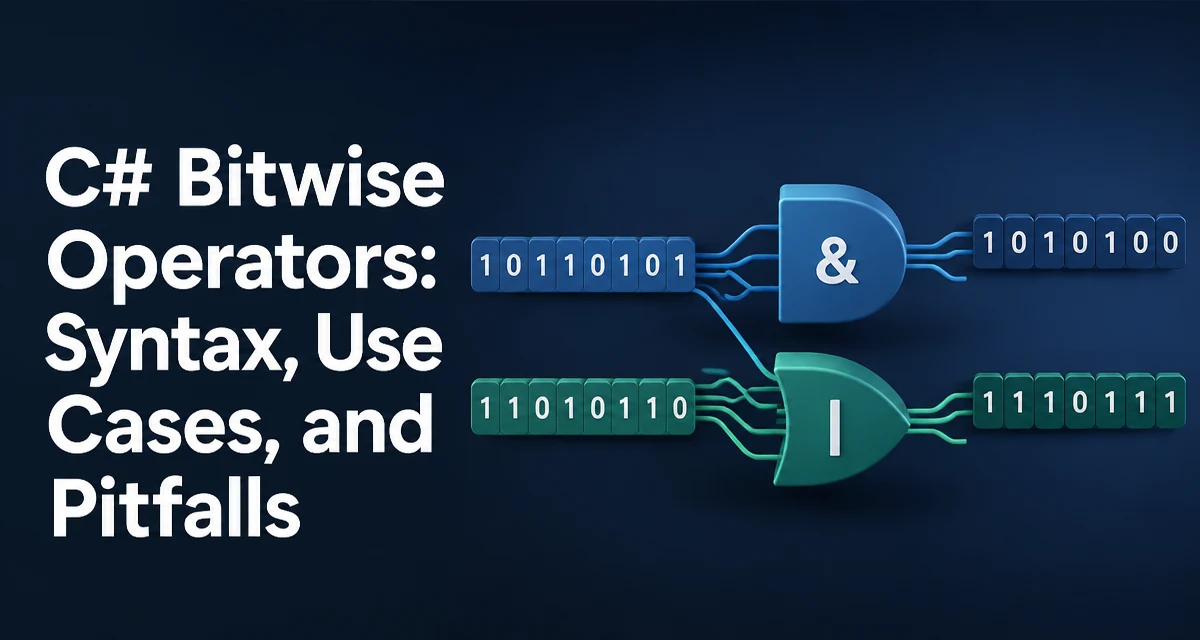
C# bitwise operators work directly on the binary representation of integer types. They are essential when you need to pack multiple flags into a single value, parse protocol headers, or implement algorithms that depend on binary arithmetic. In C#, the operators are &, |, ^, ~, <<, and >>, and they apply to sbyte, byte, short, ushort, int, uint, long, and ulong. This article explains the syntax, the semantics of each operator, and the mistakes that appear when they are used in real code.
The Six Bitwise Operators and Their Behavior
Each bitwise operator works on the individual bits of its operands. The table below summarizes the operators and their effect on two 4-bit values for illustration.
| Operator | Name | Example (4-bit) | Result |
|---|---|---|---|
& | AND | 0b1100 & 0b1010 | 0b1000 |
| ` | ` | OR | `0b1100 |
^ | XOR | 0b1100 ^ 0b1010 | 0b0110 |
~ | NOT | ~0b1100 | 0b0011 (on 4 bits) |
<< | Left shift | 0b0001 << 2 | 0b0100 |
>> | Right shift | 0b1100 >> 2 | 0b0011 (logical) |
The ~ operator is unary and flips every bit in its operand. On a real int, ~0 is -1 because of the two's complement representation. The shift operators move bits left or right, and the behavior of right shift depends on whether the operand is signed.
When you apply bitwise operators to byte, short, or ushort, the operands are promoted to int before the operation. The result is an int, so you may need to cast it back to the smaller type if you assign it. For example:
byte a = 0b1100;
byte b = 0b1010;
byte result = (byte)(a & b); // Without the cast, this does not compile.
This promotion is a common source of compile-time errors for developers new to bitwise logic.
Using Bitwise Operators for Flags and Enums
The most common production use of bitwise operators in C# is combining enum values with the [Flags] attribute. A flags enum assigns each member a distinct bit position, usually powers of two. You combine them with |, test with &, toggle with ^, and remove a flag with & ~.
[Flags]
public enum FileAccess
{
    None = 0,
    Read = 1,
    Write = 2,
    Execute = 4
}

var access = FileAccess.Read | FileAccess.Write;
bool canRead = (access & FileAccess.Read) != 0;
bool canWrite = (access & FileAccess.Write) != 0;
bool canExecute = (access & FileAccess.Execute) != 0;

// Remove the Write flag
access &= ~FileAccess.Write;
The & test checks whether the specific bit is set. The & ~ combination clears that bit without affecting others. The ^ operator toggles a bit: if it is set, it becomes unset, and vice versa. These operations are the basis of permission systems, state machines, and configuration masks.
Bit Shifting and Its Edge Cases
Left shift (<<) moves bits toward the most significant bit and fills the low-order bits with zeros. Right shift (>>) moves bits toward the least significant bit. For signed types, right shift is arithmetic: it fills the high-order bits with the sign bit. For unsigned types, it is logical: it fills with zeros.
int signedValue = -8;          // 11111111 11111111 11111111 11111000
int arithmeticShift = signedValue >> 2; // still negative
uint unsignedValue = 0b11111111_11111111_11111111_11111000;
uint logicalShift = unsignedValue >> 2; // positive
The shift count is masked based on the size of the left operand. For int and uint, the count is masked to the low five bits (0–31); for long and ulong, it is masked to the low six bits (0–63). This means 1 << 32 is actually 1 << 0, which is 1. This behavior can surprise developers who expect a zero result or an overflow exception.
Common Pitfalls: Operator Precedence and Sign Extension
Bitwise operators have lower precedence than arithmetic and relational operators in C#. The expression x & mask == 0 is parsed as x & (mask == 0) because == binds tighter than &. This is a frequent bug.
int x = 5;
int mask = 4;
bool result = (x & mask) == 0; // Correct: parentheses are required.
Without parentheses, the compiler evaluates mask == 0 first, which is a bool, and then tries to apply & to an int and a bool. That produces a compile-time error, so the mistake is caught early. However, the real risk is when you mix bitwise operators with other operators in a way that compiles but evaluates incorrectly. For example, x | y == 0 is parsed as x | (y == 0) and will not compile because y == 0 is a bool. So the compiler catches most cases, but you should still use parentheses to make the intent clear.
Sign extension matters when you right-shift a negative signed value. The high-order bits are filled with 1s, not 0s. If you are unpacking bytes from a protocol, you often want logical shift, so use uint or ulong for the shift.
Performance and When to Use Bitwise Operators
Bitwise operators are low-level operations that map directly to CPU instructions and do not allocate memory. However, that does not mean you should replace all arithmetic with bitwise equivalents. The C# compiler and the JIT already optimize common arithmetic patterns, and readability usually matters more than saving a cycle.
Use bitwise operators when the problem is inherently bit-oriented: parsing a binary format, implementing a hash function, working with hardware registers, or managing flag sets. Avoid them for generic arithmetic where the intent is clearer with +, *, or %. Premature bitwise optimization often makes code harder to maintain without measurable benefit.
One practical performance note: when you need to check whether an integer is a power of two, the expression (x & (x - 1)) == 0 is a well-known bitwise trick. It is correct for positive integers and is often used in low-level code.
public static bool IsPowerOfTwo(int x)
{
    return x > 0 && (x & (x - 1)) == 0;
}
This works because subtracting 1 flips the lowest set bit and all bits below it. The AND then clears that bit, leaving zero only if there was exactly one set bit.
Maintainability and Readability Considerations
Bitwise code is compact but can become cryptic. A bare expression like (flags & 0x40) != 0 forces the reader to know that 0x40 means a specific permission. Use named constants or a [Flags] enum to give meaning to the bits.
const int ReadPermission = 1 << 2; // 4
const int WritePermission = 1 << 3; // 8

bool canRead = (permissions & ReadPermission) != 0;
When the flag set grows, an enum with [Flags] is easier to extend and read. You can also add helper methods to encapsulate common operations. A direct & check is more explicit and avoids the method call overhead of Enum.HasFlag, which is useful in hot paths.
Another readability issue is operator precedence. Always use parentheses around bitwise expressions when they are combined with other operators, even if you think the precedence is obvious. This prevents future maintainers from misreading the code.
Compatibility and Platform Behavior
Bitwise operators are defined by the C# language specification and behave the same across .NET Framework, .NET Core, and .NET 5+. The only platform-dependent aspect is the size of int and long, which are fixed at 32 and 64 bits respectively in C#. The shift count masking is part of the language specification, so it is consistent across runtimes. There is no undefined behavior as in C or C++.
One subtlety: when you use bitwise operators on enum types, the operation is performed on the underlying type. If the enum is based on byte, the operands are promoted to int, and the result is an int, not the enum type. You must cast back to the enum if you want to assign the result. This is the same promotion rule as for other small integer types.
Choosing Between Bitwise Operators and Other Approaches
Not every flag or permission system needs bitwise operators. A HashSet<T> or a list of enum values is often clearer and easier to debug. Use bitwise flags when the set of possible values is small, fixed, and known at compile time, and when memory or performance constraints are real. For dynamic sets or when the number of flags exceeds the available bits, a collection is the better choice.
If you are implementing a protocol that uses bit fields, bitwise operators are unavoidable. In that case, document the bit layout clearly and provide helper methods to extract and set fields. The cost of a wrong bit operation is subtle corruption, so test the boundary cases: all bits set, no bits set, and single-bit transitions.
This decision guidance is the practical takeaway: reach for bitwise operators when the data is inherently binary, and reach for higher-level collections when you are only simulating flags for convenience.