C# HashSet IntersectWith: In-Place Set Intersection
c# hashset intersectwith: Learn how to use HashSet.IntersectWith in C# to compute set intersection in place, with code examples, performance notes, and common pitfalls.
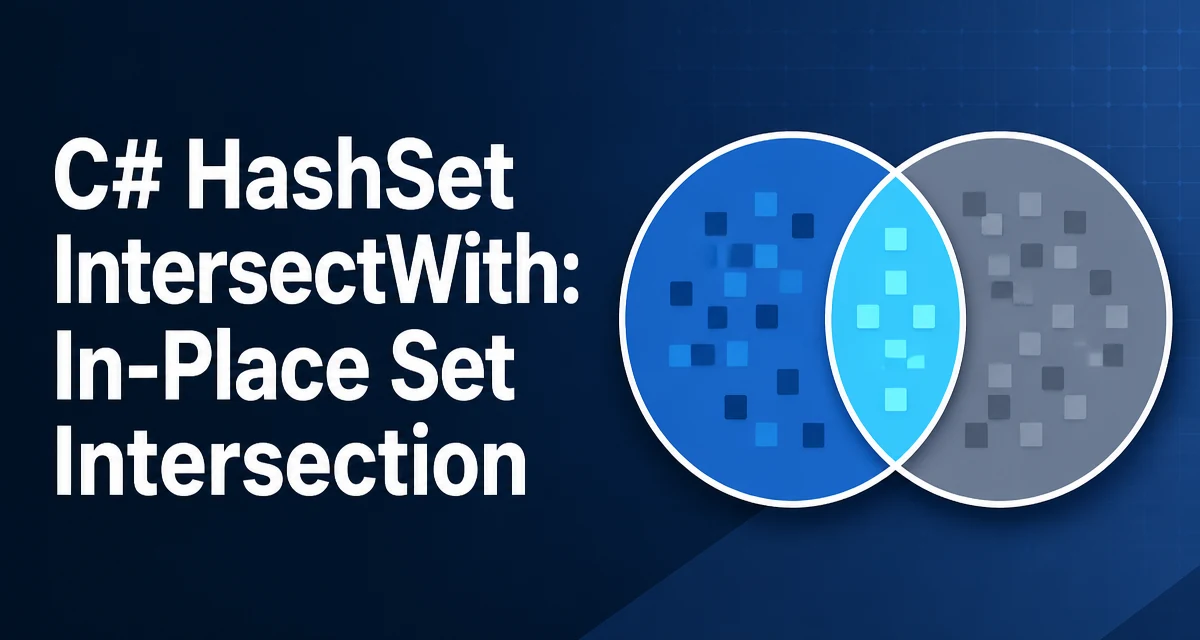
c# hashset intersectwith requires a clear understanding of the core syntax, runtime behavior, and practical implementation patterns demonstrated in the examples below.
The IntersectWith method on HashSet<T> computes the intersection of the current set with another collection and updates the current set in place. Unlike LINQ's Intersect, which returns a new sequence, IntersectWith modifies the original set and returns void. This behavior makes it a memory-efficient choice when you need to filter a set based on another collection without allocating a new set.
What IntersectWith Does
The method signature is public void IntersectWith(IEnumerable<T> other). It removes every element from the current set that is not also present in the other collection. After the call, the current set contains only the elements that existed in both the original set and other. If other is null, the method throws ArgumentNullException. The method does not return a value; it mutates the instance it is called on.
Basic Example
Consider two sets of integers. Calling IntersectWith on the first set with the second as the argument filters the first set down to the common elements.
var setA = new HashSet<int> { 1, 2, 3, 4, 5 };
var setB = new HashSet<int> { 4, 5, 6, 7 };

setA.IntersectWith(setB);

Console.WriteLine(string.Join(", ", setA)); // 4, 5
The original setA is modified. If you need to preserve the original set, create a copy before calling IntersectWith or use LINQ's Intersect to get a new sequence.
IntersectWith vs LINQ Intersect
LINQ's Enumerable.Intersect returns a new IEnumerable<T> and leaves the source collections untouched. The choice between the two depends on whether you want in-place mutation or a non-destructive query.
| Aspect | HashSet.IntersectWith | LINQ Intersect |
|---|---|---|
| Mutates source | Yes | No |
| Return value | void | IEnumerable<T> |
| Allocation | No new set allocated | New set and result sequence |
| Best used when | You want to update an existing set | You need a separate result |
IntersectWith is often more efficient when you already have a HashSet and want to filter it in place, because it avoids allocating a new set and copying elements. LINQ Intersect is convenient when you want to keep the original data intact or you are working with any IEnumerable<T>.
Performance and Memory Behavior
The performance of IntersectWith depends on the type of the other collection. If other is a HashSet<T>, membership checks are O(1) on average, giving an overall O(n) complexity where n is the size of the current set. If other is a List<T> or another collection with O(n) lookup, the complexity becomes O(n * m), where m is the size of other. This is because the method must check each element of the current set against the other collection.
Memory-wise, IntersectWith does not allocate a new set. It removes elements from the existing set's internal storage. This can reduce garbage collection pressure in hot paths where set intersection is performed frequently. However, if you need to retain the original set for later use, the copy required to preserve it may negate the memory benefit.
Common Pitfalls and Edge Cases
One common mistake is passing a null argument, which throws ArgumentNullException. Another is calling IntersectWith on an empty set; the result is an empty set, which is correct but may surprise developers expecting a different outcome.
If you are iterating over the set while calling IntersectWith, you will get an InvalidOperationException because the set is modified during enumeration. Always perform the intersection outside a foreach loop over the same set.
When using a custom IEqualityComparer<T> in the HashSet, the other collection must be compatible with that comparer. If other uses a different equality definition, the intersection may not behave as expected. For example, a case-sensitive set intersected with a case-insensitive collection will only match elements that are equal according to the set's comparer.
Choosing Between IntersectWith and Other Set Operations
HashSet<T> provides several in-place set operations: UnionWith, ExceptWith, SymmetricExceptWith, and IntersectWith. Each modifies the current set differently. UnionWith adds all elements from other, ExceptWith removes elements that are in other, and SymmetricExceptWith keeps only elements that appear in exactly one of the two sets. IntersectWith is the right choice when you need to keep only the common elements and you are willing to discard the rest.
Use IntersectWith when you have a HashSet that represents a working set and you want to filter it based on another collection without creating a new object. If you need a non-destructive operation or you are working with a plain IEnumerable, prefer LINQ's Intersect. The in-place nature of IntersectWith can be a performance advantage in scenarios where allocations are costly, such as tight loops or high-throughput data processing.