C# Lambda Explicit Return Type
c# lambda explicit return type: Learn when and how to specify an explicit return type for a C# lambda expression, including syntax, limitations, and practical examples.
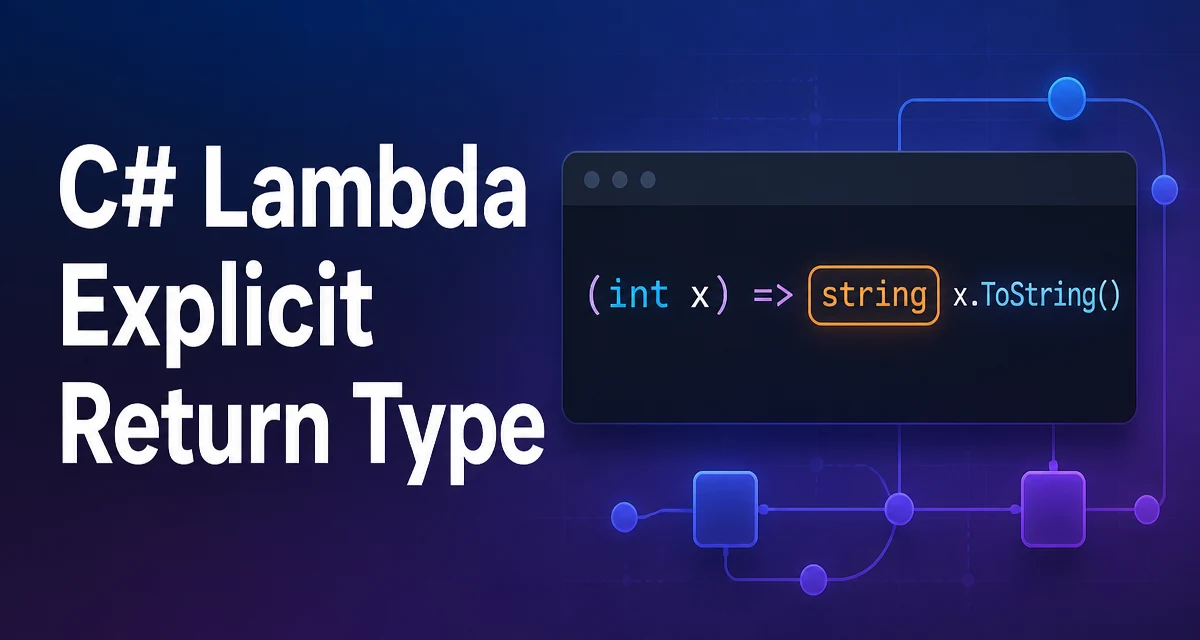
c# lambda explicit return type requires a clear understanding of the core syntax, runtime behavior, and practical implementation patterns demonstrated in the examples below.
When you write a lambda expression in C#, the compiler usually infers its return type from the context. For example, Func<int, int> square = x => x * x; infers that the lambda returns an int because the Func<int, int> delegate expects an int result. However, there are scenarios where you need or want to specify the return type explicitly. This article explains exactly when that is possible, how to do it, and why it matters for type safety and code clarity.
Understanding Lambda Return Type Inference
In C#, lambda expressions have no inherent type on their own. Their type is determined by the delegate or expression tree type expected by the context. When you assign a lambda to a Func<int, string> delegate, the compiler infers that the lambda takes an int parameter and returns a string. This inference works well for most ordinary cases, but it can fail or become ambiguous when the body's return type is not obvious. For instance, a lambda with a switch expression or a conditional that returns different types in each branch can confuse the compiler because it cannot always deduce a single best type.
Also, when a lambda body is an expression that returns a value, the inferred return type is the type of that expression. If the body is a statement block, the compiler looks for return statements and infers a common type from all of them. If no common type exists, you get a compile-time error. This is where an explicit return type can rescue the code, but only if the syntax allows it.
When You Can Specify an Explicit Return Type
The C# language specification allows an explicit return type on a lambda expression only when the lambda has a parameter list. The syntax is (int x) => ... or (int x, string y) => .... Without a parameter list, you cannot write a return type. For example, int x => x * x is invalid. The return type appears immediately before the parameter list, as in int (int x) => x * x;. This syntax is part of C# 10 and later. If you are using an earlier version of C#, you will not be able to compile this syntax, so check your project's target framework and language version.
The explicit return type is particularly useful when the lambda body would otherwise be ambiguous. Consider a conditional expression that returns either an int or a long. The compiler may choose the common numeric type, which might not be what you intend. By explicitly declaring the return type, you force the lambda to conform to that type, and the compiler will insert conversions where necessary.
How to Use Explicit Return Types in C#
To use an explicit return type, place the type before the parameter list and separate them with a space. Here is a minimal example:
Func<int, int> increment = int (int x) => x + 1;
In this code, the lambda returns int, and the parameter is also int. The explicit return type int is placed before the parameter list (int x). This is functionally equivalent to (int x) => x + 1 because the type is inferred, but writing it out can improve readability in complex expressions.
Another common use is with a statement-bodied lambda. For instance:
Func<int, int> compute = int (int n) =>
{
    var temp = n * 2;
    return temp + 10;
};
Here, the block body returns an int, and declaring the return type explicitly makes the contract clear at a glance. This is helpful when the body contains several statements and the return type is not visually obvious.
Why Explicit Return Type Matters for Type Safety
Explicit return types give you compile-time control over the signature of the lambda. Without them, the inferred type depends on the body's expressions and the target delegate. If you later change the body or the expected delegate type, the inferred return type can silently shift, potentially causing subtle bugs. An explicit declaration prevents that by making the return type part of the lambda's contract.
For example, consider a lambda that returns a value from a JSON parse. The body might be data => int.Parse(data) which infers int. If the source data changes to a long, you would need to adjust the lambda body anyway. But if the return type is explicitly long, the compiler enforces that the body returns something convertible to long. This catches mistakes earlier, like accidentally returning a double when you expected an integer.
Explicit return types also aid code reviews. A reviewer can see the intended return type without tracing through the entire body. This is especially valuable in data transformation pipelines where lambdas are chained together.
Practical Example: Using Explicit Return Type with Expression Trees
Expression trees are a special case where return type matters for runtime behavior. When you create an Expression<Func<T, T>>, the lambda expression is represented as a data structure that can be inspected and compiled. The return type is part of that structure. Specifying it explicitly can prevent unexpected type widening.
Consider a query builder that expects a Func<int, long> selector. If you write x => x where x is an int, the compiler will not choose long implicitly; you need a cast or an explicit return type. With an explicit return type, you can write long (int x) => x and the compiler will insert a numeric conversion from int to long. This makes your intention clear and avoids extra casts in the body.
Expression<Func<int, long>> selector = long (int x) => x;
Without the explicit return type, you would need to write x => (long)x, which is less elegant and can obscure the signature.
Limitations and Compiler Behavior
The explicit return type syntax is only allowed when the lambda has a parenthesized parameter list. You cannot use it with a single parameter without parentheses, like int x => .... Also, you cannot use it with an expression-bodied lambda that omits the parameter type entirely; the parameter types must be present. The same rules apply to expression trees as to delegates.
Another limitation is that explicit return types work only when the lambda is directly assigned to a delegate type or expression tree type. If you use the lambda in a context where the target type is not known, such as passing to a method overload that accepts multiple delegate types, the explicit return type might not resolve. In that case, the compiler still needs to determine the overall type from the context, and a mismatch can cause ambiguity errors.
When you specify a return type, the body must be compatible with that type. The compiler will report an error if the lambda body cannot be implicitly converted to the stated return type. For example, if you write string (int x) => x * 2, you will get a compile-time error because int cannot convert to string without an explicit cast.
Compatibility and Version Notes
Explicit lambda return types require C# 10 and a compiler that supports them. Older compilers will produce a syntax error. If you are working with a legacy codebase, you may need to upgrade the language version or avoid this syntax. In addition, the syntax is not supported in Visual Basic, but that is outside the scope of this article.
When targeting the .NET Framework with C# 9, the feature is unavailable. If you are using a modern SDK, you can enable it by setting <LangVersion>10.0</LangVersion> or a later version in your project file. For library authors, using this syntax means your code requires consumers to compile with C# 10+, which might be a consideration if you distribute source.
Maintainability and Readability Tradeoffs
Explicit return types add noise to the code. For short lambdas, like Func<int, int> f = (x) => x + 1;, the explicit return type int (int x) => ... is longer and arguably less readable. However, for longer lambdas with complex bodies, the explicit return type can serve as a concise form of documentation. The decision should be based on whether the context makes the return type obvious.
If a lambda is assigned to a strongly typed delegate, the delegate signature already declares the return type, so explicit typing is redundant. In those cases, relying on inference is idiomatic. But when the lambda is passed directly to a method like IEnumerable.Select where the generic type parameters are inferred, an explicit return type can force a specific generic argument. For example, source.Select(long (x) => x) with x as an int makes the Func<int, long> explicit.
Choosing When to Use Explicit Return Types
Use an explicit return type when the lambda body does not clearly reveal its return type, when you want to enforce a specific numeric type to avoid unintended conversions, or when you need to match a method overload exactly. Avoid it in trivial cases where the delegate type already states the return type and the body is straightforward. Overusing explicit return types can reduce readability, so let the complexity of the body guide your decision.
In practice, most production C# code uses inferred return types for simple lambdas and reserves the explicit syntax for cases where ambiguity or type safety is a real concern. For example, in a refactoring where you change the return type from int to long, adding an explicit return type on the lambda can guarantee that all call sites update correctly. The compiler enforces that the lambda body still conforms, preventing silent widening.
Advanced Usage: Explicit Return Type with Statement Lambdas
Statement lambdas (block bodies) can also take an explicit return type. This is particularly helpful when the body contains early returns with different types. Without an explicit type, the compiler attempts to find a common type for all return expressions. If the common type is not what you intended, you get a compile error or a surprising inference. For instance:
Func<int, object> convert = object (int x) =>
{
    if (x < 0) return "negative";
    return x;
};
Here, the return type is object, which is the common base class of string and int. Without the explicit return type, the compiler might attempt to infer object anyway, but in more complex scenarios the common type might be int? or an interface, leading to unexpected behavior. By declaring object, you make the intent explicit and avoid surprises.
Interaction with Tuple Return Types
C# supports tuple return types, and you can specify them explicitly as well. For example:
Func<int, (int Sum, int Count)> accumulate = (int Sum, int Count)(int x) => (x + 1, x * 2);
This syntax might look unusual, but it is valid. The explicit return type (int Sum, int Count) is placed before the parameter list. This matters when you want the tuple element names to be part of the lambda's signature, which can affect how downstream code accesses the result. If you rely on inference, the element names might not be preserved, causing Item1 and Item2 to appear instead of Sum and Count.
Runtime Cost and Compiler Optimizations
Specifying an explicit return type has no runtime cost; it is a compile-time construct. The generated IL is identical whether you write the return type explicitly or let the compiler infer it. The compiler may insert a conversion instruction if the body returns a value that requires implicit conversion to the declared type. That conversion would exist even with inference, but explicit typing makes it visible in the code. Therefore, performance should not be a consideration when choosing between explicit and inferred return types. The only tradeoff is readability.
Common Errors and How to Avoid Them
A frequent mistake is placing the return type after the parameter list, such as (int x) int => ..., which is invalid. The correct order is int (int x) =>. Another error is using an explicit return type with a single parameter without parentheses, like int x => ..., which the compiler rejects. Always include parentheses around the parameter list when using an explicit return type.
If you get a CS1660 error (cannot convert lambda to delegate type because it is not a delegate type), check that the target type is a delegate or expression tree. Explicit return types do not convert lambdas to different delegate types; they only affect the lambda's own signature. Also, ensure you are using a C# 10+ compiler.
Summary of Rules
To recap the syntax rules:
- Place the return type before the parameter list.
- The parameter list must be parenthesized.
- The lambda body must be compatible with the declared return type.
- The feature requires C# 10 or later.
Here is a side-by-side comparison:
| Syntax | Valid? | Explanation |
|---|---|---|
x => x * 2 | Valid | Inferred return type int |
int (int x) => x * 2 | Valid | Explicit return type int |
int x => x * 2 | Invalid | Missing parentheses |
(int x) int => x * 2 | Invalid | Return type after parameters |
Final Example: Combining Explicit Return Type with LINQ
In LINQ queries, explicit return types can be used to control the type of the projected result. For example, suppose you have a list of strings and you want to select their lengths as long. Without an explicit return type, Select(x => x.Length) returns int. To force long, you can write:
List<string> names = new() { "Ada", "Grace", "Linus" };
IEnumerable<long> lengths = names.Select(long (string s) => s.Length);
The explicit return type ensures the lambda returns a long, and the compiler inserts the necessary conversion from int to long. This can be especially useful when the result is fed into a method that expects IEnumerable<long>, avoiding a separate Select with a cast.
Conclusion
Understanding when and how to use an explicit return type for lambda expressions in C# gives you more control over your code's type safety and readability. While inference is convenient for simple cases, explicit return types are a valuable tool for ambiguous bodies, tuple returns, and cross-type conversions. Use the syntax returnType (parameterList) => expression, ensure your compiler supports C# 10, and favor clarity over brevity when the context warrants it. With this knowledge, you can write lambdas that are both expressive and precise.