C# Logical Operators Explained with Examples
c# logical operators: Learn how C# logical operators work, including short-circuit behavior, precedence, and practical examples for writing clear conditional logic.
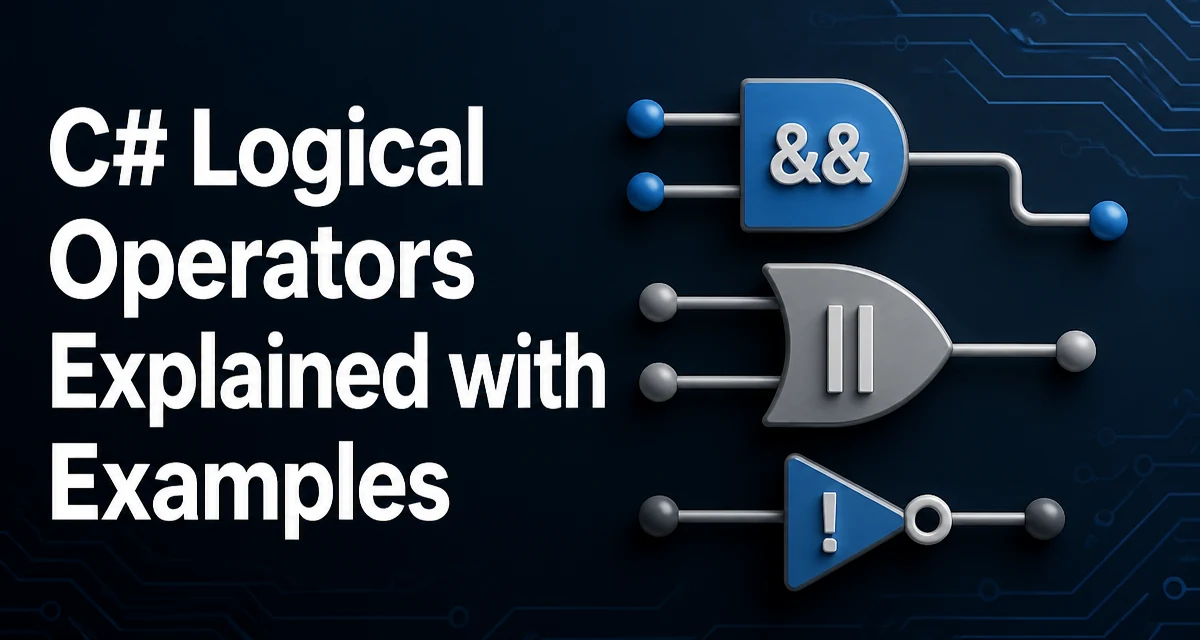
C# logical operators let you combine Boolean expressions into a single condition. The three main operators are && (logical AND), || (logical OR), and ! (logical NOT). They return bool values and are used in if, while, and other control-flow statements. Understanding their evaluation order and side effects directly affects correctness in your code.
The Three Core Operators
The && operator returns true only when both operands are true. The || operator returns true when at least one operand is true. The ! operator negates a Boolean value.
bool isActive = true;
bool hasAccess = false;

bool canEnter = isActive && hasAccess;   // false
bool canTry = isActive || hasAccess;     // true
bool isNotActive = !isActive;            // false
These operators work with any expressions that evaluate to bool, such as comparison results or method calls.
Short-Circuit Behavior and Side Effects
The most important runtime behavior of && and || is short-circuit evaluation. In a && b, if a is false, b is not evaluated because the result is already false. Similarly, in a || b, if a is true, b is not evaluated.
Short-circuiting matters when operands have side effects, like method calls that modify state or perform I/O.
bool TryUpdate()
{
    // some side effect
    Console.WriteLine("TryUpdate executed");
    return true;
}

bool ready = false;
if (ready && TryUpdate())
{
    // This block is not reached because ready is false
}
In this example, TryUpdate is never invoked because ready is false. If you need both operations to always run, you must evaluate them separately.
Combining Multiple Conditions
Logical operators can be chained to express more complex rules. For example, a discount might apply when a customer is a member or when the order total exceeds a threshold, but only if the order is not flagged as fraud.
decimal orderTotal = 250m;
bool isMember = true;
bool isFraudulent = false;

bool hasDiscount = (isMember || orderTotal > 200m) && !isFraudulent;
Here, parentheses make precedence explicit. Without them, the default precedence of ! > && > || would still give the same result, but using parentheses improves readability and reduces mistakes.
Operator Precedence and Grouping
C# defines a specific precedence order for logical operators. ! has the highest precedence among them, followed by &&, then ||. However, relying on this order without parentheses can confuse readers.
Consider this expression:
bool result = a || b && c;
Because && binds tighter, this is equivalent to a || (b && c), not (a || b) && c. Experienced developers often add parentheses even when not strictly necessary to clarify intent.
Practical Usage in Conditionals
Logical operators are most common in if statements, but they also appear in while loops, ternary expressions, and null checks.
if (value != null && value.Length > 0)
{
    Console.WriteLine(value.ToUpper());
}
This pattern uses short-circuiting to safely access value.Length only when value is not null. Removing the short-circuit behavior would throw a NullReferenceException.
Common Mistakes and Pitfalls
A frequent mistake is using & or | instead of && or ||. The single-character versions are bitwise operators, which always evaluate both operands and work on integer types. Using them with bool operands is legal but can produce unexpected behavior because both sides always execute.
Another pitfall is confusion between ! and !=. The former negates a Boolean; the latter compares for inequality. For example, if (!flag) checks if flag is false, while if (flag != true) does the same but is more verbose and less readable.
Performance and Maintainability Considerations
Short-circuit evaluation can reduce unnecessary method calls, which matters when an operand involves expensive operations like database queries or file reads. Placing the cheaper or more restrictive condition first often improves performance without changing semantics.
From a maintainability perspective, complex Boolean expressions are hard to read. If a condition spans multiple lines or combines many operators, extract it into a named method or property.
private bool IsEligibleForDiscount(Order order)
{
    return order.Total > 200m || order.Customer.IsMember;
}
This makes the logic reusable and testable in isolation.
Using Logical Operators with Non-Boolean Values
Unlike some dynamic languages, C# logical operators require both operands to be bool. You cannot write if (someInt) because an integer is not implicitly convertible to bool. Instead, you must write if (someInt != 0). This strictness avoids ambiguity and keeps the behavior predictable.
Bitwise Operators as Operators of Last Resort
The bitwise &, |, and ^ can be used on bool values, but they do not short-circuit. The primary use of these operators is on integer types for flag manipulation. For Boolean logic, prefer &&, ||, and ! unless you specifically need both sides to be evaluated.