C# Recursive Method: Syntax, Stack, and Pitfalls
c# recursive method: Learn how to write C# recursive methods, understand base cases, call stack behavior, and avoid stack overflow pitfalls.
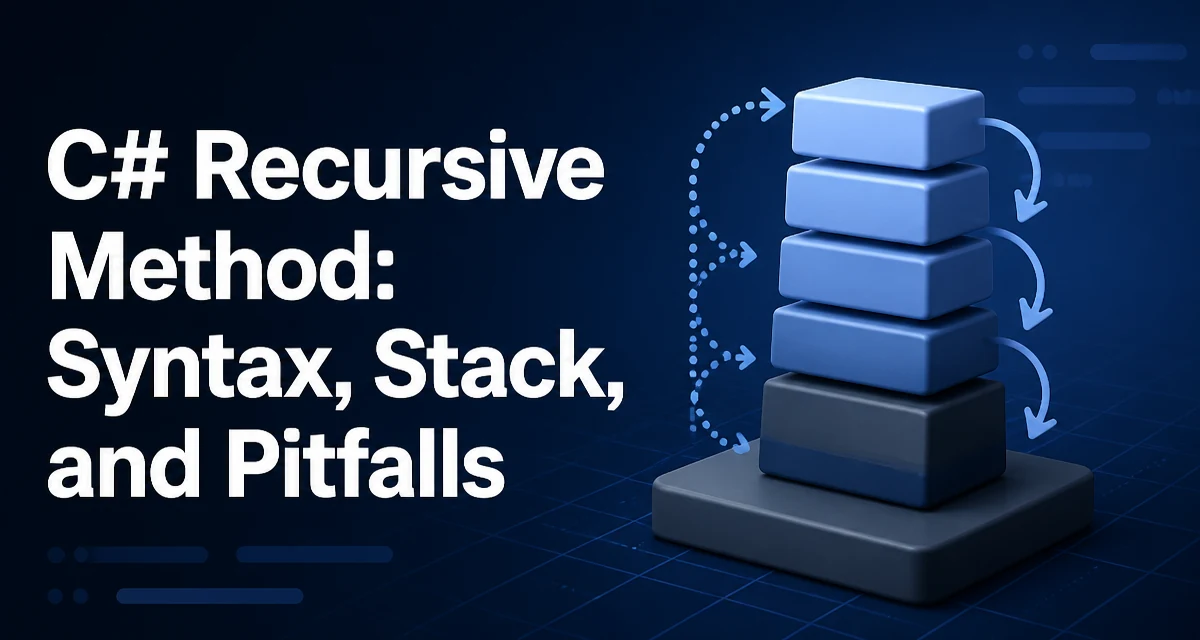
A C# recursive method is a method that calls itself to solve a problem by breaking it into smaller subproblems. The key to a correct recursive method is a base case that stops the recursion and a recursive case that moves toward that base case. Without a base case, the method will keep calling itself until the call stack overflows, throwing a StackOverflowException.
Core Structure of a Recursive Method
Every recursive method has two essential parts: a base case and a recursive case. The base case is a condition that, when met, returns a value without making another recursive call. The recursive case reduces the problem size and calls the method again with a smaller or simpler input. This structure ensures that each call makes progress toward the base case, guaranteeing termination.
For example, a method that computes the sum of integers from 1 to n can be written recursively. The base case is n == 1, returning 1. The recursive case adds n to the sum of 1 to n-1.
A Minimal Example: Factorial
The factorial of a non-negative integer n is a classic recursive example. The base case is n == 0 or n == 1, where the factorial is 1. For any larger n, the factorial is n multiplied by the factorial of n-1.
public static int Factorial(int n)
{
    if (n <= 1)
        return 1;
    return n * Factorial(n - 1);
}
This method works because each recursive call receives a smaller argument, eventually reaching the base case. The multiplication is performed as the call stack unwinds, producing the correct result. While this example is simple, it demonstrates the pattern used in more complex recursive algorithms.
How the Call Stack Behaves
When a recursive method calls itself, the runtime pushes a new stack frame for each invocation. Each frame contains the method's parameters, local variables, and the return address. The stack grows with each call and shrinks as each call returns. This is why recursion uses memory proportional to the recursion depth.
If the base case is never reached, or the recursion depth is too large, the stack will exhaust its available memory. In .NET, this results in a StackOverflowException, which cannot be caught and will terminate the process. This is a critical difference from exceptions like ArgumentNullException that can be handled.
Recursion vs Iteration
Any recursive algorithm can be rewritten using an explicit loop and a stack or queue. Iteration avoids the overhead of repeated method calls and is often more memory-efficient. However, recursion can lead to cleaner, more readable code for problems that have a naturally recursive structure, such as tree traversals, graph searches, and divide-and-conquer algorithms.
Consider the factorial example. An iterative version uses a simple loop:
public static int FactorialIterative(int n)
{
    int result = 1;
    for (int i = 2; i <= n; i++)
        result *= i;
    return result;
}
Both versions produce the same result. The iterative version uses constant stack space, while the recursive version uses O(n) stack space. For small n, the difference is negligible, but for large n, the recursive version risks a stack overflow.
Performance and Stack Overflow Considerations
Recursion can be expensive when the depth is large. Each call allocates a new stack frame, and the overhead of method invocation is not free. In performance-sensitive code, iterative solutions are often preferred. However, recursion can be optimized in some cases.
Tail recursion is a special form where the recursive call is the last operation in the method. In theory, a tail-recursive method can be optimized by the compiler to reuse the current stack frame, reducing memory usage to O(1). However, the C# compiler and the .NET runtime do not guarantee tail-call optimization. As of .NET 6 and later, some tail-call optimizations exist in specific scenarios, but they are not reliable across all platforms and versions. Therefore, you should not rely on tail-call optimization to prevent stack overflows in C#.
For deep recursion, consider using an explicit stack or converting to an iterative approach. For example, a depth-first search on a tree can be written iteratively with a Stack<T> to avoid recursion depth limits.
Common Pitfalls and How to Avoid Them
The most common mistake is forgetting the base case, leading to infinite recursion and a stack overflow. Another pitfall is a base case that is never reached because the recursive call does not reduce the problem size. For instance, if you call Factorial(n) instead of Factorial(n - 1), the method will never terminate.
Redundant recursive calls can also cause exponential time complexity. The classic Fibonacci sequence implemented naively recalculates the same values many times:
public static long Fibonacci(int n)
{
    if (n <= 1)
        return n;
    return Fibonacci(n - 1) + Fibonacci(n - 2);
}
This implementation has exponential time complexity and becomes unusable for n above about 40. Memoization or an iterative approach can solve this problem. Always analyze the number of recursive calls and consider whether caching results is beneficial.
When to Use Recursion in C#
Recursion is most appropriate when the problem has a natural recursive structure and the depth is bounded. Examples include traversing a binary tree, parsing nested expressions, or implementing algorithms like quicksort and merge sort. In these cases, the recursion depth is typically logarithmic or proportional to the tree height, which is manageable.
Use iteration when the recursion depth could be large or unbounded, such as processing a deeply nested file system or a linked list with millions of nodes. Also, prefer iteration in performance-critical paths where method call overhead matters. A good rule of thumb is to use recursion when it makes the code significantly clearer and the depth is known to be small, otherwise use an explicit stack or loop.