C# Stack vs Heap: Memory Allocation Explained
c# stack vs heap: Understand how C# allocates value types on the stack and reference types on the heap, and how this affects performance, GC, and code design.
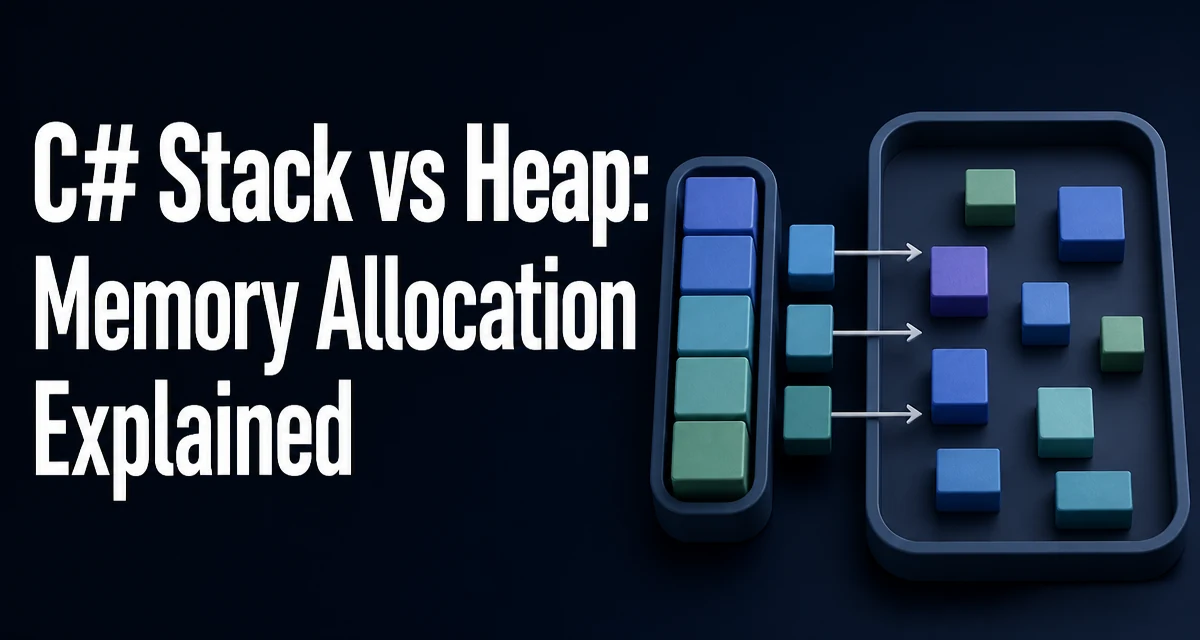
When you declare a variable in C#, the runtime decides whether to place its data on the stack or on the heap based on the type's category. This decision affects memory usage, performance, and how objects are cleaned up. Understanding c# stack vs heap is essential for writing code that behaves predictably under load and for reasoning about garbage collection pressure.
What Lives on the Stack and What Lives on the Heap
The stack is a region of memory that grows and shrinks automatically as methods are called and return. It is fast because allocation is just a pointer increment, and deallocation happens when the method exits. The heap is a larger, shared region managed by the garbage collector (GC). Allocation on the heap is slower because the GC must find a free block, and deallocation is non-deterministic.
In C#, the type category determines the default location:
- Value types (structs, enums, primitive types like
int,bool,double) are stored directly on the stack when they are local variables or method parameters. - Reference types (classes, interfaces, delegates, arrays, strings) are stored on the heap. The variable itself holds a reference (a pointer) to the heap object, and that reference lives on the stack.
public struct Point
{
    public int X;
    public int Y;
}

public class Person
{
    public string Name;
    public int Age;
}

public static void Demonstrate()
{
    Point p = new Point { X = 1, Y = 2 }; // p is on the stack
    Person person = new Person();        // reference on stack, object on heap
}
Here, p holds the actual Point data on the stack. person holds a reference to a Person object allocated on the heap. The Person object itself contains a string reference (also heap) and an integer value type (stored inline within the heap object).
How Value Types and Reference Types Behave in Memory
The distinction goes beyond location. When you assign a value type to another variable, the data is copied. When you assign a reference type, only the reference is copied; both variables point to the same heap object.
Point a = new Point { X = 1, Y = 2 };
Point b = a; // copies the struct
b.X = 10;
Console.WriteLine(a.X); // still 1

Person p1 = new Person { Name = "Alice", Age = 30 };
Person p2 = p1; // copies the reference
p2.Age = 31;
Console.WriteLine(p1.Age); // 31, same object
This behavior is a direct consequence of stack versus heap allocation. Value types on the stack are self-contained, so copying is cheap for small sizes. Reference types on the heap are shared, which can lead to unintended side effects if you mutate an object through one reference and observe it through another.
Allocation and Deallocation: Stack vs Heap
Stack allocation is deterministic. When a method is called, its local variables are pushed onto the stack. When the method returns, the stack pointer is reset, and all those variables are effectively gone. No cleanup code runs; the memory is simply reused for the next call.
Heap allocation is non-deterministic. Objects are allocated when new is used, but they are not freed until the garbage collector runs. The GC tracks references and reclaims objects that are no longer reachable. This introduces latency spikes because the GC may pause the application to compact the heap.
Consider a loop that creates many small objects:
for (int i = 0; i < 100000; i++)
{
    var list = new List<int>(); // heap allocation each iteration
    list.Add(i);
}
Each iteration allocates a new List<int> on the heap. Even if those lists become unreachable quickly, they still generate garbage that the GC must eventually collect. If you used a struct or reused a single instance, you could avoid that pressure.
Performance and GC Pressure: When It Matters
The stack is faster for allocation and access because it is contiguous and cache-friendly. The heap is slower because it involves dynamic memory management and potential cache misses. However, the practical impact depends on the size and lifetime of the data.
For small, short-lived data, value types on the stack are often more efficient. For large or long-lived data, reference types on the heap are necessary because the stack has limited space and cannot hold objects that outlive the method that created them.
GC pressure is a real concern in high-throughput applications. Every heap allocation eventually costs time during collection. Reducing unnecessary allocations by using value types can lower GC frequency, but it is not always the right choice. A large struct (e.g., 100 bytes or more) copied frequently can be more expensive than a reference type because copying large value types is not cheap.
public struct LargeStruct
{
    public int A, B, C, D, E, F, G, H, I, J;
}

public static void ProcessLargeStruct(LargeStruct data)
{
    // Passing by value copies 40 bytes onto the stack
}
Passing a large struct by value copies all its fields. Passing a reference type copies only the reference (8 bytes on 64-bit). If the struct is large and passed often, the copy overhead may outweigh the benefit of avoiding heap allocation.
Common Pitfalls: Boxing, Closures, and Large Structs
Boxing occurs when a value type is converted to object or an interface. This allocates a heap object and copies the value into it. Unboxing extracts the value back. Boxing is often hidden in code that uses non-generic collections or string concatenation with value types.
int number = 42;
object boxed = number; // boxing: heap allocation
int unboxed = (int)boxed; // unboxing
Boxing is unnecessary in most modern C# because generic collections like List<int> avoid it. But it can still appear in legacy code or when using ArrayList or Hashtable. Every boxed value generates garbage, so it is worth avoiding in performance-sensitive paths.
Closures capture variables from the enclosing scope. If a lambda captures a local value type, the compiler may hoist that variable into a heap-allocated object to preserve its lifetime. This can turn a stack variable into a heap allocation without you noticing.
public static Func<int> CreateCounter()
{
    int count = 0; // captured variable
    return () => ++count;
}
Here, count is not on the stack because it must outlive the CreateCounter method. The compiler creates a closure object on the heap to hold it. This is a subtle way that stack allocation can become heap allocation.
Large structs, as mentioned, can cause performance problems when copied. A common mistake is using a struct for a type that is logically a value but is large, such as a 3D matrix. If you need to pass it around frequently, a class may be more efficient despite the heap allocation.
Choosing Between Stack and Heap: Practical Guidance
There is no universal rule that value types are always better. The decision should be based on the type's semantics and usage patterns.
- Use a struct when the type represents a single value that is small (typically 16 bytes or less), is immutable, and is not frequently boxed. Examples include
Point,Color,DateTime. - Use a class when the type has identity, needs to be shared, or is large enough that copying becomes expensive. Examples include
Person,MemoryStream,List<T>. - Avoid large structs in collections that are frequently iterated or copied, because each copy duplicates all fields.
- Be mindful of closures and boxing in hot paths; they silently add heap allocations.
Consider this example of a small value type used in a loop:
struct Vector2
{
    public float X, Y;
}

Vector2[] positions = new Vector2[1000]; // array of structs, contiguous on heap
for (int i = 0; i < positions.Length; i++)
{
    positions[i].X += 1.0f;
    positions[i].Y += 1.0f;
}
The array itself is a reference type, so it lives on the heap. But the Vector2 elements are stored inline within the array, not as separate heap objects. This is more cache-friendly than an array of classes, where each element is a separate heap object.
In contrast, an array of classes would require dereferencing each element, causing more cache misses and GC pressure:
class Vector2Class
{
    public float X, Y;
}

Vector2Class[] positions = new Vector2Class[1000];
for (int i = 0; i < positions.Length; i++)
{
    positions[i] = new Vector2Class(); // 1000 separate heap objects
}
For performance-critical code, prefer arrays of structs when the data is homogeneous and accessed sequentially. This leverages the stack-like locality even though the array is on the heap.
The Role of the Garbage Collector in Heap Management
The GC is responsible for reclaiming heap memory. It uses generational collection: short-lived objects are in Gen0, and objects that survive are promoted to Gen1 and Gen2. The stack does not need a GC because it is automatically cleaned when methods return.
Understanding this helps you write code that minimizes GC pauses. For example, allocating many short-lived objects in a loop fills Gen0 quickly, triggering frequent collections. Reusing objects or using value types can reduce that pressure.
// Frequent allocations
for (int i = 0; i < 10000; i++)
{
    string s = "value" + i; // creates a new string each time
}

// Better: use a StringBuilder if you need to build a single string
But be careful not to over-optimize. The GC is well-tuned for many scenarios. Only when profiling shows GC time as a bottleneck should you invest in reducing allocations.
When Stack and Heap Boundaries Are Blurred
Some C# features make the distinction less obvious. For instance, Span<T> and ref struct types are restricted to the stack. They cannot be used in async methods or as fields of classes because they might escape the stack frame. This restriction exists to prevent heap allocation and ensure safety.
Span<int> numbers = stackalloc int[10]; // stackalloc allocates on the stack
stackalloc allocates memory on the stack, which is extremely fast but limited in size. It is useful for temporary buffers that do not need to outlive the method.
On the other hand, async methods complicate stack usage. When an async method awaits, the compiler creates a state machine on the heap to preserve local variables across await points. This means that even value type locals in an async method may end up on the heap as part of the state machine.
public async Task<int> ComputeAsync()
{
    int local = 42; // may be hoisted to heap state machine
    await Task.Delay(100);
    return local;
}
This is an important nuance: the stack vs heap distinction is not absolute. The compiler and runtime can move data to the heap when necessary for correctness.
Understanding c# stack vs heap is not just an academic exercise. It directly influences how you design types, write loops, and handle async code. By recognizing where data lives, you can avoid unnecessary allocations, reduce GC pressure, and write code that performs consistently in production.