C# Stack vs Queue: Choosing the Right Collection
c# stack vs queue: Understand the core differences between Stack and Queue in C#, including LIFO vs FIFO behavior, typical operations, performance, and when to use each.
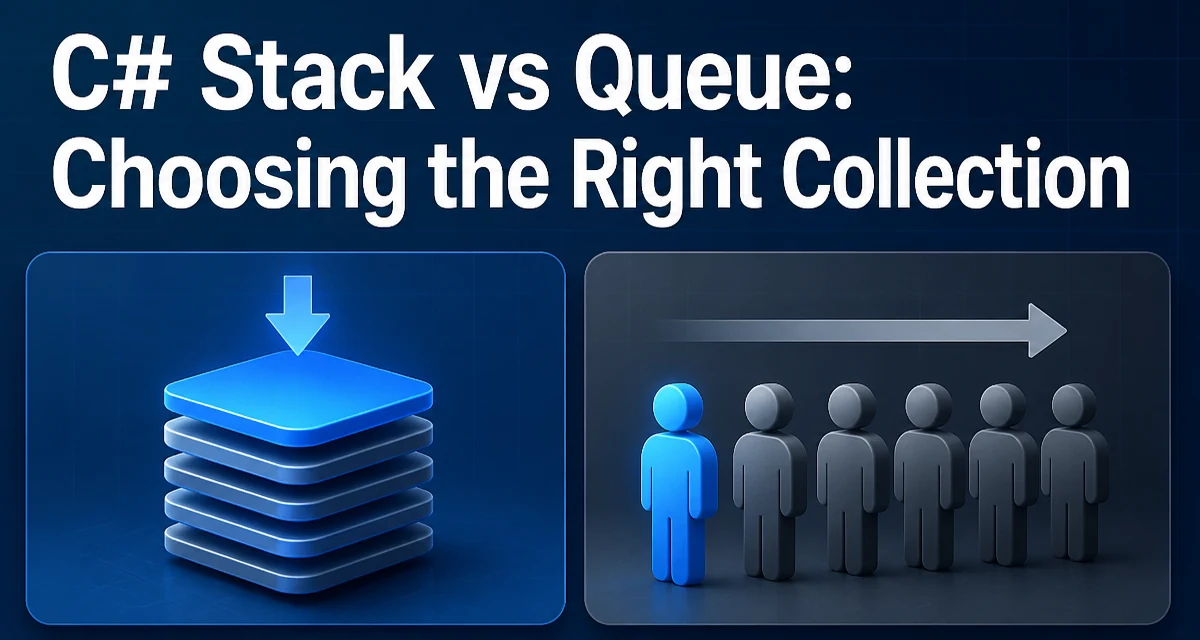
When you need to process items in a specific order, C# offers two generic collections that look similar at first glance: Stack<T> and Queue<T>. The choice between them comes down to one fundamental rule: do you need last-in-first-out (LIFO) or first-in-first-out (FIFO) semantics? This article walks through the practical differences, typical usage patterns, and the tradeoffs you should consider when deciding between c# stack vs queue in your code.
Understanding LIFO and FIFO
A Stack<T> gives you LIFO behavior. The last element added is the first one removed. Think of a pile of plates: you take the top plate, which is the one you placed most recently. A Queue<T> gives you FIFO behavior. The first element added is the first one removed, like a line of customers waiting for service. This ordering difference drives every other design decision.
In C#, both collections are implemented as generic classes in the System.Collections.Generic namespace. They store objects of a single type T and provide similar methods for adding, removing, and inspecting elements. But the meaning of those methods differs based on the underlying order.
Basic Stack and Queue Usage in C#
Here is a minimal example of using both collections to process integers:
using System;
using System.Collections.Generic;

var stack = new Stack<int>();
stack.Push(1);
stack.Push(2);
stack.Push(3);

while (stack.Count > 0)
{
    Console.WriteLine(stack.Pop()); // 3, 2, 1
}

var queue = new Queue<int>();
queue.Enqueue(1);
queue.Enqueue(2);
queue.Enqueue(3);

while (queue.Count > 0)
{
    Console.WriteLine(queue.Dequeue()); // 1, 2, 3
}
The Push and Pop methods on a stack add and remove from the top. The Enqueue and Dequeue methods on a queue add to the back and remove from the front. Both collections expose Peek to inspect the next element without removing it, and both have a Count property to check how many elements are currently stored.
Common Operations and Their Costs
Both Stack<T> and Queue<T> are implemented as resizable arrays internally. This means that adding an element to the end of the internal array is amortized O(1), but occasionally the array must be resized, which copies all existing elements to a new larger array. The same applies to removing from the end for a stack. For a queue, removing from the front is also O(1) because the implementation uses a circular buffer that tracks a head index, avoiding shifting all elements on every dequeue.
The table below summarizes the typical operations:
| Operation | Stack<T> | Queue<T> |
|---|---|---|
| Add | Push | Enqueue |
| Remove | Pop | Dequeue |
| Peek | Peek | Peek |
| Order | LIFO | FIFO |
| Internal | Resizable array | Circular buffer |
Both Push and Enqueue are amortized O(1). Pop and Dequeue are also O(1) in the average case. The main difference is not algorithmic complexity but the order in which elements are processed. If you need to reverse the order of insertion, a stack is the natural fit. If you need to preserve the order, a queue is the correct choice.
Memory Allocation and Resizing Behavior
Because both collections are backed by arrays, they share similar memory characteristics. When the internal array reaches its capacity, the collection allocates a new array, typically double the previous size, and copies the elements. This can cause temporary memory spikes and CPU work. If you know the approximate number of elements ahead of time, you can pass an initial capacity to the constructor to reduce resizing:
var stack = new Stack<int>(1000);
var queue = new Queue<int>(1000);
This does not limit the collection to that size; it only pre-allocates the internal array. If you exceed the initial capacity, the collection still grows dynamically.
For a queue, the circular buffer implementation means that after many enqueue and dequeue operations, the head index moves forward, and when the tail reaches the end of the array, it wraps around to the beginning if there is space. This avoids shifting elements but can lead to fragmentation if the queue grows and shrinks frequently. In practice, the memory overhead is similar for both collections, and the resizing behavior is rarely the deciding factor unless you are working with very large datasets.
Thread Safety and Concurrent Access
Neither Stack<T> nor Queue<T> is thread-safe for concurrent reads and writes. If multiple threads modify the same collection without synchronization, you can corrupt its internal state. The .NET documentation states that these collections support multiple concurrent readers as long as the collection is not modified. For scenarios where you need thread-safe operations, you have a few options:
- Use a lock around all access.
- Use
ConcurrentStack<T>andConcurrentQueue<T>fromSystem.Collections.Concurrent. - Use
BlockingCollection<T>for producer-consumer scenarios.
ConcurrentStack<T> and ConcurrentQueue<T> are lock-free implementations that provide thread-safe Push, TryPop, Enqueue, and TryDequeue methods. They are designed for high-concurrency scenarios and avoid the overhead of explicit locking. However, they do not guarantee a consistent snapshot when enumerating, and their Count property is approximate. If you need strict ordering and thread safety, these concurrent versions are the appropriate choice.
Choosing Between Stack and Queue
The decision between c# stack vs queue is driven by the ordering requirement of your algorithm. Use a stack when you need to reverse the order of processing, such as:
- Undo/redo functionality in an editor.
- Expression evaluation or syntax parsing.
- Depth-first search algorithms.
- Matching brackets or parentheses.
Use a queue when you need to preserve the order of arrival, such as:
- Processing requests in the order they arrive.
- Breadth-first search algorithms.
- Task scheduling where earlier tasks have priority.
- Buffering data streams.
There is no performance advantage of one over the other in terms of asymptotic complexity. Both offer O(1) add and remove operations. The real difference is semantic. If you accidentally use a stack where a queue is required, your algorithm will process items in the wrong order and produce incorrect results. The reverse is equally true.
Practical Use Cases and Edge Cases
Consider a simple undo system. Each action is pushed onto a stack. When the user presses undo, you pop the most recent action and revert it. This is a natural fit for LIFO. On the other hand, consider a print spooler. Documents are submitted and printed in the order they were received. A queue ensures that the first document submitted is the first one printed.
One edge case to be aware of is the behavior of Peek and Pop on an empty stack or Dequeue on an empty queue. Both throw an InvalidOperationException. Always check Count before calling these methods, or use the TryPop and TryDequeue methods available on the concurrent versions. The non-concurrent collections do not have TryPop or TryDequeue methods, so you must guard with Count.
Another subtle point is that both Stack<T> and Queue<T> implement IEnumerable<T>, so you can iterate over them with foreach. However, the iteration order is not guaranteed to be the same as the order in which elements will be removed. For a stack, foreach enumerates from the top of the stack to the bottom, which is the reverse of insertion order. For a queue, it enumerates from the front to the back, which is the insertion order. If you rely on enumeration order, be explicit about what you expect.
When performance is critical and you are working with value types, both collections avoid boxing because they are generic. The internal array stores the actual values, not references. This reduces memory overhead and improves cache locality compared to non-generic ArrayList or Queue. If you need to store a large number of small structs, both Stack<T> and Queue<T> are efficient choices.
In summary, the choice between c# stack vs queue is not about performance but about the order in which you need to process elements. Analyze the algorithm you are implementing, identify the required ordering, and select the collection that matches that ordering. Both are simple to use, well-tested, and perform well for their intended purpose.