C# Using Statement vs Using Declaration
c# using statement vs using declaration: Compare C# using statement and using declaration: syntax, scope, disposal timing, and when to choose each for reliable resourc...
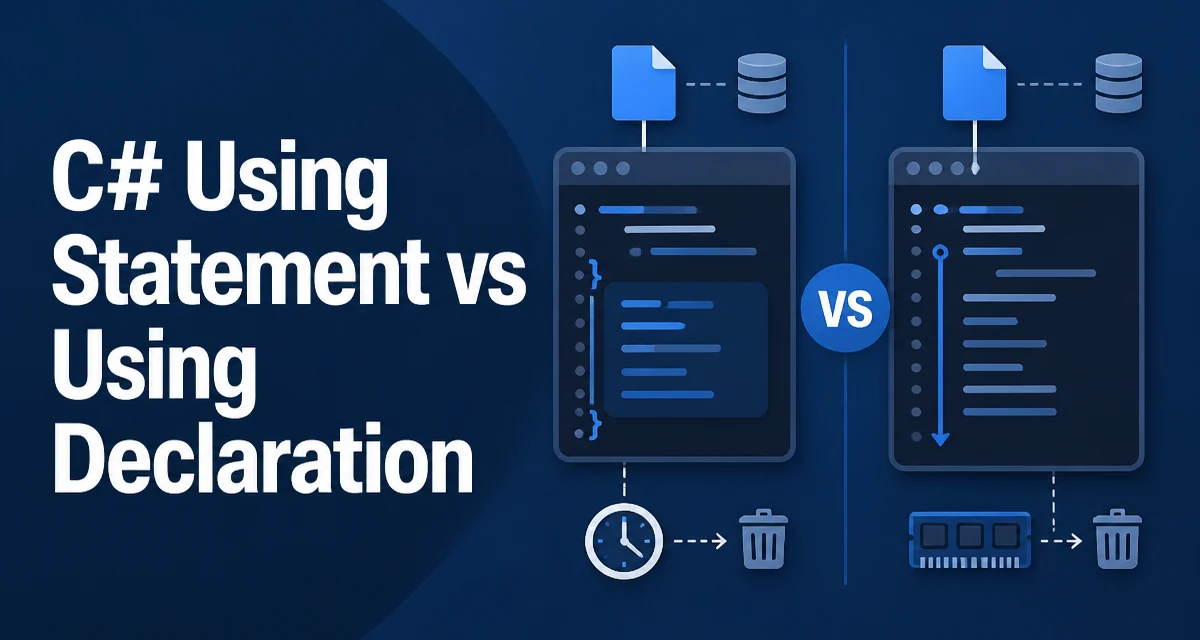
When working with types that implement IDisposable, the using keyword is the standard way to guarantee that unmanaged resources are released. C# 8 introduced the using declaration, which simplifies the syntax but changes the scope in which the resource is disposed. The choice between c# using statement vs using declaration affects not only readability but also the exact point where Dispose() is called, which can matter in long-running methods or loops.
The Classic Using Statement
The using statement has been part of C# since version 1.0. It ensures that Dispose() is called when execution leaves the block, even if an exception is thrown. The syntax explicitly defines the lifetime of the resource with braces.
using (var reader = new StreamReader("file.txt"))
{
    string line = reader.ReadLine();
    // resource is alive here
}
// reader is disposed here
Inside the block, reader is fully usable. After the closing brace, the compiler inserts a call to Dispose() in a finally block, so cleanup happens even on early returns or exceptions. The variable is not accessible after the block, which prevents accidental use of a disposed object.
The Using Declaration
C# 8 introduced the using declaration, which removes the explicit block. You simply declare the variable with using and the compiler disposes it at the end of the enclosing scope.
using var writer = new StreamWriter("output.txt");
writer.WriteLine("Hello");
// writer is disposed when the enclosing scope ends
The enclosing scope is the current block, method, or other code block. The disposal happens at the end of that scope, not at the end of a dedicated using block. This is a subtle but important difference.
Scope Differences and Disposal Timing
The most significant difference between the two forms is when Dispose() is called. With a using statement, disposal occurs at the closing brace of the using block. With a using declaration, disposal occurs at the end of the containing scope. Consider a method that performs multiple operations:
void Process()
{
    using var conn = new SqlConnection(connectionString);
    conn.Open();
    // ... some work ...
    using var cmd = conn.CreateCommand();
    cmd.CommandText = "SELECT ...";
    // ... more work ...
    // conn and cmd are disposed here, at the end of Process
}
Both conn and cmd stay alive until the method returns. If you wanted to release the connection earlier, you would need a using statement to control the exact point of disposal. In a long method, keeping resources alive longer than necessary can hold locks or keep file handles open, which may cause contention or exhaustion.
Practical Impact on Resource Lifetime
For short methods, the difference is often negligible. But when a method contains multiple independent resources, the using declaration can inadvertently extend their lifetime. For example, if you open a file, read some data, then perform a CPU-heavy computation that does not need the file, the using declaration keeps the file handle open during that computation. The using statement lets you close the file immediately after the read:
// Using declaration
using var file = File.OpenRead("data.bin");
byte[] header = new byte[16];
file.Read(header, 0, 16);
// file stays open during the expensive calculation
ComputeChecksum(header);

// Using statement
using (var file = File.OpenRead("data.bin"))
{
    byte[] header = new byte[16];
    file.Read(header, 0, 16);
}
// file is closed before the expensive calculation
ComputeChecksum(header);
In the first case, the file handle remains open until the method ends. In the second, it is released before the computation. This matters when resources are scarce or when you want to avoid holding locks for longer than necessary.
Nested Using and Scope Confusion
Using declarations can be nested naturally, but their scope can lead to unexpected behavior when combined with loops or conditional blocks. Consider a loop that creates a new resource each iteration:
for (int i = 0; i < 10; i++)
{
    using var stream = new MemoryStream();
    // ... use stream ...
}
// Each stream is disposed at the end of each iteration
Here, the using declaration is inside the loop body, so the resource is disposed at the end of each iteration. That works correctly. But if you declare the using variable outside the loop, it will be disposed only when the enclosing scope ends, which might be after all iterations:
using var stream = new MemoryStream();
for (int i = 0; i < 10; i++)
{
    // same stream reused, not disposed until after the loop
}
That is intentional, but it can be easy to misread. The using statement makes the lifetime explicit and less prone to such ambiguity.
Compatibility and Language Version
The using declaration is available in C# 8 and later. If you are targeting an older language version, you must use the using statement. Most modern .NET projects use C# 9 or later, so this is rarely a constraint, but it can matter when maintaining legacy codebases or when the project explicitly pins a lower language version.
Another difference is that the using statement can be used with multiple resources in a single block, like this:
using (var a = new ResourceA())
using (var b = new ResourceB())
{
    // both are disposed in reverse order
}
The using declaration does not support this syntax directly; you would write two separate declarations, which is equivalent but slightly more verbose.
Choosing Between the Two Forms
The decision between c# using statement vs using declaration comes down to the desired scope and the clarity of intent. Use the using declaration when the resource should live for the entire enclosing scope and you want to reduce nesting. This is common for resources that are used throughout a method, such as a database connection that is opened at the start and used by multiple queries. Use the using statement when you need to control the exact disposal point, especially when the resource is only needed for a small portion of the method, or when you want to make the lifetime visually explicit to readers.
A practical rule: if the resource is used in a small block and then no longer needed, prefer the using statement. If the resource is used throughout the method and you want to avoid extra indentation, the using declaration is cleaner. The using declaration also reduces nesting in methods that already have multiple levels of indentation, which can improve readability.
Common Pitfalls with Using Declarations
One common mistake is assuming that a using declaration inside a switch case or a conditional block will be disposed at the end of that case. In C#, the scope of a using declaration is the entire block that contains it, not the case block. For example:
switch (mode)
{
    case "read":
        using var reader = new StreamReader("file.txt");
        // reader is alive here
        break;
    case "write":
        // reader is still in scope here, but not disposed yet
        break;
}
// reader is disposed here, after the switch
This can lead to the resource living longer than intended. The using statement avoids this because the resource is disposed at the end of the using block, which you can place inside the case with explicit braces.
Another pitfall is relying on the using declaration to dispose a resource before a long-running operation that does not need it. As shown earlier, the resource remains alive until the end of the method, which can cause memory pressure or lock contention. Always consider the lifetime of the resource relative to the operations that follow.
Maintainability and Code Review
From a maintainability perspective, the using declaration can make code more concise, but it can also hide the exact disposal point. When reviewing code, a developer must mentally track the enclosing scope to know when a resource is released. The using statement makes the disposal point explicit and local, which is often easier to reason about. In large methods, the using declaration can lead to resources being held open longer than necessary, which is a subtle bug that is hard to detect without profiling.
On the other hand, the using declaration reduces indentation and can make the primary logic of a method more visible. For short methods where the resource is used throughout, the using declaration is a good choice. For longer methods with multiple resources, the using statement provides clearer boundaries and avoids accidental resource retention.
A good approach is to default to the using statement when the resource is only needed for a specific operation, and use the using declaration when the resource is meant to live for the entire method. This keeps the intent clear and avoids surprises.
Final Code Example: Combining Both
You can mix both forms in the same method when appropriate. For example, a method that opens a file for reading and writes a log entry might use a using declaration for the file (since it is used throughout) and a using statement for the log writer (to flush it immediately):
void ProcessFile(string path)
{
    using var file = File.OpenRead(path);
    // process file...

    using (var logger = new StreamWriter("log.txt", append: true))
    {
        logger.WriteLine("Processing complete");
    } // logger is disposed here, before method returns

    // file is still open here, but will be disposed when method ends
}
This demonstrates that the two forms are not mutually exclusive. The choice depends on the resource's intended lifetime and the need for early cleanup. By understanding the scope and disposal timing of each form, you can write code that is both readable and resource-efficient.