C# Value Type vs Reference Type: Key Differences
c# value type vs reference type: Understand how C# value types and reference types behave in memory, assignment, parameter passing, and equality, and when to choose each.
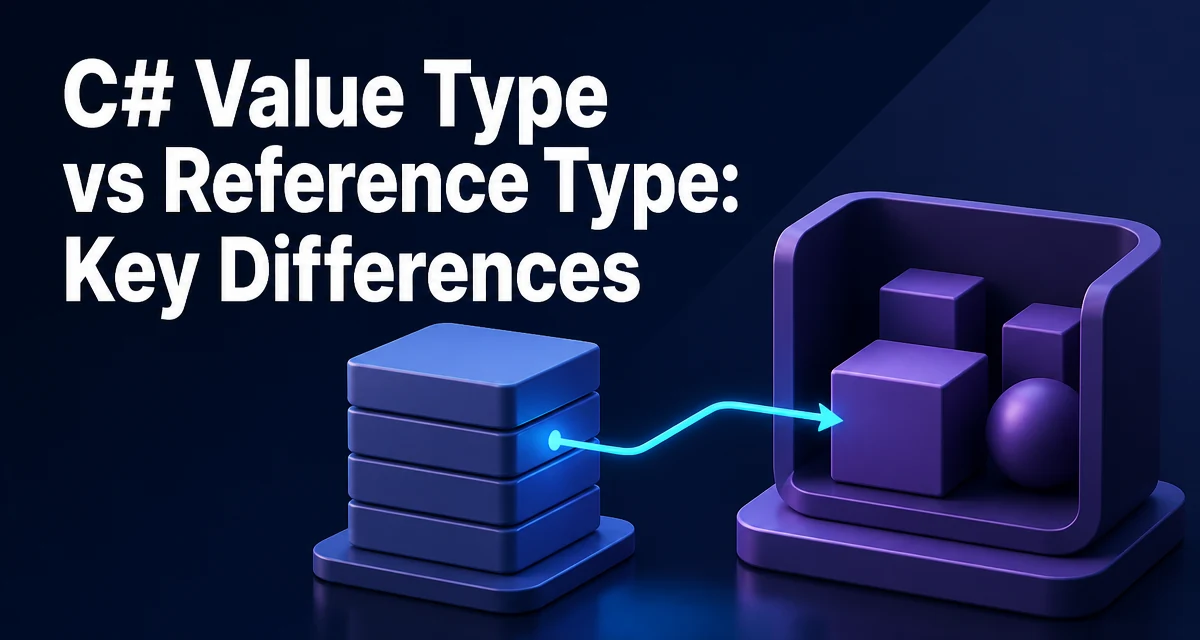
In C#, the distinction between value types and reference types shapes how data is copied, compared, and passed between methods. This article explains the practical differences between c# value type vs reference type and how they affect everyday code.
The Core Difference: Where Data Lives
A value type variable holds its data directly. When you declare an int, a bool, a struct, or an enum, the variable contains the actual value. A reference type variable, such as a class, an array, a string, or a delegate, holds a reference to an object stored elsewhere in memory.
The runtime places value type data on the stack in most cases, while reference type objects are allocated on the managed heap. The stack is a last-in-first-out structure that grows and shrinks as methods call and return. The heap is a larger pool of memory managed by the garbage collector. This difference in storage location has direct consequences for copying, equality, and performance.
struct Point
{
    public int X;
    public int Y;
}

class Rectangle
{
    public Point TopLeft;
    public int Width;
    public int Height;
}
Here, Point is a value type, so a Point variable stores its X and Y directly. Rectangle is a reference type, so a Rectangle variable stores a reference to a heap object that contains a Point field and two integers.
Assignment Behavior: Copy vs Reference
When you assign one value type variable to another, the runtime copies the entire value. The two variables are independent after the assignment. Changing one does not affect the other.
Point a = new Point { X = 1, Y = 2 };
Point b = a;
b.X = 10;

Console.WriteLine(a.X); // 1
Console.WriteLine(b.X); // 10
When you assign a reference type variable to another, the runtime copies only the reference. Both variables now point to the same heap object. Changes made through one variable are visible through the other.
Rectangle r1 = new Rectangle { Width = 5, Height = 10 };
Rectangle r2 = r1;
r2.Width = 20;

Console.WriteLine(r1.Width); // 20
Console.WriteLine(r2.Width); // 20
This distinction is fundamental. It affects how you design data structures and how you reason about side effects in your code.
Parameter Passing: By Value vs By Reference
By default, method parameters in C# are passed by value. For a value type, this means the method receives a copy of the value. Modifications inside the method do not affect the caller's variable.
void ModifyPoint(Point p)
{
    p.X = 100;
}

Point original = new Point { X = 1, Y = 2 };
ModifyPoint(original);
Console.WriteLine(original.X); // 1
For a reference type, passing by value still copies the reference, but the object it points to is shared. The method can modify the object's members, and the caller sees those changes.
void ModifyRectangle(Rectangle r)
{
    r.Width = 50;
}

Rectangle rect = new Rectangle { Width = 5, Height = 10 };
ModifyRectangle(rect);
Console.WriteLine(rect.Width); // 50
To modify the caller's variable itself—for example, to reassign a reference or to change a value type variable—you use the ref or out keyword. This passes the variable by reference, allowing the method to write to the original storage location.
void Swap(ref int a, ref int b)
{
    int temp = a;
    a = b;
    b = temp;
}

int x = 1, y = 2;
Swap(ref x, ref y);
Console.WriteLine($"{x} {y}"); // 2 1
Understanding when the method sees the original variable versus a copy is essential for avoiding subtle bugs.
Equality: Value Equality vs Reference Equality
Value types use value equality by default. Two value type variables are equal if all their fields are equal. Reference types use reference equality by default: two variables are equal only if they refer to the exact same object.
Point p1 = new Point { X = 1, Y = 2 };
Point p2 = new Point { X = 1, Y = 2 };
Console.WriteLine(p1 == p2); // True (if struct implements ==, otherwise Equals)

Rectangle r1 = new Rectangle { Width = 5, Height = 10 };
Rectangle r2 = new Rectangle { Width = 5, Height = 10 };
Console.WriteLine(r1 == r2); // False (reference equality)
For value types, the == operator is not automatically defined. By default, Equals performs a field-by-field comparison, but == is not available unless you implement it. For structs, you often implement IEquatable<T> and overload == to get efficient value equality. For reference types, you can override Equals and GetHashCode to define custom equality semantics, but the default remains reference equality.
This difference matters when you use types in collections, dictionaries, or LINQ operations. A HashSet<Point> will treat two points with the same coordinates as equal, while a HashSet<Rectangle> will treat them as distinct unless you provide a custom comparer.
Choosing Between Struct and Class
Deciding whether to model a concept as a struct (value type) or a class (reference type) is a common design question. The CLR has specific rules: a struct cannot inherit from another type, cannot have a parameterless constructor (before C# 10), and is sealed. But the practical considerations go beyond syntax.
Use a struct when the type represents a single, small, immutable value that is logically a unit. Examples include coordinates, money amounts, or a pair of values. Structs are copied frequently, so they should be small to avoid performance penalties from copying large amounts of data. Use a class when the type has identity, is large, or needs to be shared and mutated across multiple references.
The distinction also affects nullability. A reference type can be null; a value type is never null unless it is a Nullable<T> (e.g., int?). This changes how you handle missing data and how you design APIs.
struct Money
{
    public decimal Amount;
    public string Currency;
}

class Account
{
    public Money Balance;
    public string Owner;
}
Here, Money is a value type because it is a small immutable value. Account is a reference type because it has identity and can be modified over time.
Performance and Memory Considerations
The stack vs heap distinction has performance implications. Value types allocated on the stack are typically cheaper to allocate and deallocate because the stack pointer simply moves. Reference types require heap allocation and garbage collection, which adds overhead. However, copying a large struct is more expensive than copying a reference, because the entire struct must be copied.
Consider a method that returns a large data structure. Returning a reference type returns a pointer, which is cheap. Returning a large struct copies the entire struct, which may be costly. In performance-sensitive code, you may choose to use a class to avoid copying, or you may use ref returns or in parameters to avoid copying while retaining value semantics.
The garbage collector also compacts the heap, moving objects. This can affect performance if you have many large objects, but for most applications the difference is negligible. The key is to understand that value types avoid heap allocation and GC pressure, but only when they are small and not boxed.
Boxing occurs when a value type is converted to object or an interface. This allocates a heap object and copies the value into it. Repeated boxing in loops can create unnecessary garbage. Avoid boxing by using generics instead of non-generic collections, and by not casting value types to interfaces unless necessary.
Common Pitfalls with Value and Reference Types
One frequent mistake is assuming that a struct is always more efficient than a class. If the struct is large, copying it repeatedly can be slower than using a reference. Another pitfall is modifying a struct that is stored in a collection. Because collections return a copy of the struct, you cannot change the original directly without reassigning the entire element.
List<Point> points = new List<Point>();
points.Add(new Point { X = 1, Y = 2 });

// This does not compile: points[0].X = 5; // error CS1612
// You must reassign the element:
points[0] = new Point { X = 5, Y = points[0].Y };
For reference types, a common issue is unintended sharing. If you assign one object to another and then modify it, the original object changes too. This can lead to bugs when you pass objects to methods that mutate them. To avoid this, consider making your classes immutable or using defensive copying.
Another subtlety is the difference between == and Equals. For value types, == may not be defined unless you implement it. For reference types, == checks reference equality by default, which often surprises developers who expect value equality. Always override Equals and GetHashCode together, and implement IEquatable<T> for value types to avoid boxing.
Finally, remember that string is a reference type, but it behaves like a value type in many ways. Strings are immutable, and == compares the string content, not the reference. This is an exception to the general rule and is worth keeping in mind when working with strings.