Java Abstract Method: Declaration and Behavior
java abstract method: Learn how to declare and use abstract methods in Java, including abstract class and interface rules, overriding behavior, and common pitfalls.
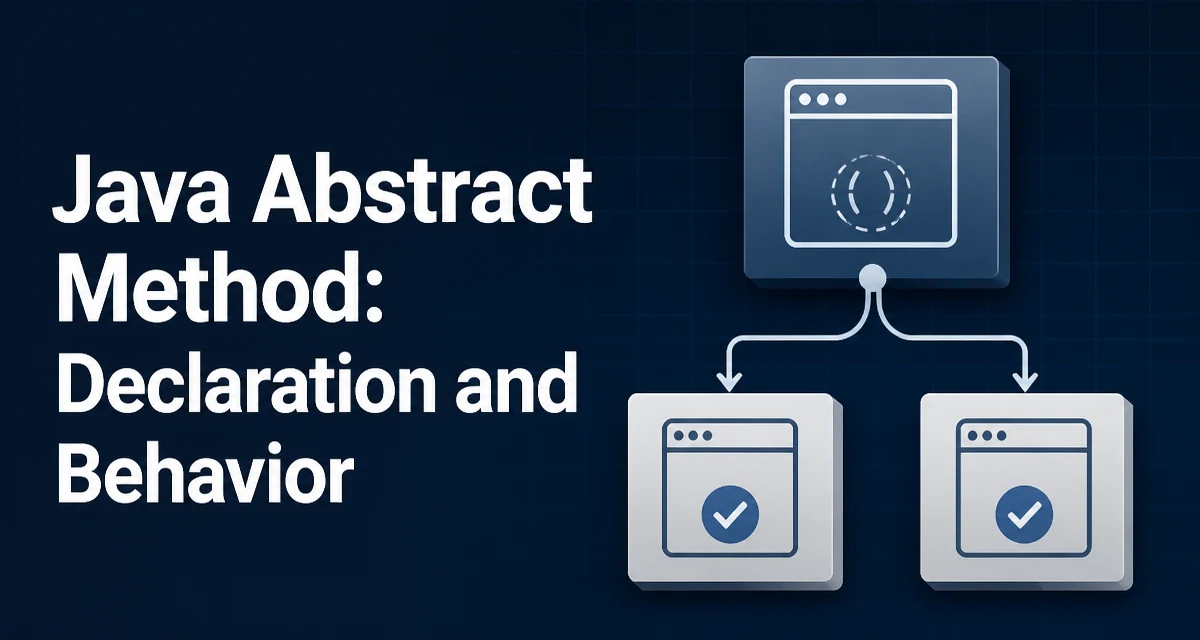
A java abstract method is a method declaration without a body. It ends with a semicolon instead of a brace block, and it must be implemented by a concrete subclass or by the class that implements the interface declaring it. Abstract methods exist to define a contract that subclasses must fulfill, without prescribing how they fulfill it.
Declaring an Abstract Method in an Abstract Class
An abstract method is declared with the abstract keyword. The method signature includes the access modifier, return type, name, and parameter list, followed by a semicolon:
public abstract class PaymentProcessor {
    public abstract boolean processPayment(Payment payment);
}
The abstract keyword can appear before or after the access modifier; both public abstract and abstract public are valid, though public abstract is the conventional order. An abstract method cannot be private, static, final, or synchronized. A private method cannot be overridden, a static method belongs to the class rather than an instance, and a final method cannot be overridden — all of which contradict the purpose of an abstract method.
A class that contains at least one abstract method must itself be declared abstract. If you remove the abstract modifier from the class while keeping the abstract method, the compiler rejects the code with an error stating that the class must be declared abstract or the method must have a body.
Overriding Requirements in Concrete Subclasses
When a concrete class extends an abstract class, it must provide implementations for all inherited abstract methods. If it fails to implement even one, the compiler reports an error and the class must remain abstract.
public class CreditCardProcessor extends PaymentProcessor {
    @Override
    public boolean processPayment(Payment payment) {
        // actual credit card processing logic
        return true;
    }
}
The @Override annotation is optional but recommended. It causes the compiler to verify that the method actually overrides a superclass or interface method, catching signature mismatches early.
An abstract subclass does not have to implement inherited abstract methods. It can defer the implementation to its own subclasses, but it must either implement the method or remain abstract.
Abstract Methods in Interfaces
Before Java 8, every method in an interface was implicitly abstract. Since Java 8, interfaces can also declare default and static methods with bodies, but a method without a body in an interface is still implicitly abstract — you do not need to write the abstract keyword.
public interface Repository {
    void save(Entity entity);
    Entity findById(long id);
}
A class that implements the interface must provide concrete implementations for both methods. If the implementing class is abstract, it can leave them unimplemented.
The distinction matters for compatibility. Adding a new method to an interface breaks all existing implementations unless the method is declared default or static. Abstract classes do not have this problem because a new abstract method only breaks concrete subclasses that do not implement it.
When to Use an Abstract Method
Use an abstract method when you need to guarantee that every subclass provides a specific behavior, but the exact implementation depends on the subclass. Common cases include:
- Template method patterns where the algorithm skeleton is fixed but individual steps vary.
- Strategy-like designs where the caller depends on a contract rather than a concrete type.
- Framework code that invokes subclass hooks at defined points in a workflow.
Do not use an abstract method when a default implementation would be reasonable for most subclasses. In that case, a concrete method in the abstract class, or a default method in an interface, reduces duplication and lets subclasses override only when necessary.
Runtime Behavior and Dispatch
Abstract methods are resolved at runtime through dynamic dispatch. When you call a method through a reference typed as the abstract class or interface, the JVM invokes the implementation in the actual object's class.
PaymentProcessor processor = new CreditCardProcessor();
boolean ok = processor.processPayment(payment);
The variable's static type determines which methods are visible at compile time. The object's runtime type determines which implementation executes. This is what makes abstract methods useful for polymorphism: callers depend on the contract, while the concrete class supplies the behavior.
Common Mistakes and Edge Cases
One frequent mistake is attempting to instantiate an abstract class. The compiler rejects new PaymentProcessor() because the class has an abstract method and cannot be constructed. You must instantiate a concrete subclass.
Another mistake is declaring an abstract method with a body. The compiler reports that abstract methods cannot have a body. The method must end with a semicolon.
A third issue involves access modifiers. An abstract method declared protected in the superclass can be overridden with protected or public visibility, but not with private or package-private visibility that reduces access. Widening visibility is allowed; narrowing it is not.
Abstract Methods and Functional Interfaces
A functional interface is an interface with exactly one abstract method. It can be implemented with a lambda expression instead of a full anonymous class.
@FunctionalInterface
public interface Validator {
    boolean isValid(String input);
}
Validator v = input -> input != null && !input.isEmpty();
The lambda provides the implementation of the single abstract method. This works only when the interface has exactly one abstract method; if it has multiple, the lambda cannot determine which method to implement. The @FunctionalInterface annotation is optional but makes the constraint explicit.
Maintainability Considerations
Abstract methods force subclasses to implement behavior, which keeps contracts explicit but also creates coupling. Adding a new abstract method to an abstract class breaks every concrete subclass. If the hierarchy is large or external, prefer a concrete default method or an interface default method to avoid breaking changes.
Keep abstract methods focused on a single responsibility. A class with many abstract methods becomes difficult to implement correctly, and subclasses end up with boilerplate UnsupportedOperationException stubs. If a subclass cannot meaningfully implement a method, the abstraction is probably wrong.