Java add vs offer: Choosing the Right Queue Method
java add vs offer: Understand the difference between add() and offer() in Java Queue, including return values, capacity handling, and when to use each.
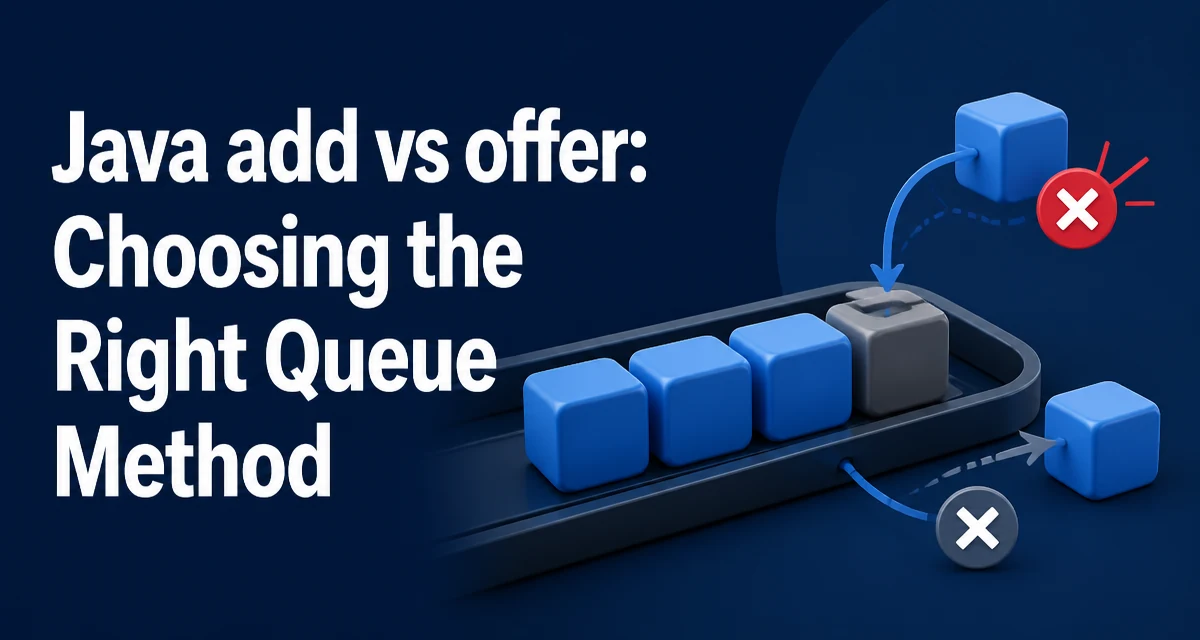
When working with Java's Queue interface, the add and offer methods often appear interchangeable. Both insert an element into the queue, and both return a boolean. But the similarity ends there. The critical difference is how they behave when the queue cannot accept the element. This distinction matters most when you use bounded queues, where capacity is limited. Understanding java add vs offer helps you write code that fails predictably instead of unexpectedly.
What add() and offer() Do in a Queue
The Queue interface extends Collection, so it inherits the add(E e) method from Collection. It also declares its own offer(E e) method. Both methods attempt to insert an element at the tail of the queue. For an unbounded queue such as LinkedList, both methods succeed as long as the element is non-null. The practical difference appears when the queue has a fixed capacity, like ArrayBlockingQueue or a custom bounded implementation.
Queue<String> queue = new LinkedList<>();
queue.add("first");
queue.offer("second");
In this example, both calls succeed and return true. The queue ends up with two elements. There is no observable difference for an unbounded queue.
Return Value and Exception Contract
The add method returns true when the element is added successfully. If the queue is full and cannot accept the element, add throws an IllegalStateException. In contrast, offer returns false when the element cannot be added, and it does not throw an exception. This is the core behavioral difference.
Queue<Integer> bounded = new ArrayBlockingQueue<>(2);
bounded.add(1);
bounded.add(2);
// Next line throws IllegalStateException
bounded.add(3);
The same scenario with offer:
Queue<Integer> bounded = new ArrayBlockingQueue<>(2);
bounded.offer(1);
bounded.offer(2);
boolean added = bounded.offer(3); // false
This contract is defined in the Queue interface documentation. add is inherited from Collection and signals failure by throwing, while offer is designed for queues and signals failure by returning false. The choice affects how you handle a full queue in your code.
Capacity-Limited Queues and Failure Behavior
Bounded queues are common in producer-consumer patterns, thread pools, and rate-limiting scenarios. When the queue reaches its capacity, the behavior of add and offer diverges sharply. add throws an unchecked IllegalStateException, which can crash a thread if not caught. offer returns false, allowing the caller to decide what to do next—retry, drop the element, block, or apply backpressure.
Queue<Task> taskQueue = new ArrayBlockingQueue<>(100);
if (!taskQueue.offer(task)) {
    // Handle overload: log, retry, or reject
}
Using add in the same situation would require a try-catch block:
try {
    taskQueue.add(task);
} catch (IllegalStateException e) {
    // Handle overload
}
The offer approach is more explicit and avoids exception handling for a normal control-flow condition. Exceptions should be reserved for exceptional circumstances, not for a full queue that is an expected state in a bounded system.
Choosing Between add() and offer()
The decision depends on the queue type and the desired failure semantics. Use offer when the queue may be bounded and you want to handle the full condition without exception overhead. This is almost always the safer default for production code. Use add when you are certain the queue is unbounded, or when you want a full queue to be treated as a programming error that should surface immediately.
Consider the following guidelines:
- If the queue is a
LinkedListor another unbounded implementation, both methods behave identically.addis slightly more conventional because it comes fromCollection, butofferis equally valid. - If the queue is bounded,
offeris the better choice because it gives you a boolean result to act on. - If you are implementing a method that accepts a
Queueparameter and you cannot know whether it is bounded, preferofferto avoid unexpected exceptions. - If you are writing a library that must strictly follow the
Collectioncontract,addmight be expected by callers who treat the queue as a collection.
In practice, most queue consumers should rely on offer because it aligns with the queue's intended use case and makes capacity handling explicit.
Practical Example: Bounded Queue in Action
Consider a simple task dispatcher that uses a bounded queue. The dispatcher receives tasks from multiple producers and processes them with a single worker. Using offer lets you handle a full queue gracefully.
Queue<Runnable> tasks = new ArrayBlockingQueue<>(10);

boolean submitted = tasks.offer(() -> System.out.println("Task executed"));
if (!submitted) {
    System.out.println("Queue is full, task rejected");
}
If you used add, the same situation would throw an exception, which might be caught at a higher level or crash the producer thread. The offer version keeps the control flow in the producer, making the rejection decision local and clear.
For a more realistic scenario, you might combine offer with a retry loop or a timeout. The boolean return value gives you the flexibility to implement backpressure without relying on exception handling.
Common Misconceptions About add() and offer()
One misconception is that offer is always non-blocking and add is always blocking. Neither method blocks. Both attempt an immediate insertion and return or throw based on the current state. For blocking behavior, you need put() from BlockingQueue, which waits until space becomes available. add and offer are both non-blocking; they differ only in their failure signal.
Another misconception is that offer is slower than add. The performance difference is negligible for typical queue implementations. The real difference is in the contract, not the runtime cost. Both methods are O(1) for common implementations like LinkedList and ArrayBlockingQueue, but the constant factors depend on the underlying data structure and the JVM, not on the method name.
Performance and Runtime Considerations
From a performance standpoint, add and offer are equivalent for unbounded queues. For bounded queues, offer avoids the cost of constructing and throwing an exception when the queue is full. Exception creation is expensive because it captures the stack trace. Using offer for expected full conditions eliminates that overhead. However, if the queue is rarely full, the difference is negligible.
The more important consideration is maintainability. Code that uses offer and checks the return value is self-documenting: it clearly shows that the queue might reject an element. Code that uses add must either assume an unbounded queue or wrap every call in a try-catch, which obscures the normal flow. When you review code, offer signals that the developer considered capacity limits; add signals either an unbounded queue or a potential oversight.
In a producer-consumer system, the choice between add and offer also affects how you implement backpressure. With offer, you can decide to drop tasks, retry after a delay, or apply a policy. With add, you are forced into exception handling, which is less flexible and often less readable.
Handling Queue Full Conditions in Production
In production, a full queue is often a symptom of a broader issue: a slow consumer, a burst of traffic, or a resource leak. The way you handle that condition can make the difference between a graceful degradation and a cascading failure. Using offer lets you log the rejection, emit a metric, or trigger a circuit breaker. Using add would throw an exception, which might be caught far from the insertion point and lead to confusing error logs.
Consider a bounded queue used in a thread pool. If the queue fills up, the thread pool's rejection policy kicks in. The ThreadPoolExecutor uses offer internally to submit tasks. If the queue is full, it falls back to the configured RejectedExecutionHandler. This design mirrors the offer approach: the caller is notified of rejection through a callback, not an exception.
For your own queue-based components, adopt the same philosophy. Use offer as the default insertion method. Reserve add for cases where you deliberately want an exception to propagate, such as during initialization when a full queue indicates a configuration error. By choosing offer, you make the capacity behavior explicit and keep the failure handling close to the insertion point, which improves both reliability and code clarity.