Java Aggregation vs Composition: Ownership and Lifecycle
java aggregation vs composition: Understand the practical difference between aggregation and composition in Java, including lifecycle ownership, implementation, and de...
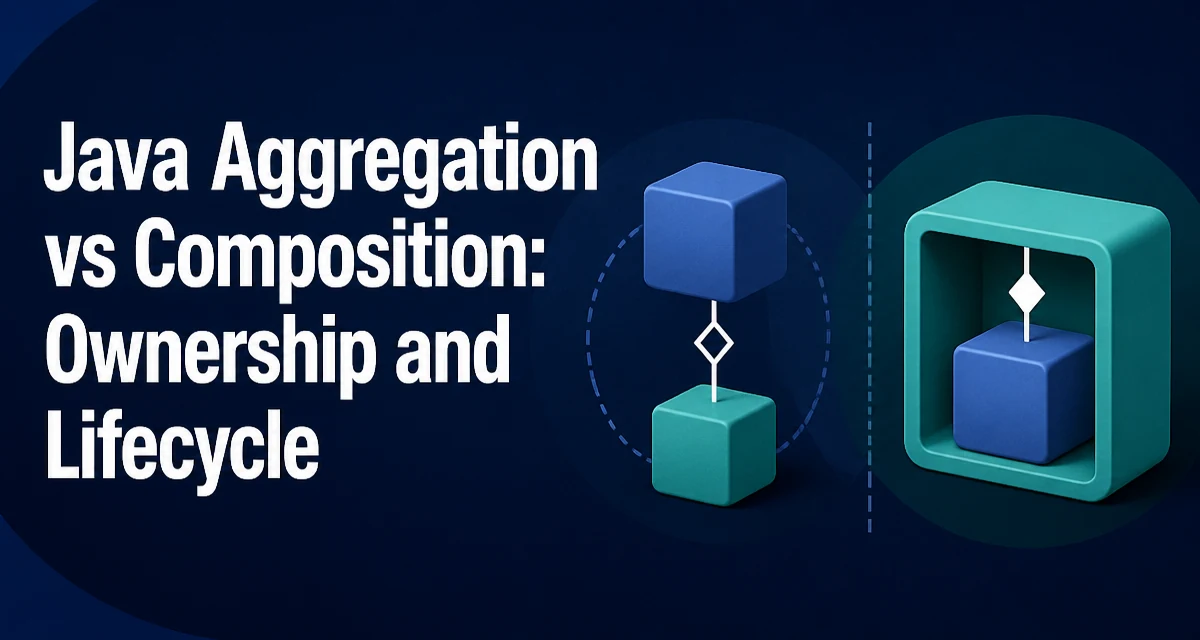
When modeling object relationships in Java, the distinction between aggregation and composition determines who owns the lifecycle of an object. The difference is not just a UML notation detail; it affects how you construct objects, how you manage memory, and how you reason about the codebase. This article explains the practical difference between java aggregation vs composition, shows how to implement each relationship, and gives you concrete criteria for choosing one over the other.
The Core Difference Between Aggregation and Composition
Both aggregation and composition describe a "has-a" relationship, but they differ in ownership strength. In aggregation, the contained object can exist independently of the container. For example, a Department has Employee objects, but those employees exist even if the department is dissolved. In composition, the contained object has no independent existence. A House has Room objects; if the house is destroyed, the rooms are gone too.
This ownership distinction is not just philosophical. It determines how you create objects, who is responsible for their lifecycle, and what happens when the container is garbage collected. In Java, there is no explicit destructor, so ownership is enforced by construction patterns: if the container creates the contained object internally, it is composition; if the contained object is passed in from outside, it is aggregation.
Representing Aggregation in Java
Aggregation is implemented by receiving a reference to an existing object. The container does not create the object; it merely holds a reference. This allows the contained object to be shared across multiple containers and to outlive the container.
class Department {
    private final List<Employee> employees;

    Department(List<Employee> employees) {
        this.employees = employees;
    }
}
Here, the Department does not instantiate Employee objects. They are created elsewhere and passed into the constructor. If the Department is no longer referenced, the employees list may still be referenced elsewhere, so the employees continue to exist. This is aggregation.
Aggregation gives you flexibility. The same Employee instance can belong to multiple departments, and the department does not need to know how employees are created. However, this also means the department has no control over the employees' lifecycle. If the caller forgets to clear references, you may keep objects alive longer than necessary, but that is a memory management concern rather than a design flaw.
Representing Composition in Java
Composition is implemented by creating the contained object inside the container. The container owns the lifecycle of the contained object, and the contained object cannot be shared.
class House {
    private final Room room;

    House() {
        this.room = new Room();
    }
}
The House creates its Room in the constructor. When the House becomes unreachable, the Room also becomes unreachable (assuming no other references exist). The Room has no independent existence; it is a part of the house.
Composition enforces a strict ownership boundary. The container is self-contained and does not depend on external code to provide its parts. This makes the container easier to test and reason about because its internal structure is fully under its control. However, it also means the container is tightly coupled to the concrete type of its parts, which can reduce flexibility if you need to swap implementations.
Lifecycle Ownership and Memory Implications
The practical impact of aggregation versus composition shows up in object lifetime. In composition, the container is responsible for creating and destroying its parts. In Java, destruction is handled by garbage collection, but the ownership pattern determines reachability. With composition, when the container is no longer referenced, its contained objects are also no longer referenced (unless they have been leaked elsewhere). This reduces the risk of accidental retention.
With aggregation, the contained object may be referenced by other containers or by the caller. The container does not control when the contained object becomes garbage. This can lead to objects living longer than expected if references are not cleared, but it also allows for shared state and reuse.
Consider a Course that has a Professor. If the Course is composition, the Professor is created when the course is created and cannot teach another course. If it is aggregation, the same Professor can teach multiple courses. The choice directly affects how you manage memory and how you model the domain.
How Aggregation and Composition Affect Maintainability
Composition tends to produce more maintainable code because the container encapsulates its parts. A House that creates its own Room does not require the caller to know how to build a Room. This reduces the surface area of the API and makes the class easier to use correctly. Composition also aligns well with the principle of encapsulation: the container hides the details of its parts.
Aggregation, on the other hand, introduces a dependency on the external creation of the contained object. The caller must know how to construct the Employee and pass it in. This can make the API more flexible but also more complex. Aggregation is useful when you want to decouple the container from the creation logic, for example, when using dependency injection.
A common mistake is to use aggregation when composition is more appropriate. If a Library has Book objects, and a book cannot exist without a library, then composition is the correct model. If you use aggregation, you allow books to be created independently, which may violate the domain invariant. Conversely, using composition when aggregation is needed can make the code rigid and prevent sharing.
Choosing Between Aggregation and Composition
The decision between aggregation and composition should be based on the domain semantics and the lifecycle requirements. Use composition when the contained object has no meaning without the container, when you want to enforce encapsulation, or when the lifecycle of the contained object is strictly tied to the container. Use aggregation when the contained object can be shared, when it has an independent existence, or when you want to decouple creation from the container.
The following table summarizes the key differences:
| Criterion | Aggregation | Composition |
|---|---|---|
| Object existence | Independent | Dependent on container |
| Creation responsibility | External caller | Container itself |
| Sharing | Possible | Not typical |
| Encapsulation | Weaker | Stronger |
| Coupling | Lower (via interfaces) | Higher (concrete types) |
In practice, composition is often preferred because it reduces the number of objects that must be managed externally. However, aggregation is necessary when you need to share objects across multiple containers. For example, a Person may belong to both a Family and a Company. That person should not be created by either container; it should be passed in.
When you design a class, ask: "Does this contained object have a reason to exist without the container?" If the answer is no, use composition. If yes, use aggregation. This simple test will guide you toward the correct relationship in most cases. Also consider whether you need to swap implementations. If you do, aggregation with an interface may be more flexible than composition with a concrete class. But if the part is an implementation detail, composition keeps the API cleaner.
Both relationships are valid in Java, and neither is inherently better. The right choice depends on the domain model and the maintainability tradeoffs you are willing to accept. By understanding the ownership and lifecycle implications, you can make a deliberate decision rather than relying on habit.