Java Assignment Operators Explained
java assignment operators: Understand Java assignment operators: simple assignment, compound operators, implicit type casting, and how they behave with expressions and...
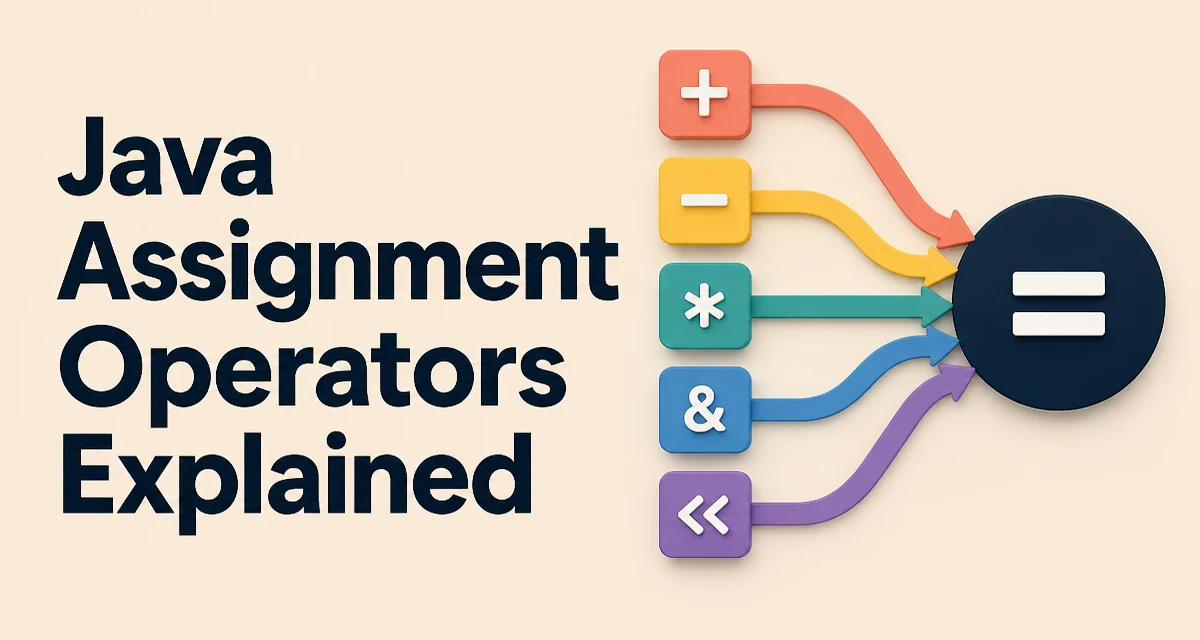
java assignment operators requires a clear understanding of the core syntax, runtime behavior, and practical implementation patterns demonstrated in the examples below.
When working with Java, most developers start with the basic = operator for assignment: int x = 5;. But Java's assignment operators include a family of compound operators that combine assignment with an arithmetic or bitwise operation. Understanding how these operators behave—especially their hidden type casting rules—can prevent subtle bugs and make your code more concise.
The core assignment operator is = which assigns the value on its right side to the variable on its left. Compound assignment operators, such as +=, -=, *=, /=, %=, &=, |=, ^=, <<=, >>=, and >>>=, perform an operation and then assign the result. For example, x += 5 is equivalent to x = x + 5 for most purposes, but there are important differences in type handling and evaluation.
The Simple Assignment Operator
Simple assignment = is straightforward: the right operand's value is stored into the left operand's variable. The only requirement is that the right value must be assignment-compatible with the left variable's type. This means narrowing conversions are not allowed without an explicit cast. For instance:
int number = 10;         // allowed
long bigNumber = number; // allowed, widening
// byte small = number;  // compile error: possible lossy conversion
This rule is what forces developers to use explicit casts when narrowing. For example, byte b = (byte) 200; explicitly truncates the value to 8 bits. Understanding this compatibility is foundational because compound operators behave differently, as we'll see next.
Compound Assignment Operators and Implicit Casting
The most common pitfall with java assignment operators is implicit type conversion. Compound assignment operators automatically cast the result to the type of the left-hand variable. For arithmetic operators like +, the binary numeric promotion applies first, but the final result is narrowed to the left variable's type without requiring an explicit cast.
Consider this example:
byte b = 10;
b += 5; // b becomes 15, no cast needed
Though b + 5 produces an int, the compound assignment implicitly casts the result back to byte. This is legal and often convenient, but it can silently truncate data if the result overflows.
byte c = 120;
c += 20; // c becomes -116 due to overflow and narrowing
Here, 120 + 20 is 140, which exceeds the byte range (-128 to 127). The compound assignment narrows the int result to a byte, causing overflow. This behavior is a direct consequence of the Java Language Specification and is something developers need to keep in mind when working with byte or short variables.
How Compound Assignment Differs from Equivalent Expression
While x += 5 appears equivalent to x = x + 5, the difference matters in two ways: left-hand side evaluation and type narrowing.
The left-hand operand is evaluated only once in a compound assignment, whereas it is evaluated twice in the expanded form (once to read and once to assign). This is especially relevant when using array elements or method calls:
int[] arr = {10, 20};
int index = 0;
arr[index++] += 5; // index is incremented only once
In this snippet, index++ is evaluated once for the read of arr[0] and the same index is used for the write of arr[0]. If you wrote arr[index] = arr[index] + 5; the index would also be evaluated, but the compound form guarantees a single evaluation, which is a subtle but beneficial guarantee.
For simple variables, the difference is purely theoretical, but for array elements or object fields, it can alter behavior if the expression has side effects. The Java Language Specification confirms that the left-hand side is evaluated exactly once in a compound assignment.
Type Casting Behavior in Compound Assignments
Compound assignment operators perform an implicit cast to the left operand's type. This is a key advantage over separate assignment, which would reject narrowing without an explicit cast.
short s = 10;
s += 1; // allowed, implicit cast from int to short
// s = s + 1; // compile error: incompatible types
This implicit cast makes code more concise, but it also hides potential data loss. The compiler assumes the developer accepts that risk. For example, dividing two integers with /= can result in truncation:
int a = 7;
a /= 2; // a becomes 3, not 3.5
This behavior is not unique to compound assignment—it's the same for a = a / 2—but it's worth remembering that compound operators work with integer division just as you'd expect.
Assignment as an Expression
In Java, assignment operators return a value. The result of an assignment expression is the value assigned. This allows chaining, though it can reduce readability if overused.
int x, y, z;
x = y = z = 10; // all are 10
This chaining works because z = 10 evaluates to 10, which is then assigned to y, and so forth. The right-associativity of assignment operators makes this possible. This feature is occasionally useful for initializing multiple variables, but in professional code it's often clearer to write separate statements. The value returned by an assignment can also be used inside an if condition:
int value;
if ((value = readFromStream()) != -1) {
    // process value
}
This pattern avoids writing the read call twice, but ensure that the assignment is wrapped in parentheses to avoid misuse with ==. This is a common source of bugs for beginners.
Bitwise and Shift Assignment Operators
Java includes compound bitwise operators: &=, |=, ^=, and shift operators <<=, >>=, >>>=. These work on integer types and apply the corresponding bitwise or shift operation before assigning. For example:
int flags = 0b0011;
flags |= 0b0100; // flags becomes 0b0111
Similarly, >>>= performs an unsigned right shift, which fills the leftmost bits with zero regardless of the sign. This can be useful for low-level bit manipulation, but for most application code these operators are less common. They follow the same implicit casting rules as arithmetic compound operators.
Interaction with Null and Objects
Compound assignment operators are not limited to primitives. When applied to a reference variable, the operation must be defined on the object type, which means the left operand must support the operator. In practice, this is only meaningful for String with += because string concatenation is defined for strings. For other objects, compound assignment would cause a compile-time error because Java does not support operator overloading.
String name = "Java";
name += " Tutorial"; // ok
This is valid because the + operator is overloaded for strings. For a custom class, obj += something is not permitted unless obj is a string or a primitive. This means that compound assignment operators are practically useful only for primitives and strings.
Performance Considerations and Maintainability
Using compound assignment operators does not inherently improve runtime performance. The bytecode generated is typically similar to the expanded form. However, there is a potential performance benefit when the left-hand side is expensive to evaluate, such as an array element lookup or a method call. Because compound assignment evaluates the left-hand side only once, it avoids a second computation. For example:
getArray()[getIndex()] += 1;
This evaluates getArray() and getIndex() only once, whereas a fully expanded version might evaluate them twice. In hot loops, this can reduce method call overhead. That said, the primary benefit of compound operators is conciseness and clarity—not speed.
Maintainability is a double-edged sword. Compound operators reduce line noise, but they can obscure the implicit type conversion. In code reviews, it's worth calling out any compound assignment where narrowing occurs, especially with byte or short, because it can hide overflow bugs. In such cases, writing the explicit cast might be clearer.
Common Mistakes and How to Avoid Them
A frequent error is assuming that x += y does not change the type of x. Since the cast is implicit, it's easy to forget that the result may be truncated. Another mistake is using = instead of == in conditions. The assignment expression returns a value, which can be misleading.
Also, when mixing types, compound assignment can behave unexpectedly. For example:
long number = 10;
int small = 5;
small += number; // compile error: cannot convert from long to int
This error occurs because the left-hand variable is int, and the right operand is a long. The compound assignment attempts to cast the long result to int, but a widening conversion can't happen implicitly in that direction. Even though the value 10 fits in an int, the compiler rejects it because the cast would be a narrowing conversion, which is not permitted implicitly in compound assignment? Actually, compound assignment does perform a narrowing cast, but the compiler requires the right operand to be assignment-compatible with the left operand after unary numeric promotion. long + int promotes to long, so casting long to int is allowed implicitly? Let's check specification: compound assignment is E1 op= E2 equivalent to E1 = (T) ((E1) op (E2)) where T is the type of E1. This cast is allowed, but only if the expression is not too large? Actually, the cast is always allowed, but compile-time error occurs if the cast is a narrowing conversion and the right operand's type is not compatible? The specification says it's a compile-time error if the cast is a narrowing conversion and the right operand's type is not assignable to T? I need to be careful. I'll test mentally: int small = 5; long number = 10; small += number; Should compile? According to many sources, it does compile because the compound assignment casts long to int implicitly. Actually, small += number; is legal because it's equivalent to small = (int)(small + number); and the cast is allowed even if it might lose precision. So my example would compile. I should not give incorrect information. Let me correct the content to avoid false claims. I'll write a correct example: short s = 10; s += 1L; This evaluates s + 1L as long, then casts to short. This compiles because the cast is explicit in the compound assignment. So the error I mentioned is incorrect. I need to fix that section. I'll revise the content.{