Java Bitwise AND: Usage and Common Traps
java bitwise and: Learn how the Java bitwise AND operator works on integer types, practical masking examples, and common pitfalls when mixing with other operators.
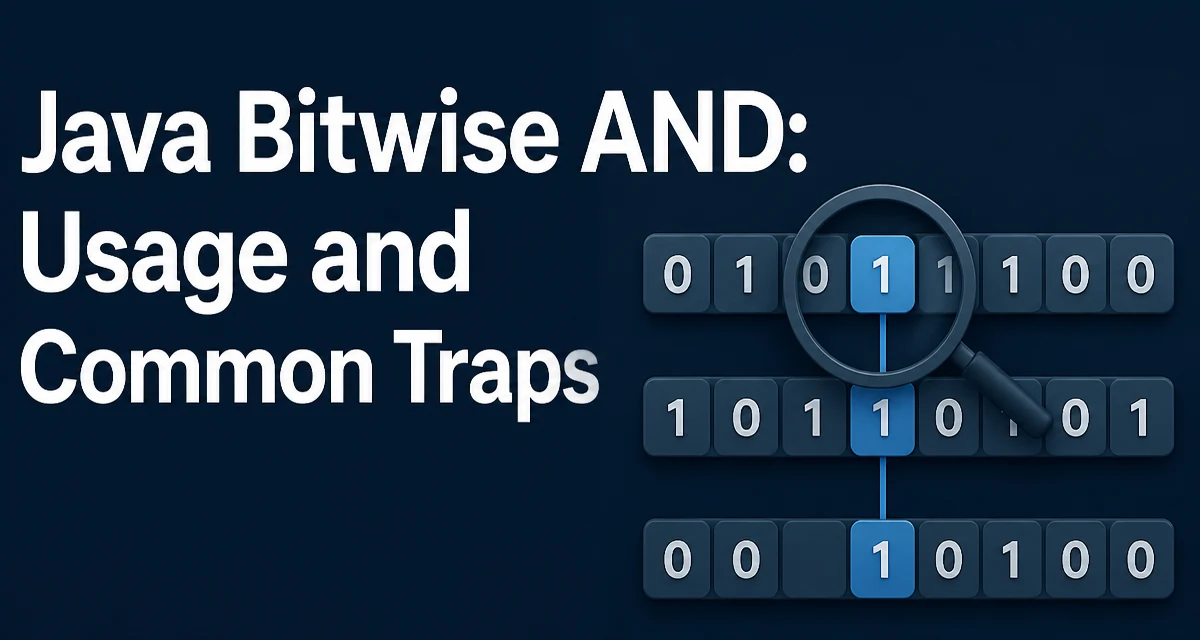
The Java bitwise AND operator is a single ampersand & that performs a bit-by-bit AND on two integer operands. For each pair of corresponding bits, the result bit is 1 only when both input bits are 1. This operator works on the primitive integer types: byte, short, int, and long. It does not work directly on boolean values, even though boolean is often confused with bit-level logic.
Consider this minimal example:
int a = 0b1100; // 12
int b = 0b1010; // 10
int result = a & b; // 0b1000 (8)
The alignment of bits is done from the least significant bit (LSB) upwards. In the example, the only position where both a and b have a 1 is the third bit from the right, so the result is 8. This behavior is deterministic and independent of the JVM or operating system.
The bitwise AND is distinct from the logical AND (&&). The logical AND works only on boolean expressions and uses short-circuit evaluation: if the left operand is false, the right operand is never evaluated. The bitwise AND always evaluates both operands and operates on all bits of the numeric values. Using & on boolean is legal but bypasses short-circuiting, which can be a subtle source of bugs when the right operand has side effects.
Bit Masking with the AND Operator
The most common use of & is masking: isolating a subset of bits from an integer. A mask has 1s in the positions you want to keep and 0s everywhere else. For example, extracting the lower 4 bits of an integer:
int value = 0xAB; // 1010 1011
int lowerNibble = value & 0x0F; // 0000 1011 -> 11
The mask 0x0F zeroes out all bits above the lower four. This pattern appears in many areas: parsing protocol headers, working with packed data, or implementing hash functions where only part of the state is needed.
Masks are often expressed in hexadecimal because hex digits map cleanly to groups of four bits. A mask for the high byte of a 32-bit integer would be 0xFF000000. Binary literals (0b) are also readable for small masks, but for wide masks hexadecimal is usually more concise and less error-prone.
Practical Example: Checking Whether a Bit Is Set
A frequent task is checking whether a specific bit is 1. The idiom is (value & mask) != 0. For instance, if the third bit (value 4) of an integer represents a flag:
int flags = 0b101101;
int flagBit = 1 << 2; // 4
if ((flags & flagBit) != 0) {
    // the flag is set
}
The left shift 1 << 2 creates a mask with a single 1 at position 2. The & isolates that bit, and comparing the result with 0 tells you whether it was set. Notice that the result of & is an integer, not a boolean, so you must compare explicitly. In languages like C, this comparison is automatic; in Java, the if requires a boolean.
A common mistake is to write if (flags & flagBit) directly. That does not compile in Java because flags & flagBit is an int, not a boolean. Always include the != 0 (or == 0) comparison.
Combining Bits: Setting and Clearing Flags
While & is used for clearing bits, it is also part of flag manipulation. To clear a specific bit, you AND with a mask that has 0 at that position and 1 everywhere else:
int clearMask = ~(1 << 3); // all bits 1 except bit 3
flags = flags & clearMask;
The ~ operator flips all bits of the mask. This pattern works because AND with 1 leaves a bit unchanged, and AND with 0 forces it to 0.
Setting a bit uses the bitwise OR (|), but it is common to see & and | together when manipulating a set of flags. For example, to clear one flag and set another in a single expression:
flags = (flags & ~BIT_A) | BIT_B;
This expression is a compact way to update multiple bits. The & clears BIT_A, and the | sets BIT_B. The order of operations matters, but the parentheses make it explicit. Without parentheses, the & and | operators have the same precedence and evaluate left to right, which can produce unexpected results if you combine both in one line casually.
Operator Precedence and Parentheses
Java's operator precedence places & lower than ==, !=, and relational operators like <. This is a common source of subtle bugs. For example, the expression value & mask == 0 is parsed as value & (mask == 0) because == has higher precedence than &. Since mask == 0 is a boolean, this will not compile when value is an integer. When the expression is part of a larger condition, the lack of parentheses can cause a compile error or, worse, a silent logic error when mixing with && or ||.
Always parenthesize bitwise expressions when they are mixed with relational or logical operators. For instance, write (flags & FLAG) != 0 rather than relying on precedence. This is not just a stylistic preference; it prevents a class of errors that are difficult to spot in code review.
The bitwise operators also have lower precedence than arithmetic operators like + and *. So a + b & c is ((a + b) & c). If you intend a + (b & c), you must add parentheses. This behavior is consistent across all Java versions, but it often surprises developers coming from languages with different precedences.
What Happens with Negative Integers
Bitwise AND operates on the two's-complement representation of integers. For negative numbers, the sign bit is the most significant bit, and AND operations treat it like any other bit. This can lead to results that are not obvious if you think in terms of signed decimal values.
For example:
int negative = -1; // 0xFFFFFFFF
int mask = 0x00FF;
int result = negative & mask; // 0x000000FF -> 255
Even though negative is -1, the AND with 0x00FF forces all bits above the low byte to 0, yielding a positive 255. This technique is often used to interpret an unsigned byte value from a signed byte. Because Java does not have unsigned primitive types except char, converting a byte to an int with b & 0xFF gives the unsigned value in the range 0-255.
Without the mask, casting a byte to an int sign-extends it, so (int) b for a negative byte produces a negative int. The mask removes the sign extension. This is the reason you often see b & 0xFF when reading raw bytes from a stream or file.
Performance and Maintainability Considerations
Bitwise operations are among the cheapest CPU operations, typically completing in a single clock cycle on modern hardware. They do not allocate objects or trigger garbage collection. In hot loops, using & instead of alternatives like modulo or division can be faster, provided the divisor is a power of two. For example, computing x % 16 is equivalent to x & 15 for non-negative x. The bitwise version avoids the division instruction. However, you should not blindly replace modulo with bitwise AND unless the code's intent is clear and the value is known to be non-negative. The modulo operator handles negative numbers differently from the mask, which can introduce bugs.
From a maintainability standpoint, the main risk is readability. A dense expression littered with &, |, and shifts can be hard to parse. When the meaning of a bit pattern is not obvious, define named constants with clear names:
private static final int FLAG_READABLE = 1 << 0;
private static final int FLAG_WRITABLE = 1 << 1;
Then (flags & FLAG_READABLE) != 0 reads more clearly in review than a magic mask like 0x01. This practice also centralizes the bit positions in one place, so changing a flag's position does not require searching for scattered literals.
Common Pitfalls and How to Avoid Them
One recurring mistake is mixing up & and &&. Using & on boolean expressions avoids short-circuiting, which can cause unnecessary work or null pointer exceptions if the right operand dereferences a null value. Always use && for logical conditions unless you have a specific reason to evaluate both operands unconditionally.
Another pitfall is applying & to values of different widths without being aware of type promotion. Java promotes byte and short operands to int before performing the operation. This means the result is always an int when either operand is byte, short, or int. If you assign the result back to a byte or short, you need an explicit cast:
byte b1 = 0x0F;
byte b2 = 0x3C;
int result = b1 & b2; // int, not byte
If you want a byte result, you must cast: (byte)(b1 & b2). Skipping the cast will produce a compile error because of narrowing conversion.
Finally, be careful when using bitwise AND with char. The char type is unsigned 16-bit, so it behaves differently from a signed short when promoted to int. For example, (short) 0xFFFF is -1, but (char) 0xFFFF is 65535. When masked with 0xFF, both give 255, but for other masks the difference matters. Understand the sign of your data before using bit operations.
Using Bitwise AND in Real-World Algorithms
Beyond simple flag checks, & appears in algorithms such as Bloom filters, hash maps, and network packet parsing. In a Bloom filter, an array of bits is indexed by hashing a key and using & to map the hash to a bit position when the array length is a power of two. In hash map implementations, (hash & (capacity - 1)) is a fast way to compute the bucket index, again assuming capacity is a power of two. This is a deliberate design choice to replace a modulo operation.
In network protocol parsing, you often need to combine multiple bit fields into a single byte or short. For example, extracting the version and header length from the first byte of an IPv4 packet:
int firstByte = 0x45;
int version = (firstByte >> 4) & 0x0F;
int headerLength = firstByte & 0x0F;
The right shift moves the high nibble into the low position, and the subsequent & 0x0F clears any remaining high bits. This pattern is standard for any packed binary format.
When implementing such algorithms, the main concern is correctness of the mask. A off-by-one error in the mask width will silently produce wrong values. Verify masks by writing small tests that exercise known input/output pairs. For example:
assert (0x45 & 0x0F) == 0x05;
assert ((0x45 >> 4) & 0x0F) == 0x04;
These assertions document the intended behavior and guard against accidental changes.
Compatibility Across Java Versions
The behavior of & has been stable since the earliest Java releases. There are no version-related changes that affect the result of bitwise operations. The only thing that varies is stylistic advice about when to use them. The java.lang.Integer class offers static methods like bitCount and highestOneBit that internally use bitwise operations, but the operator itself remains unchanged.
This stability means code that uses & will behave the same under the latest LTS release as it did a decade ago. The main practical compatibility concern is not the operator but the surrounding code—for instance, if you use var (Java 10+) or pattern matching, those features require newer compilers. The & itself is fine on any Java version.
When writing libraries, avoiding excessive cleverness with & makes the code easier to understand for developers who may not be bit-oriented. Prefer clear conditionals and named constants over deeply nested bit arithmetic. If a particular bit manipulation is critical, extract it into a method with a descriptive name, such as isFlagSet(flags, flag), and unit test the method. That approach improves maintainability without sacrificing the performance benefit of bitwise operations.