Using the Java Bitwise OR Operator
java bitwise or: Learn how to use the Java bitwise OR operator to combine flags, set bits, and understand its behavior on signed integers.
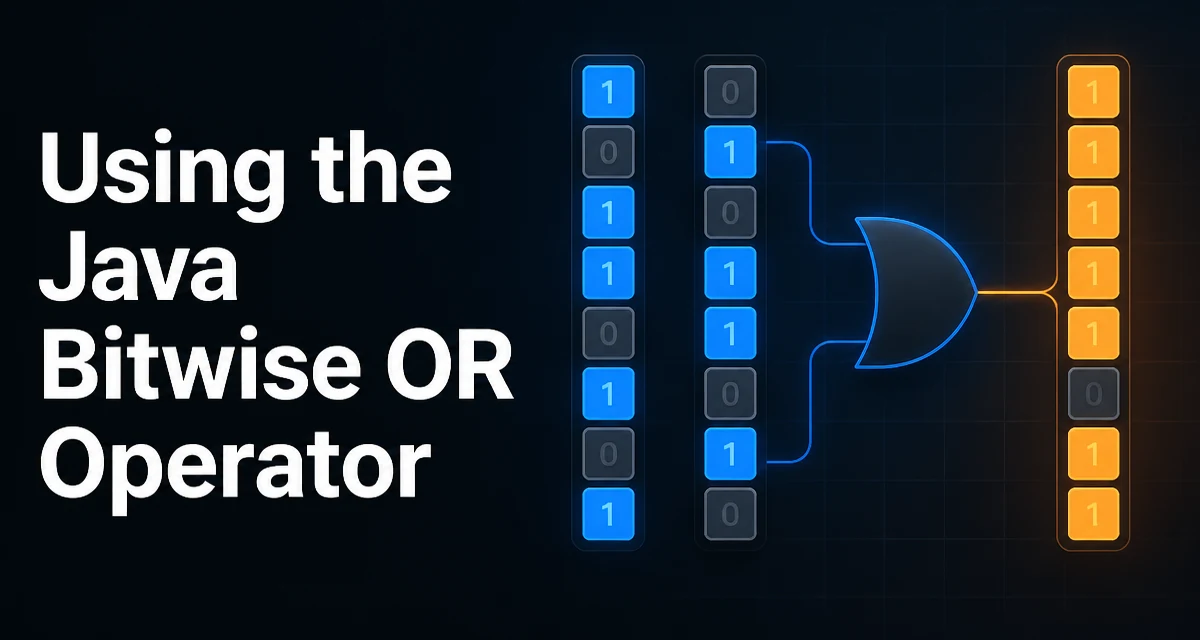
java bitwise or requires a clear understanding of the core syntax, runtime behavior, and practical implementation patterns demonstrated in the examples below.
The | operator in Java is the bitwise OR. It compares each bit of two integer operands and produces a result where each bit is 1 if either corresponding bit is 1, and 0 only if both bits are 0. This operator works on all integral types: byte, short, int, long, and char. Unlike the logical OR (||), the bitwise OR does not short-circuit and cannot be applied to boolean values without resulting in a compile-time error (except when used as a non-short-circuit logical OR on booleans, which is a distinct but related usage). For integer types, it performs a bit-by-bit operation as shown below.
Basic Syntax and Behavior of |
The bitwise OR operator is a binary operator. Given two integers, it operates on their binary representations. For example:
int a = 0b1100; // 12 in decimal
int b = 0b1010; // 10 in decimal
int result = a | b; // 0b1110, which is 14
Each bit position in result is the OR of the corresponding bits of a and b. If either bit is 1, the result bit is 1. This operator is often used to set specific bits to 1 without affecting other bits, as described in later sections. The operator follows the standard precedence rules in Java: it has lower precedence than relational and equality operators, so expressions like a == 0 | b == 0 are valid but may not be what you intend. Parentheses are recommended to clarify intent.
Using Bitwise OR for Flag Combinations
The most common practical application of java bitwise or is to combine multiple boolean flags into a single integer value. Each flag is represented by a distinct bit position, often defined as a constant with a power-of-two value. For example:
public class Permissions {
    public static final int READ = 1;    // 0b0001
    public static final int WRITE = 2;   // 0b0010
    public static final int EXECUTE = 4; // 0b0100

    public static void main(String[] args) {
        int userPermissions = READ | WRITE;
        // userPermissions now has bits 0 and 1 set, which is 0b0011 (3)
    }
}
The | operator combines the flags by setting the bits that are present in either operand. This allows you to represent a set of boolean options compactly and pass it around as a single parameter. To check whether a particular flag is set, you would use the bitwise AND operator (&) in a test like (permissions & READ) != 0. This pattern is widely used in Java APIs, such as in java.nio.file.StandardOpenOption sets, where you pass multiple options as a Set or variable arguments, but bitmask techniques appear in low-level I/O and networking code.
Setting and Clearing Specific Bits
Beyond combining flags, the OR operator can selectively turn on bits in an integer. For example, if you have an int variable and you want to set bit 5 (value 32) to 1, you use flags |= (1 << 5). The expression (1 << 5) creates a value with only that bit set, and the OR operation ensures that bit becomes 1 while leaving all other bits unchanged.
To clear a bit (set it to 0), you need the AND operator with a negated mask, for example flags &= ~(1 << 5). This shows that bit manipulation often requires a combination of operators; the OR is only one part of the toolkit. Here is a complete example:
int flags = 0; // all bits zero
flags |= (1 << 2); // set bit 2 -> flags = 0b0100 (4)
flags |= (1 << 5); // set bit 5 -> flags = 0b100100 (36)
System.out.println(Integer.toBinaryString(flags)); // outputs 100100

flags &= ~(1 << 2); // clear bit 2 -> flags = 0b100000 (32)
System.out.println(Integer.toBinaryString(flags)); // outputs 100000
When using this technique, keep in mind the shift distance operand is masked to the lower five bits for int (or six for long) by the Java language specification. For example, 1 << 32 is equivalent to 1 << 0, which can lead to subtle bugs if you are not careful. But for shifting by a constant at compile time, this behavior is well-defined.
Bitwise OR on Signed Integers and Two's Complement
Java's integral types are signed (with the exception of char), and they use two's complement representation. The bitwise OR operates on this internal representation directly. The leftmost bit (the sign bit) is treated just like any other bit for the purpose of the | operation. This means that if you OR a number with a value that has a high bit set, you can affect the sign of the result.
For example:
int negative = -1; // 0xFFFFFFFF in two's complement
int positive = 0x80000000; // only sign bit set, is actually Integer.MIN_VALUE (a negative number)
int result = negative | positive; // still 0xFFFFFFFF, which is -1
The result is -1 because the OR of any value with -1 yields -1. This behavior is rarely useful in typical flag handling, but it is crucial to understand when debugging or when doing low-level bit manipulation. If you only work with non-negative numbers below 2^31, the sign bit remains zero and you don't have to worry about it. However, if you use values like 0x80000000 as a flag, remember that it's interpreted as a negative int. In such cases, using long or using >>> (unsigned right shift) may be more appropriate for your logic.
Performance Considerations and Readability
Bitwise OR operations themselves are extremely fast at the CPU level, but the performance of code that uses them is not solely about the operation. The main performance advantage comes from avoiding object allocations and method calls when passing sets of options. For instance, instead of creating a HashSet of enum constants, you can pass a single int bitmask. This reduces memory overhead and can improve cache behavior and method call speed, especially in tight loops or high-frequency operations.
However, you should not sacrifice code clarity for micro-optimizations unless profiling shows a bottleneck. Bitmask code is less readable than enum sets, so it is best used in performance-critical paths or in APIs that have specifically exposed integer flags (like some Java I/O classes). When you do use bitwise OR, always define named constants for the flag values and provide helper methods to set and test them. This keeps the behavior understandable because the mask values remain self-documenting.
The Java EnumSet and EnumMap classes provide a safer, strongly typed alternative for enum flags. They internally use bit vectors (with long fields) to represent the set, giving you both performance and type safety. So for new code, prefer EnumSet over manual bitmasking unless you need to interoperate with an existing bitmask API or you have a specific performance requirement that EnumSet cannot meet.
Common Mistakes and Editing Pitfalls
A frequent mistake is confusing | with ||. In an if condition, if (a | b) is a compile-time error because | is not defined for boolean operands, except for booleans it acts as non-short-circuit logical OR: if (a | b) compiles when both a and b are boolean, but it evaluates both sides even if a is true. This can cause performance problems if the right side has side effects, and could introduce subtle bugs. Prefer || for logical conditions unless you specifically need to avoid short-circuit behavior.
Another mistake is using | on numeric values in a boolean context. For example, if ((flags & READ) != 0) is correct, but if (flags & READ) would be wrong because the result is an int and Java does not implicitly convert integers to booleans. The compiler will reject it, which is a helpful error.
When combining flags, ensure that the flag values do not overlap. If two constants use the same bit, ORing them yields the same bit set, but you lose the ability to distinguish them. Each flag must be a distinct power of two. If you need many flags, use long and the corresponding 1L << n shifts to avoid type overflow issues.
Choosing Between Bitmask and EnumSet
When deciding whether to use bitwise OR with masks or an EnumSet, consider the tradeoffs:
| Aspect | Hand-rolled bitmask (int or long) | EnumSet<MyEnum> |
|---|---|---|
| Type safety | Low, any integer can be passed | High, only the specified enum type |
| Readability | Requires named constants and helper methods | Self-documenting through enum names |
| Performance | Minimal memory, one value passed | Internally uses bit vectors, but may allocate objects |
| API compatibility | Needed for legacy APIs or low-level operations | Works seamlessly with modern Java collections |
Use a bitmask when you are dealing with an API that explicitly uses integer options, such as flags in a file open call or in networking code. Use EnumSet when you control the API and want compile-time checks, because it guards against passing invalid flags and makes the code more maintainable. There is also Set of enum constants, but EnumSet is specifically optimized for performance and compactness.
Edge Case: OR with Zero and Maximum Values
ORing any value with zero returns that value unchanged, because bits that are 0 in the mask do not affect the result. This property is often used to combine only the bits that are required. ORing with -1 always produces -1, as mentioned earlier, which can be surprising but is consistent with the bit semantics. For unsigned behavior on long, consider using Long.remainderUnsigned or shifting explicitly with >>> where needed. In practice, these edge cases matter when writing generic bit-manipulation utilities, so always test with boundary values like 0, -1, Integer.MAX_VALUE, and Integer.MIN_VALUE.
Implementing a Utility Method for Flags
To make bitmask handling less error-prone, you can write small utility methods. Here is an example that centralizes the bit operations:
public final class BitFlags {
    private BitFlags() {}

    public static int set(int flags, int mask) {
        return flags | mask;
    }

    public static int clear(int flags, int mask) {
        return flags & ~mask;
    }

    public static boolean isSet(int flags, int mask) {
        return (flags & mask) == mask;
    }
}
These methods make the intention explicit and reduce the chance of mixing up operators. They also provide a single place to add validation, such as ensuring the mask is not zero or that it contains only known bits. In a production system, you might want to validate that provided flags do not contain unknown bits by checking (flags & ~ALL_KNOWN_BITS) == 0, but that validation has a runtime cost, so consider whether it is worth it for your use case. It helps in debugging because it surfaces mistakes early.
Compatibility and Portability Across Java Versions
The bitwise OR operator has existed since Java 1.0 and its behavior is stable across all versions. There is no version-specific difference in how | works on integer types. The only changes over time are in the surrounding APIs and in the advice about using EnumSet (introduced in Java 5). For code that must target very old Java versions, bitmasking was the only way to get compact sets, but modern Java code should prefer type-safe collections. When you migrate legacy code, you can often replace bitmask flags with EnumSet without changing external behavior, and this improves maintainability significantly.
One subtle compatibility issue is that | on boolean operands is also valid and evaluates both operands. This behavior is specified in the Java Language Specification and has not changed. If you rely on non-short-circuit logical OR, it will continue to work, but be aware that it may cause unintended side effects if the second operand throws an exception when the first would have prevented it. In such cases, never use | as a substitute for || in conditionals.
Testing Bitwise Operations Without Surprises
When writing tests for code that uses bitwise OR, consider the boundary values:
- OR with 0 leaves the flags unchanged.
- OR with a known mask sets exactly those bits.
- Combining two independent flags yields both bits.
- ORing with -1 always gives -1.
For example, a unit test for a flag setter might look like:
@Test
public void testSetFlag() {
    int flags = 0;
    flags = BitFlags.set(flags, READ);
    flags = BitFlags.set(flags, WRITE);
    assertTrue(BitFlags.isSet(flags, READ));
    assertTrue(BitFlags.isSet(flags, WRITE));
    assertFalse(BitFlags.isSet(flags, EXECUTE));
}
Such tests ensure the bit operations behave correctly and act as documentation for future maintainers. They also catch a common mistake where you accidentally use & instead of |, because the expected flag combination would be wrong. Since the Java language is strict about types, the compiler catches the most egregious errors, but logical mistakes like overlapping flags can only be caught by tests.
Where Java Bitwise OR Fits in Modern Code
Manual bitwise OR still appears in performance-critical sections, in low-level libraries like networking, graphics, or cryptography, and in code that interoperates with native binaries. Frameworks like Netty or the standard java.net packages often expose integer options that you combine with |. For example, SocketOption objects are not bitmasks, but some APIs like DatagramSocket or I/O modes might be. As a Java developer, you will encounter bitwise OR in code that predates the collections framework or in assembly-like manipulations for data compression. Keeping your skills sharp in bitwise operations is useful for debugging and for writing high-performance libraries.
However, for application-level business logic, you should avoid manual bitmasks unless there is a concrete benefit. The readability and maintainability cost usually outweigh the tiny performance gain. When you do use them, the techniques shown here allow you to write clear, correct code that handles flags reliably.
The final practical concern is operator precedence. In expressions like a | b == 0, the == is evaluated first, which is often not what you intend. Always parenthesize your bitwise operations, for example (a | b) == 0. This simple habit prevents a whole class of bugs and preserves the intention for readers.