Java BlockingQueue: Blocking Methods and Implementations
java blockingqueue: Understand Java BlockingQueue's blocking methods, implementations, and how to choose the right queue for producer-consumer concurrency.
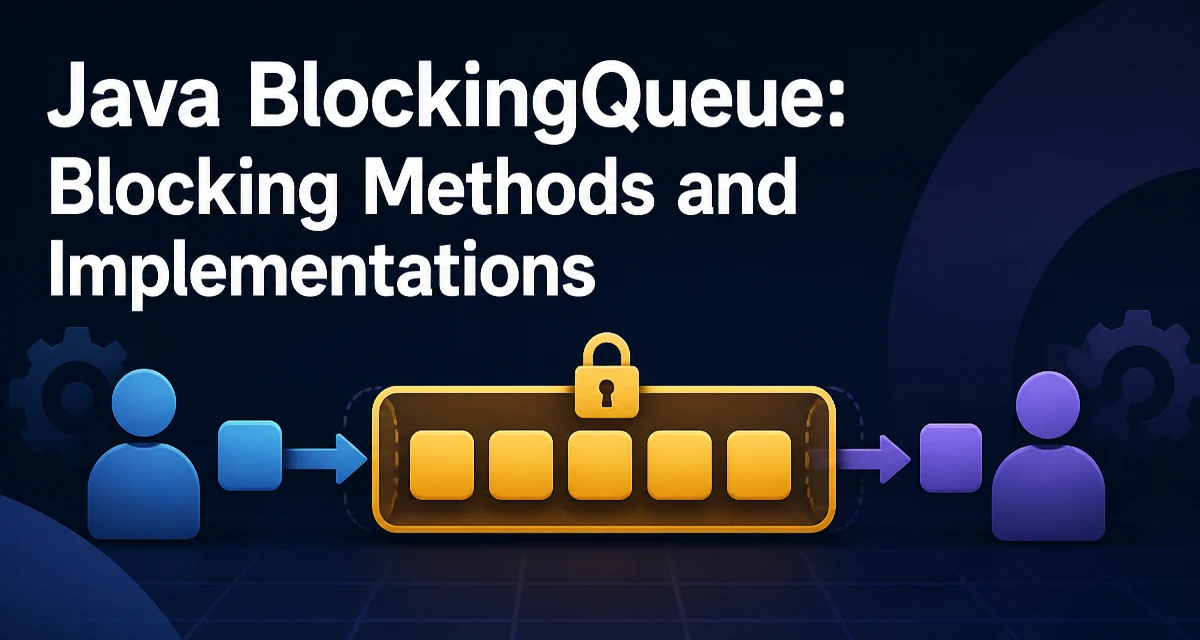
java blockingqueue requires a clear understanding of the core syntax, runtime behavior, and practical implementation patterns demonstrated in the examples below.
Java's BlockingQueue interface, part of java.util.concurrent, is the standard abstraction for thread-safe producer-consumer coordination. Unlike a plain Queue, BlockingQueue adds blocking operations: put blocks when the queue is full, and take blocks when it is empty. This makes it straightforward to build robust concurrent pipelines without hand-rolled waiting loops.
How BlockingQueue's Blocking Methods Work
The interface defines four families of operations, each with a different behavior when the queue is full or empty:
put(e)waits until space is available, then inserts the element.take()waits until an element is available, then removes and returns it.offer(e, timeout, unit)attempts to insert, waiting up to the specified timeout before giving up.poll(timeout, unit)attempts to remove, waiting up to the specified timeout before returningnull.
These methods are the core of BlockingQueue's usefulness. For example, a producer can call put without worrying about the consumer's speed, and a consumer can call take without busy-waiting. The queue itself handles the synchronization.
BlockingQueue<String> queue = new ArrayBlockingQueue<>(10);

// Producer thread
new Thread(() -> {
    try {
        queue.put("item");
    } catch (InterruptedException e) {
        Thread.currentThread().interrupt();
    }
}).start();

// Consumer thread
new Thread(() -> {
    try {
        String item = queue.take();
        System.out.println(item);
    } catch (InterruptedException e) {
        Thread.currentThread().interrupt();
    }
}).start();
The InterruptedException must be handled because blocking methods release the lock and re-assert the thread's interrupt status when interrupted. The standard pattern is to restore the interrupt flag and let the thread exit cleanly.
Choosing Between ArrayBlockingQueue and LinkedBlockingQueue
The two most common implementations are ArrayBlockingQueue and LinkedBlockingQueue. Both are thread-safe and support the full BlockingQueue interface, but they differ in capacity handling and internal structure.
ArrayBlockingQueue is a fixed-capacity, array-backed queue. It uses a single lock for both enqueue and dequeue operations, which simplifies the implementation but can limit throughput when both ends are heavily contended. It also supports an optional fairness policy that, when enabled, hands out permits in FIFO order, reducing starvation at the cost of some throughput.
LinkedBlockingQueue is optionally bounded. If you construct it without a capacity, it behaves as an unbounded queue. Internally it uses two locks: one for the head and one for the tail. This allows a producer and a consumer to operate concurrently without contending on the same lock, which often yields higher throughput in multi-core scenarios.
| Feature | ArrayBlockingQueue | LinkedBlockingQueue |
|---|---|---|
| Capacity | Fixed at construction | Bounded or unbounded |
| Locking | Single lock for both ends | Separate locks for head and tail |
| Fairness option | Yes | No |
| Memory footprint | Preallocated array | Node objects per element |
| Throughput under contention | Lower due to single lock | Higher with multiple threads |
Choose ArrayBlockingQueue when you need a strict capacity limit and want to avoid per-element allocation. Choose LinkedBlockingQueue when you expect high concurrency between producers and consumers, or when an unbounded queue is acceptable for your workload.
When to Use PriorityBlockingQueue, SynchronousQueue, and DelayQueue
Beyond the basic two, Java provides specialized BlockingQueue implementations for specific scenarios.
PriorityBlockingQueue is an unbounded queue that orders elements by their natural ordering or a custom Comparator. It is useful when consumers must process the highest-priority items first, such as in a task scheduler. Because it is unbounded, put never blocks, but take still blocks when the queue is empty.
SynchronousQueue is a special queue with zero capacity. Each put must wait for a matching take, and vice versa. This is not a buffer; it is a handoff mechanism. It is useful when you want to pass work directly from producer to consumer without intermediate storage, often combined with a thread pool.
DelayQueue holds elements that implement Delayed. An element can only be taken after its delay has expired. This is useful for scheduling tasks with a future execution time, such as retry queues or session timeouts.
// PriorityBlockingQueue with a comparator
BlockingQueue<Task> queue = new PriorityBlockingQueue<>(10,
    Comparator.comparingInt(Task::priority));
Each implementation exists to solve a different coordination problem. Choosing the right one depends on whether you need ordering, buffering, or delayed delivery.
Handling Interruptions and Timeouts
Blocking operations throw InterruptedException when the waiting thread is interrupted. This is a signal that the thread should stop what it is doing and clean up. The correct response is to restore the interrupt flag and exit the method or loop, not to swallow the exception.
try {
    queue.put(item);
} catch (InterruptedException e) {
    Thread.currentThread().interrupt();
    // handle cleanup, then return or throw a runtime exception
}
Timed operations like offer and poll return a boolean or an element, respectively, when the timeout expires. They do not throw an exception on timeout. This makes them suitable for non-blocking shutdown sequences, where a worker thread should periodically check a shutdown flag.
String item = queue.poll(1, TimeUnit.SECONDS);
if (item == null) {
    // no work available, check shutdown flag
}
A common mistake is to ignore the timeout result and assume the operation succeeded. Always check the return value of offer and poll to decide whether to retry or take alternative action.
Memory and Performance Tradeoffs
The blocking behavior itself has a runtime cost. Each put or take involves acquiring a lock, checking the condition, and possibly suspending the thread. The queue's internal data structure also affects memory usage.
ArrayBlockingQueue allocates its backing array once, so it has a predictable memory footprint. LinkedBlockingQueue allocates a new node for each element, which adds overhead but also allows the queue to grow dynamically when unbounded. PriorityBlockingQueue uses a heap structure that reorders on every insertion and removal, adding logarithmic time complexity.
Fairness is another performance factor. When fairness is enabled on an ArrayBlockingQueue, threads are served in arrival order, which prevents starvation but increases the overhead of each operation because the lock must track ordering. In most throughput-sensitive systems, the default non-fair mode is preferable.
There is no universal best implementation. The right choice depends on the expected concurrency level, the need for boundedness, and the ordering requirements of your application.
Common Pitfalls in Producer-Consumer Code
One frequent error is using offer without a timeout in a producer loop. If the queue is full, offer returns false immediately, and the producer may spin or drop items. Use put when you need guaranteed delivery, or offer with a timeout when you want to back off.
Another pitfall is using an unbounded queue without considering memory. An unbounded LinkedBlockingQueue or PriorityBlockingQueue can grow without limit if the producer outpaces the consumer, eventually exhausting memory. Always prefer a bounded queue in production unless you have a separate mechanism to bound the input rate.
Interrupt handling is often mishandled. Catching InterruptedException and ignoring it leaves the thread in an interrupted state, which can cause problems later. Always restore the interrupt flag.
Finally, do not confuse add and remove from the Collection interface with the blocking methods. add throws an exception when the queue is full, and remove throws when the queue is empty. Use offer and poll for non-blocking alternatives, and put and take for blocking behavior.
A Minimal Producer-Consumer Example
The following example shows a complete producer-consumer setup using a bounded ArrayBlockingQueue. It demonstrates how to start two threads, handle interruptions, and shut down cleanly.
import java.util.concurrent.ArrayBlockingQueue;
import java.util.concurrent.BlockingQueue;

public class ProducerConsumerExample {
    public static void main(String[] args) throws InterruptedException {
        BlockingQueue<Integer> queue = new ArrayBlockingQueue<>(5);

        Thread producer = new Thread(() -> {
            for (int i = 0; i < 20; i++) {
                try {
                    queue.put(i);
                    System.out.println("Produced: " + i);
                } catch (InterruptedException e) {
                    Thread.currentThread().interrupt();
                    return;
                }
            }
        });

        Thread consumer = new Thread(() -> {
            while (!Thread.currentThread().isInterrupted()) {
                try {
                    Integer value = queue.take();
                    System.out.println("Consumed: " + value);
                } catch (InterruptedException e) {
                    Thread.currentThread().interrupt();
                }
            }
        });

        producer.start();
        consumer.start();

        producer.join();
        consumer.interrupt();
        consumer.join();
    }
}
The producer uses put to block when the queue is full. The consumer uses take to block when the queue is empty. After the producer finishes, the main thread interrupts the consumer to stop it. The consumer's loop checks the interrupt flag and exits cleanly.
This pattern scales to multiple producers and consumers. The queue's internal synchronization ensures that each element is processed exactly once, and the blocking methods prevent busy-waiting.
Monitoring BlockingQueue in Production
In a running application, you may need to observe queue behavior to diagnose bottlenecks. The BlockingQueue interface provides remainingCapacity() and size(), but these are not always accurate under concurrency. For monitoring, consider using a LinkedBlockingQueue with a custom offer and take wrapper that records metrics, or use a dedicated monitoring library.
A practical approach is to expose queue depth through a metrics endpoint. For example, you can periodically sample queue.size() and queue.remainingCapacity() and report them to a monitoring system. This helps you detect when the queue is consistently near full, indicating that producers are faster than consumers, or near empty, indicating the opposite.
Keep in mind that size() on a BlockingQueue is not an atomic operation; it may traverse the queue and give a slightly stale value. For most monitoring purposes this is acceptable, but do not rely on it for precise coordination logic.