Java Collection vs Stream: Choosing the Right API
java collection vs stream: Understand the differences between Java collections and streams, including eager vs lazy evaluation, mutability, and when to use each API.
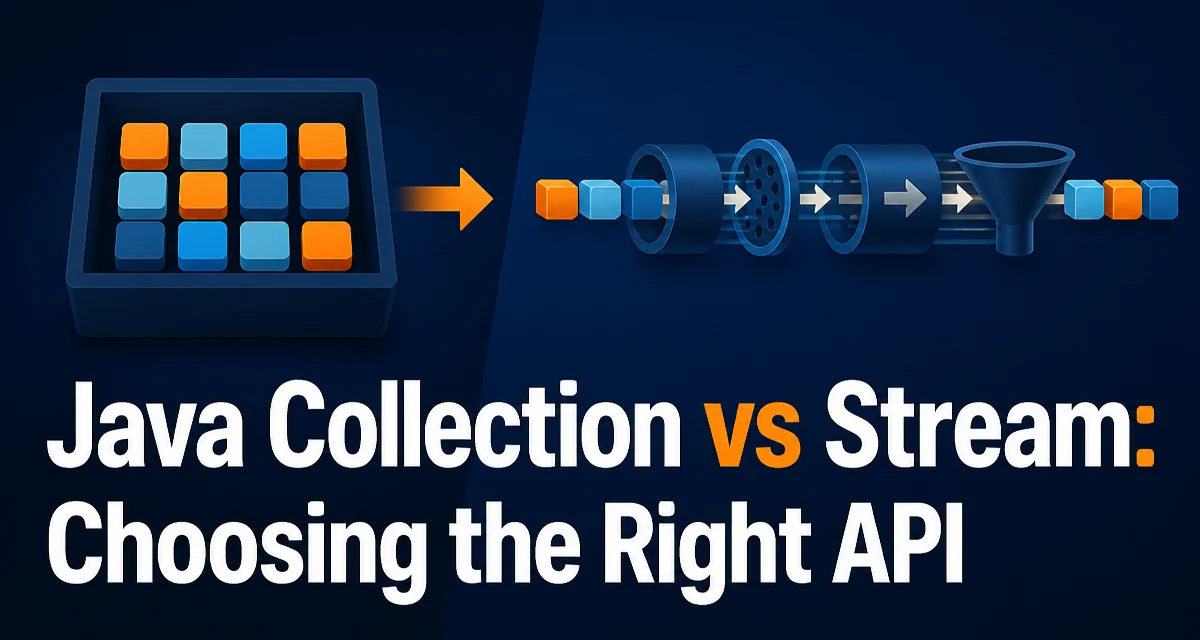
When deciding between java collection vs stream, the choice is not about one replacing the other. A collection is a data structure that holds elements; a stream is a sequence of elements that supports functional-style operations. They serve different purposes, and understanding the distinction changes how you design data pipelines.
The Core Difference: Eager vs Lazy Evaluation
A collection is eagerly materialized. When you add an element to an ArrayList, it occupies memory immediately. A stream, by contrast, is a lazily evaluated pipeline. Intermediate operations like filter and map do not execute until a terminal operation such as collect or forEach is called.
List<String> names = List.of("alice", "bob", "carol");

// Collection: eager, all elements stored
List<String> upper = new ArrayList<>();
for (String name : names) {
    upper.add(name.toUpperCase());
}

// Stream: lazy, no processing until collect()
List<String> upperStream = names.stream()
        .map(String::toUpperCase)
        .collect(Collectors.toList());
In the stream version, map does not transform anything at the moment it is called. The pipeline is built, and only when collect executes does the transformation happen. This lazy behavior enables short-circuiting: findFirst, limit, and anyMatch can stop processing early, which is impossible with a fully materialized collection.
Mutability and Reuse
Collections are mutable and reusable. You can add, remove, and iterate over them multiple times. Streams are one-shot. Once a terminal operation is invoked, the stream is consumed and cannot be reused. Attempting to call a second terminal operation on the same stream throws IllegalStateException.
Stream<String> stream = names.stream();
stream.forEach(System.out::println);
// Throws IllegalStateException: stream has already been operated upon or closed
stream.forEach(System.out::println);
This constraint is not a flaw; it reflects the design that a stream represents a single pass over data. If you need to process the same data more than once, you must either create a new stream from the original collection or collect the results into a collection first.
Code Readability and Functional Style
Streams promote a declarative style that often reads more clearly than nested loops. Consider grouping names by their first letter:
// Imperative with collection
Map<Character, List<String>> byLetter = new HashMap<>();
for (String name : names) {
    char first = name.charAt(0);
    byLetter.computeIfAbsent(first, k -> new ArrayList<>()).add(name);
}

// Functional with stream
Map<Character, List<String>> byLetterStream = names.stream()
        .collect(Collectors.groupingBy(name -> name.charAt(0)));
The stream version expresses the grouping logic without the boilerplate of computeIfAbsent and mutation. This readability advantage grows with the complexity of the pipeline: chaining filter, map, sorted, and collect is usually more maintainable than a series of nested loops with temporary variables.
However, streams are not always clearer. A simple for loop with a few lines of logic can be easier to debug because it has no lambda indirection. The choice is a tradeoff between conciseness and explicitness.
Performance Considerations
Performance is a common concern when comparing collections and streams. The lazy nature of streams can reduce work through short-circuiting. For example, finding the first element that matches a predicate does not process the entire collection:
Optional<String> firstLong = names.stream()
        .filter(name -> name.length() > 4)
        .findFirst();
This pipeline stops after the first match. An imperative loop would also stop early, so the advantage is not automatic. The overhead of streams comes from allocating stream objects, lambdas, and sometimes intermediate state. For small collections, this overhead can outweigh the benefits. For large collections with complex pipelines, streams can be competitive, especially with parallelStream() on multi-core machines, though parallel execution introduces its own coordination costs.
There is no universal rule. The underlying mechanism is that streams add a layer of abstraction over iteration. If you are doing a simple transformation on a list of a few hundred elements, a direct loop is likely faster. If you are processing millions of elements with multiple filters and a reduction, streams can be efficient because they avoid intermediate collections and allow the JVM to optimize the pipeline.
Choosing Between Collection and Stream
Use a collection when you need to store data, access elements by index, or modify the the structure over time. Collections are the source of truth for data. Use a stream when you need to to transform, filter, or aggregate data in a single pass, especially when you do not need to keep the intermediate results.
| Criterion | Collection | Stream |
|---|---|---|
| Storage | Yes, holds elements | No, transient |
| Reusability | Multiple iterations | Single use |
| Mutability | Mutable (or immutable) | Not mutable |
| Evaluation | Eager | Lazy |
| Random access | Yes (List, Map) | No |
| Best fit | Data storage and manipulation | Data processing pipelines |
If you need to pass data to multiple methods or iterate several times, start with a collection. If you are performing a one-off transformation and then discarding the result, a stream is natural.
Common Pitfalls and Edge Cases
One common pitfall is reusing a stream. Always create a new stream from a collection when you need to process it again. Another is relying on side effects inside stream operations. Streams are designed to be stateless; mutating an external variable in a map or forEach can lead to unpredictable results, especially with parallel streams.
// Bad: side effect in stream
List<String> result = new ArrayList<>();
names.stream()
        .filter(name -> name.startsWith("a"))
        .forEach(result::add); // Avoid; use collect() instead
Prefer collect to accumulate results. Also be aware that streams can be infinite. Operations like iterate and generate create unbounded streams; you must use limit to bound them, otherwise a terminal operation will run forever.
Stream.iterate(0, n -> n + 1)
        .limit(10)
        .forEach(System.out::println);
Finally, null handling differs. Collections allow null elements, but many stream operations throw NullPointerException if they encounter null during processing. If your data may contain null, filter them out explicitly or use Optional where appropriate.