Using Java ConcurrentLinkedQueue for Lock-Free Thread-Safe Queues
java concurrentlinkedqueue: Learn how to use Java's ConcurrentLinkedQueue for lock-free, thread-safe queue operations, including iteration, performance tradeoffs, and...
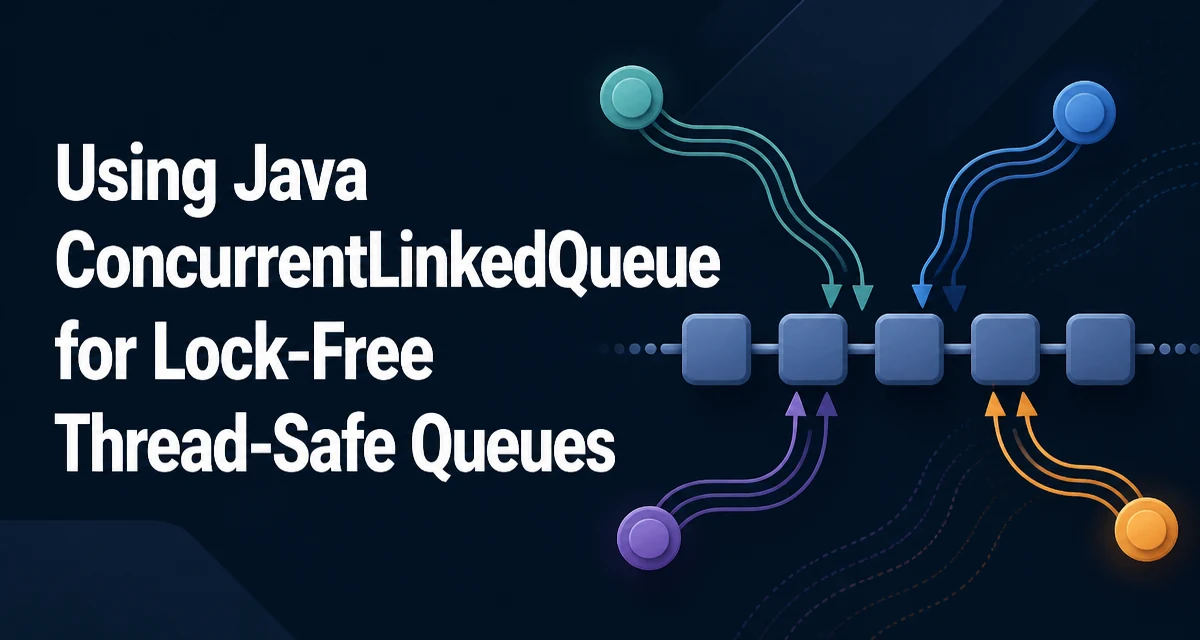
java concurrentlinkedqueue requires a clear understanding of the core syntax, runtime behavior, and practical implementation patterns demonstrated in the examples below.
When you need a thread-safe queue in Java without blocking, ConcurrentLinkedQueue is often the right choice. This class implements the Queue interface using a lock-free, linked-node structure, making it suitable for high-concurrency scenarios where multiple threads produce and consume elements without waiting on each other. Unlike blocking queues, it never blocks a thread; operations either succeed immediately or retry internally using compare-and-set (CAS) loops. This article explains how java concurrentlinkedqueue works, how to use it correctly, and where its tradeoffs matter.
Understanding the Lock-Free Thread-Safety Model
ConcurrentLinkedQueue achieves thread safety without explicit locks. Internally, it uses atomic operations on node references, relying on the sun.misc.Unsafe or java.util.concurrent.atomic primitives to update head and tail pointers. The algorithm is based on Michael and Scott's lock-free queue design, which allows multiple threads to enqueue and dequeue concurrently without contention on a single lock.
Because no thread is ever blocked, there is no risk of deadlock or priority inversion. However, this also means that operations do not support waiting for elements to become available. If a consumer tries to poll an empty queue, it immediately returns null. This is a fundamental difference from blocking queues like LinkedBlockingQueue, where take() waits until an element appears.
Basic Usage: Adding and Removing Elements
Creating a ConcurrentLinkedQueue is straightforward. The class has two constructors: one that creates an empty queue, and one that accepts a Collection to initialize the queue with existing elements.
ConcurrentLinkedQueue<String> queue = new ConcurrentLinkedQueue<>();

// Add elements
queue.offer("first");
queue.add("second"); // add() is equivalent to offer() for this queue

// Remove and return the head
String head = queue.poll(); // returns "first"

// Peek without removing
String peeked = queue.peek(); // returns "second"
The offer and add methods are functionally identical for this class; both insert an element at the tail. The poll method removes and returns the head, or null if the queue is empty. peek returns the head without removing it, also returning null for an empty queue.
Unlike LinkedList, ConcurrentLinkedQueue does not allow null elements. Attempting to add null throws a NullPointerException. This is a deliberate design choice to avoid ambiguity in methods like poll and peek, where null indicates an empty queue.
Iteration and Weakly Consistent Iterators
The iterators returned by ConcurrentLinkedQueue are weakly consistent. This means they do not throw ConcurrentModificationException if the queue is modified during iteration, and they may or may not reflect elements added or removed after the iterator was created. The iterator is guaranteed to traverse elements that were present at the moment the iterator was constructed, but it may also see elements added later, depending on timing.
ConcurrentLinkedQueue<Integer> numbers = new ConcurrentLinkedQueue<>();
numbers.add(1);
numbers.add(2);

Iterator<Integer> it = numbers.iterator();
numbers.add(3); // modification after iterator creation

while (it.hasNext()) {
    System.out.println(it.next()); // may print 1, 2, and possibly 3
}
This behavior is useful for snapshot-like traversal in concurrent environments where you want to avoid locking the entire queue. However, if you need a consistent snapshot at a specific point in time, you should copy the queue into a separate collection first.
Comparing ConcurrentLinkedQueue with Other Queue Implementations
Choosing the right queue depends on your concurrency requirements and whether blocking is acceptable. The table below highlights key differences.
| Implementation | Blocking Behavior | Thread Safety | Capacity | Use Case |
|---|---|---|---|---|
ConcurrentLinkedQueue | Non-blocking | Lock-free | Unbounded | High-throughput, non-blocking producer-consumer |
LinkedBlockingQueue | Blocking on take/put | Lock-based | Optional bounded | Producer-consumer with backpressure |
ArrayBlockingQueue | Blocking on take/put | Lock-based | Bounded | Bounded buffer with fixed capacity |
ConcurrentLinkedDeque | Non-blocking | Lock-free | Unbounded | Double-ended operations |
ConcurrentLinkedQueue is ideal when you need maximum throughput and can tolerate consumers that must poll for new elements rather than waiting. If you need a blocking take() that waits for data, use LinkedBlockingQueue or ArrayBlockingQueue. If you need a bounded queue to prevent memory exhaustion, ArrayBlockingQueue is a better fit.
Performance Characteristics and Memory Behavior
Because ConcurrentLinkedQueue uses CAS operations, it generally performs well under high contention, but it is not always the fastest choice for low-contention scenarios. The lock-free algorithm avoids the overhead of acquiring and releasing locks, but each operation involves multiple atomic reads and writes. For very small queues or low concurrency, a simple ArrayList with external synchronization might be faster, but it would not scale as well.
One important performance caveat is the size() method. Unlike LinkedList, ConcurrentLinkedQueue does not maintain a size counter because doing so would require atomic updates on every modification, which is expensive. Instead, size() traverses the entire queue to count elements, making it an O(n) operation. Calling size() frequently in a loop can degrade performance significantly. If you need an approximate count, consider maintaining your own AtomicInteger and updating it alongside queue operations, but be aware that it may not be perfectly synchronized.
Memory usage is another consideration. Each element is wrapped in a node object with two references (next and item), adding overhead compared to an array-backed queue. For queues holding many small objects, this overhead can be substantial. However, the linked structure allows constant-time insertion and removal at both ends without shifting elements.
Common Pitfalls and Usage Considerations
A frequent mistake is expecting ConcurrentLinkedQueue to block when the queue is empty. Since it is non-blocking, poll() returns null immediately. If your consumer needs to wait for elements, you must implement your own waiting logic, such as a loop with Thread.sleep or using a Semaphore. Alternatively, switch to a blocking queue.
Another pitfall is relying on size() for control flow. Because size() is O(n), using it to decide whether to poll can cause race conditions. For example, checking if (!queue.isEmpty()) { queue.poll(); } is not atomic; another thread could remove the element between the check and the poll. Instead, simply call poll() and handle the null result.
Also note that ConcurrentLinkedQueue is not a Deque; it only supports FIFO ordering. If you need LIFO or double-ended access, look at ConcurrentLinkedDeque or other concurrent deque implementations.
When to Choose ConcurrentLinkedQueue
Select ConcurrentLinkedQueue when your application requires a thread-safe, unbounded queue with non-blocking semantics. Typical use cases include:
- Work queues where producers add tasks and consumers poll for work without waiting.
- Event delivery systems where multiple threads publish events and one or more threads process them.
- Situations where blocking could cause deadlock or where you need to avoid thread suspension.
Avoid it when you need bounded capacity, blocking operations, or when you need a consistent snapshot for iteration. In those cases, a blocking queue or a synchronized collection with explicit locking is more appropriate.
For most high-throughput, non-blocking producer-consumer scenarios, ConcurrentLinkedQueue provides a solid balance of scalability and simplicity. Understanding its lock-free nature and its tradeoffs will help you use it effectively without falling into common concurrency traps.