Java Deque Interface: Operations and Implementations
java deque interface: Understand the Java Deque interface: its methods, ArrayDeque and LinkedList implementations, and how to use it for stacks and queues efficiently.
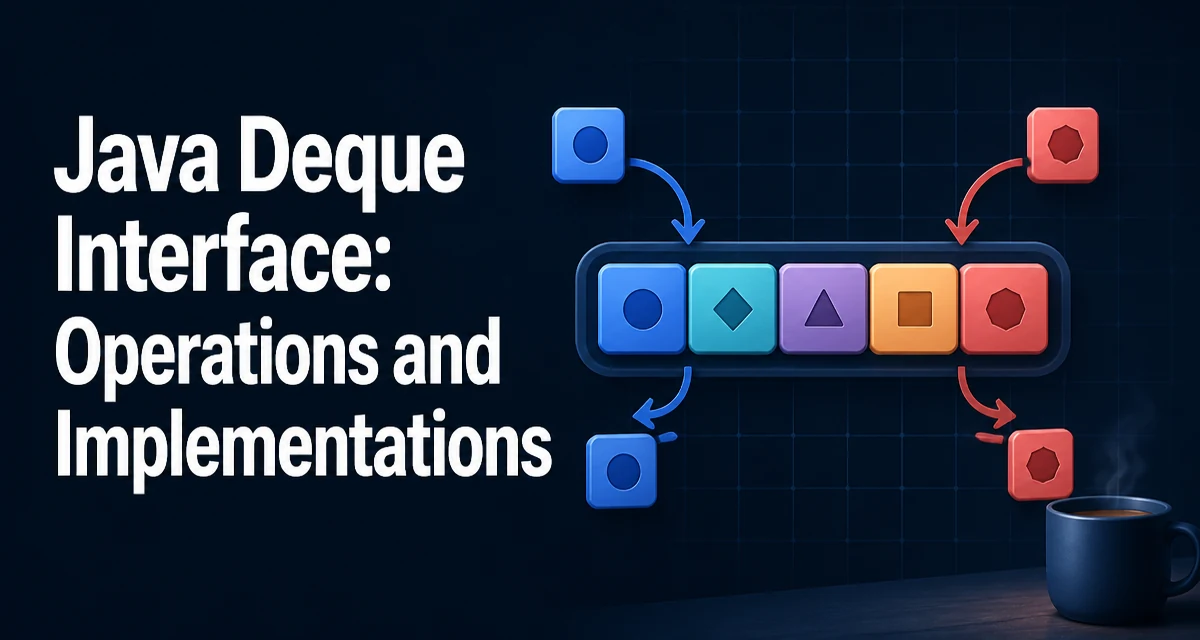
java deque interface requires a clear understanding of the core syntax, runtime behavior, and practical implementation patterns demonstrated in the examples below.
The java.util.Deque interface extends Queue and represents a double-ended queue that supports element insertion and removal at both ends. It is the foundation for implementing stacks, queues, and more flexible data structures in Java. Unlike a single-ended Queue, a Deque can act as both a FIFO queue and a LIFO stack, giving developers a single API for both patterns.
The interface defines methods for adding, removing, and inspecting elements at the head and tail. These methods come in two variants: one that throws an exception when the operation fails, and one that returns a special value (null or false) instead. This design mirrors the Queue interface and gives you control over error handling.
Core Operations: Adding and Removing at Both Ends
The Deque interface provides a rich set of operations. The addFirst and addLast methods insert elements at the front and back, respectively. Their offerFirst and offerLast counterparts return false instead of throwing when the deque is capacity-constrained (though most implementations are unbounded). For removal, removeFirst and removeLast throw NoSuchElementException on an empty deque, while pollFirst and pollLast return null. To inspect elements without removing them, use getFirst/getLast (throwing) or peekFirst/peekLast (returning null).
Here is a basic example using an ArrayDeque:
import java.util.ArrayDeque;
import java.util.Deque;

Deque<String> deque = new ArrayDeque<>();
deque.addFirst("first");
deque.addLast("last");

System.out.println(deque.getFirst()); // prints "first"
System.out.println(deque.getLast());  // prints "last"

deque.removeFirst();
deque.removeLast();
The choice between throwing and non-throwing methods depends on whether you expect the deque to be empty or full during normal operation. In typical application code, the poll and peek variants are safer because they avoid exception overhead when the deque is empty.
Using Deque as a Stack
The Deque interface includes stack-specific methods: push (adds to the head), pop (removes from the head), and peek (inspects the head). These methods are equivalent to addFirst, removeFirst, and peekFirst, respectively. This makes ArrayDeque a natural replacement for the legacy Stack class, which is synchronized and slower.
Deque<Integer> stack = new ArrayDeque<>();
stack.push(10);
stack.push(20);
stack.push(30);

System.out.println(stack.pop()); // 30
System.out.println(stack.peek()); // 20
Because ArrayDeque is not synchronized, it avoids the overhead of the Stack class's built-in locking. In single-threaded code, using ArrayDeque as a stack is both faster and more flexible.
Using Deque as a Queue
A Deque can also function as a FIFO queue. The standard pattern is to add elements at the tail with addLast or offerLast, and remove them from the head with removeFirst or pollFirst. This is equivalent to using a Queue implementation, but gives you the option to switch to LIFO behavior without changing the collection type.
Deque<String> queue = new ArrayDeque<>();
queue.addLast("task1");
queue.addLast("task2");
queue.addLast("task3");

while (!queue.isEmpty()) {
    System.out.println(queue.pollFirst());
}
This pattern is useful when you need to occasionally process elements in reverse order, or when you want to add elements to the front for priority-like behavior. The same Deque object can be used for both stack and queue semantics, which reduces the number of collection types you need to manage.
ArrayDeque vs LinkedList: Which Implementation to Choose
The two most common implementations of Deque are ArrayDeque and LinkedList. Both support the full Deque API, but they have different performance and memory profiles.
| Characteristic | ArrayDeque | LinkedList |
|---|---|---|
| Underlying structure | Resizable array | Doubly linked list |
| Null elements | Not allowed | Allowed |
| Memory overhead | Lower (contiguous array) | Higher (node objects) |
| Cache locality | Better | Worse |
| Add/remove at ends | O(1) amortized | O(1) |
| Thread safety | Not thread-safe | Not thread-safe |
ArrayDeque is generally the better default because it uses a contiguous array, which improves cache locality and reduces memory fragmentation. It also does not allocate a separate node object for each element, so it uses less memory overall. The only significant limitation is that it does not permit null elements. If you need to store null values, LinkedList is the only standard Deque implementation that allows it.
Performance and Memory Characteristics
The performance of Deque operations depends on the implementation. Both ArrayDeque and LinkedList offer O(1) time for adding and removing elements at either end. However, the constant factors differ. ArrayDeque uses a circular array that grows when full, so most addFirst and addLast operations are simple array writes. When the array needs to grow, the entire contents are copied to a new array, which is an O(n) operation. This happens rarely, so the amortized cost remains O(1).
LinkedList allocates a new node for each insertion and updates references. This incurs higher per-operation cost due to memory allocation and pointer dereferencing. Additionally, linked lists have poor cache locality because nodes are scattered in memory. For large deques, ArrayDeque typically outperforms LinkedList in both time and memory usage.
Thread Safety and Concurrency Considerations
Neither ArrayDeque nor LinkedList is thread-safe. If multiple threads access the same deque concurrently, you must synchronize access externally or use a concurrent implementation. The Java standard library provides ConcurrentLinkedDeque, which is a thread-safe, lock-free implementation of Deque designed for concurrent access. It is suitable when you need a double-ended queue in a multithreaded context.
Alternatively, you can wrap a non-thread-safe deque with Collections.synchronizedDeque, but this requires external synchronization when iterating, as the returned collection is only synchronized for individual method calls. For most concurrent scenarios, ConcurrentLinkedDeque is the better choice because it uses non-blocking algorithms and does not require explicit locking.
Common Pitfalls When Using Deque
One common mistake is assuming that all Deque implementations accept null elements. ArrayDeque throws NullPointerException if you attempt to add null. This is intentional because null is used as a sentinel value by the poll and peek methods to indicate an empty deque. If you need to store null, use LinkedList or a different data structure.
Another pitfall is confusing the stack methods with the queue methods. The push method adds to the head, while addLast adds to the tail. If you mix them without careful thought, you may end up with unexpected ordering. Always be explicit about which end you are operating on.
Finally, remember that removeFirst and removeLast throw exceptions on an empty deque, while pollFirst and pollLast return null. In performance-sensitive code, the exception path is costly, so prefer the poll and peek variants when you expect the deque to be empty.