Java element vs peek: Queue Head Retrieval Compared
java element vs peek: Compare Java Queue element() and peek() methods, including empty-queue behavior, null handling, and when to choose each approach.
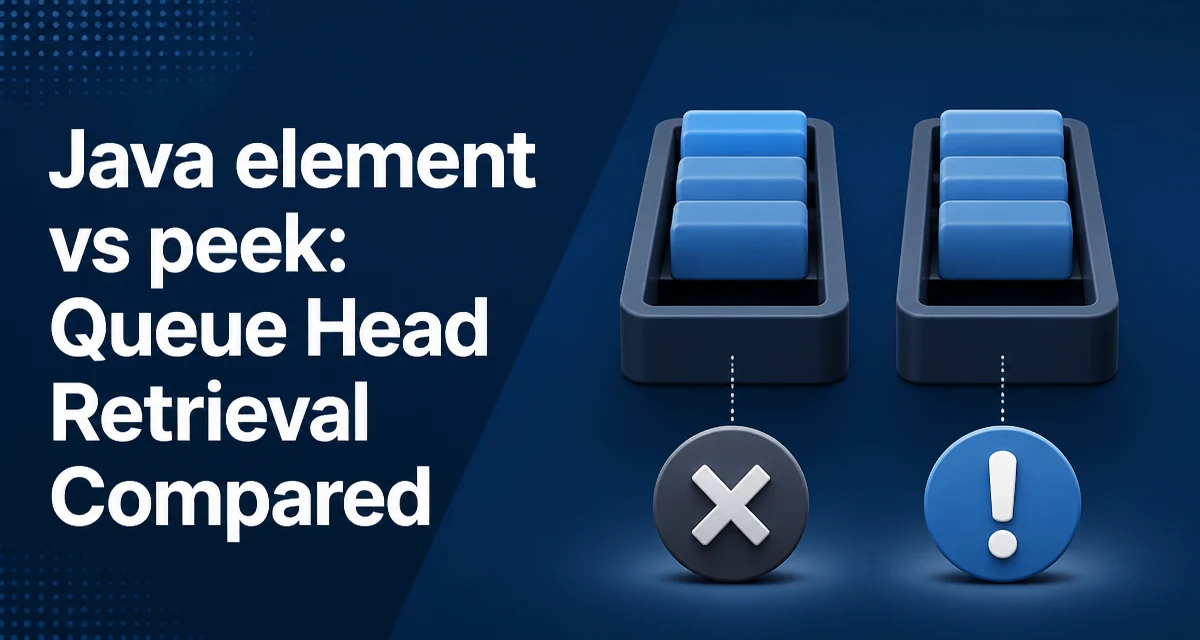
java element vs peek requires a clear understanding of the core syntax, runtime behavior, and practical implementation patterns demonstrated in the examples below.
The Core Difference Between element() and peek()
element() and peek() are both methods on the Queue interface in Java. They serve the same primary purpose: returning the head of the queue without removing it. The difference is in how they handle an empty queue. peek() returns null when the queue has no elements, while element() throws NoSuchElementException.
This single behavioral difference determines which method you should use in a given situation, and it also explains why both methods exist in the API.
What Both Methods Return on a Non-Empty Queue
When the queue contains at least one element, element() and peek() are functionally identical. Both return the head of the queue, and neither removes it.
Queue<String> queue = new LinkedList<>();
queue.add("first");
queue.add("second");

String fromPeek = queue.peek();
String fromElement = queue.element();

System.out.println(fromPeek);    // first
System.out.println(fromElement); // first
System.out.println(queue.size()); // 2
The queue still contains both elements after either call. If you need to retrieve and remove the head, you would use poll() or remove() instead.
What Happens on an Empty Queue
The empty-queue behavior is where the two methods diverge.
Queue<String> empty = new LinkedList<>();

String result = empty.peek();     // null
String result2 = empty.element(); // throws NoSuchElementException
peek() returns null, which means the caller must check for null before using the result if the queue might legitimately be empty. element() throws an unchecked exception, so the caller does not need a null check but must handle the exception if an empty queue is a possible state.
Choosing Between element() and peek()
The choice comes down to whether an empty queue is an expected state or an exceptional condition.
Use peek() when the queue may legitimately be empty during normal operation. For example, a worker thread that checks a task queue before deciding whether to wait or process would treat null as a normal signal to block or retry.
String nextTask = taskQueue.peek();
if (nextTask == null) {
    // No work available; wait or continue
} else {
    // Process nextTask
}
Use element() when an empty queue indicates a programming error or an invalid state. If your code guarantees that the queue is non-empty at the point of the call, element() will surface a violation of that invariant immediately with a NoSuchElementException.
// Invariant: at least one pending request must exist
String nextRequest = requestQueue.element();
The exception is unchecked, so it will propagate without requiring a throws declaration, but it still fails fast when the invariant is broken.
Related Methods: poll() and remove()
element() and peek() are the inspection counterparts of remove() and poll(). The same empty-queue distinction applies.
| Method | Retrieves head | Removes head | Empty queue behavior |
|---|---|---|---|
peek() | Yes | No | Returns null |
element() | Yes | No | Throws NoSuchElementException |
poll() | Yes | Yes | Returns null |
remove() | Yes | Yes | Throws NoSuchElementException |
If you need to retrieve and remove the head in one operation, use poll() when null is an acceptable empty signal, or remove() when an empty queue is exceptional.
Performance and Runtime Behavior
For typical Queue implementations such as LinkedList, ArrayDeque, and PriorityQueue, both element() and peek() run in constant time. The difference between them is not a performance concern; it is a contract concern.
The real runtime consideration is the exception path. Throwing and catching NoSuchElementException is more expensive than returning null. If your code frequently calls element() on queues that are sometimes empty, the exception construction and stack trace capture add measurable overhead. In that scenario, peek() with a null check is the cheaper pattern because it avoids exception machinery entirely.
That said, you should not choose between the two based on performance alone. The cost of exception construction only matters when empty queues occur frequently. If an empty queue is truly exceptional, element() is the clearer contract and the rare exception cost is irrelevant.
Null Elements and Queue Implementations
A subtle point: peek() returning null can be ambiguous if the queue implementation allows null elements. Most Queue implementations in the Java Collections Framework, including LinkedList, permit null elements. If your queue can contain null, then peek() returning null does not tell you whether the queue is empty or whether the head is null.
Queue<String> queue = new LinkedList<>();
queue.add(null);

String head = queue.peek(); // null, but the queue is not empty
In this case, element() is the safer choice because it distinguishes an empty queue from a queue whose head is null. If you need to support null elements and distinguish emptiness, check isEmpty() before calling peek(), or use element() and catch the exception.
Production Considerations
In production code, the choice between element() and peek() affects how failures surface. element() produces an immediate, descriptive exception when an invariant is violated. peek() produces a null that may propagate silently through the code until a later NullPointerException occurs at a location that is harder to trace.
If you are writing a library or service where callers may not read the documentation, prefer element() when an empty queue is a contract violation. The exception is self-documenting. If callers are expected to handle the empty state as a normal branch, peek() keeps the control flow explicit and avoids exception-handling code in the common path.
The same reasoning applies when you choose between remove() and poll() for removal operations. Consistency across the pair matters: if you use peek() for inspection, poll() is the natural removal counterpart, and if you use element(), remove() matches it.