Java Else If Statement Guide
java else if statement: Learn how the Java else if statement evaluates conditions in order, how to avoid common pitfalls, and when switch or polymorphism is a better c...
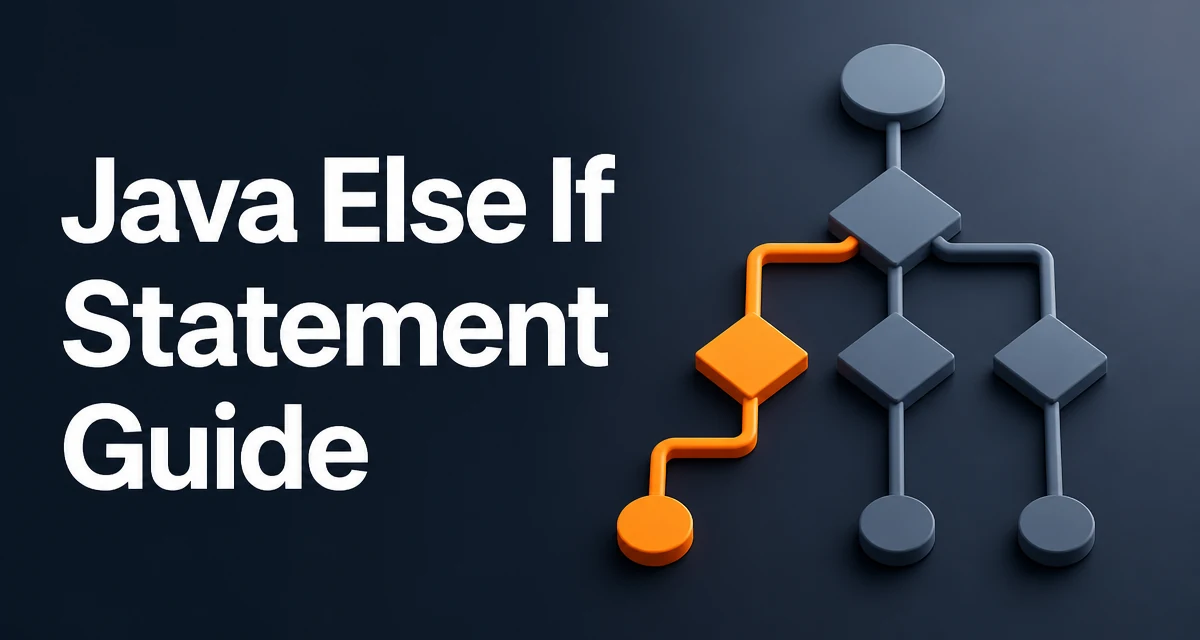
The Java else if statement is the standard way to evaluate multiple mutually exclusive conditions in sequence. It is not a separate keyword: else if is an else clause followed by a new if statement. The runtime evaluates each condition from top to bottom and executes the first block whose condition is true. Once a block runs, the rest of the chain is skipped, which makes the order of conditions significant for both correctness and runtime cost.
How the Runtime Evaluates an Else If Chain
Consider a simple classification method:
public String classify(int score) {
    if (score >= 90) {
        return "A";
    } else if (score >= 80) {
        return "B";
    } else if (score >= 70) {
        return "C";
    } else {
        return "F";
    }
}
The conditions are tested one at a time. For a score of 85, the first condition fails, the second passes, and execution returns "B". For a score of 50, all three conditions fail and the final else runs. Because evaluation stops at the first match, you can rely on earlier conditions to narrow the domain. That lets you write simpler conditions rather than spelling out every bound, as in score >= 90 followed by score >= 80 instead of score >= 80 && score < 90.
This behavior has a direct cost: a chain with many branches may require several condition evaluations before finding a match. When the number of branches is small, the cost is negligible. When the chain grows large, the linear scan can become a performance concern, especially if the conditions are expensive, such as method calls or complex pattern matches.
When Ordering Matters
In an else if chain, the order of conditions is part of the logic. Reordering can change the result. The classic mistake is checking a specific case after a general case that overlaps it. For example:
if (age >= 18) {
    // adult logic
} else if (age >= 65) {
    // senior logic - this never runs
}
The second condition is unreachable because every value that satisfies age >= 65 also satisfies age >= 18. The senior branch never executes. To fix it, put the more specific condition first:
if (age >= 65) {
    // senior logic
} else if (age >= 18) {
    // adult logic
}
This principle extends to any overlapping conditions. When writing an else if chain, ask which condition is more restrictive and place it earlier. If two conditions are mutually exclusive, order does not affect correctness, but it may affect performance if one condition is cheaper to evaluate.
Braces and the Dangling Else Problem
Without braces, the else binds to the nearest unmatched if, which can lead to subtle bugs. The classic dangling else example looks like this:
if (condition)
    if (otherCondition)
        doA();
else
    doB();
Despite the indentation, the else belongs to the inner if, not the outer one. The code is actually parsed as:
if (condition) {
    if (otherCondition) {
        doA();
    } else {
        doB();
    }
}
If the developer intended the else to run when condition is false, this is wrong. Using braces for every if and else eliminates this ambiguity and makes the intention explicit. Professional code should always use braces with if statements, including one-liners, to avoid this class of error.
Nested Ifs vs. Else If Chains
Nested if statements check conditions independently, which allows different branches to run for different combinations. Else if chains guarantee that at most one branch executes. Consider a system that must handle both category and priority:
if (category.equals("A")) {
    if (priority == 1) {
        // high-priority A
    } else {
        // low-priority A
    }
} else {
    // category B or other
}
This is appropriate when branches are not mutually exclusive at every level. However, deeply nested ifs become hard to read and test. If the nesting goes beyond two levels, consider extracting each level into its own method or using a lookup structure. The else if chain is best when you have a single variable or condition that should be matched exactly once.
Common Mistakes With Else If Chains
Three mistakes appear frequently in real code. The first is using assignments instead of equality checks in conditions:
boolean active = false;
if (active = true) {
    // always true, and reassigns active
}
Using = assigns the value and always evaluates to true if the assigned value is truthy. For booleans, the expression active = true is always true. In Java, a condition must be a boolean expression, so accidental assignment is a compile error only if the types do not match. With boolean variables, it is a silent logic bug. Use == for comparison, or better, use the variable directly.
The second mistake is checking a condition that is always true or always false. If a condition does not depend on the input, the branch is dead code. Remove it to keep the logic clear.
The third mistake is an unreachable branch due to ordering, as covered above. Run a static analysis tool or write unit tests for boundary values to catch these cases.
Performance Considerations for Long Chains
The runtime cost of an else if chain is proportional to the number of conditions evaluated before a match. For a small number of branches, this is rarely a bottleneck. But if the chain contains dozens of branches or the conditions are expensive, the linear scan can become measurable. In such cases, consider alternatives:
- Use a
switchstatement or expression when the condition is a primitiveint,char,enum,String, or a boxed numeric type. The compiler may optimize certain switch forms into tables or jump operations. - Use a
Mapto replace the chain with a direct lookup when matching exact values. - Use polymorphism to replace the chain with dynamic dispatch when the branches correspond to different object types.
A Map example for exact matching:
Map<String, Runnable> actions = new HashMap<>();
actions.put("start", this::start);
actions.put("stop", this::stop);
actions.put("pause", this::pause);

actions.getOrDefault(command, this::defaultAction).run();
This approach changes the structure from a sequence of comparisons to a hash lookup, which is typically O(1). However, it only works when you are matching a single key exactly. It does not replace range checks.
When to Choose Switch Over Else If
The switch statement is a better choice than an else if chain when all of these conditions hold:
- The branching value is a single expression.
- The branches are selected by equality, not by range or custom logic.
- The number of branches is more than three or four.
Since Java 14, switch expressions provide a more compact syntax:
String result = switch (day) {
    case MONDAY, FRIDAY -> "work day";
    case SATURDAY, SUNDAY -> "weekend";
    default -> "midweek";
};
This eliminates the fall-through problem and the need for a temporary variable. However, switch cannot express range conditions. You cannot write case >= 80; for range checks, the else if chain is still necessary, or you can range-map values to a key before using switch.
An even more flexible approach is to use a NavigableMap for range lookups, but that adds the complexity of a map and is usually overkill unless the range set is large and changes frequently.
Maintainability and Readability Tradeoffs
Else if chains are straightforward to understand when the number of branches is small and the conditions are short. They become harder to maintain when the chain grows beyond a handful of branches or when the conditions are complex. In those cases, the chain becomes a long vertical block that is difficult to scan and test.
One pattern is to replace the chain with a set of guard methods, each checking a condition and returning an optional result. This is often called a chain of responsibility or a strategy pattern. For example:
class ScoreClassifier {
    private final List<Predicate<Integer>> conditions;

    ScoreClassifier(List<Predicate<Integer>> conditions) {
        this.conditions = conditions;
    }

    public Optional<String> classify(int score) {
        for (Predicate<Integer> condition : conditions) {
            if (condition.test(score)) {
                return Optional.of(...); // requires mapping
            }
        }
        return Optional.empty();
    }
}
This is more flexible but also more code. For most Java applications, a short else if chain is the most readable and maintainable option. Reserve more elaborate structures for cases where the chain is genuinely large or the conditions are supplied externally, such as a rules engine.
A practical decision rule: if the else if chain fits on one screen and each condition is a simple comparison, keep the chain. If the chain spans multiple screens or the conditions are complex Bolean expressions, refactor to a different structure.
The final consideration is testability. An else if chain is easy to test with boundary values. For each branch, test the exact boundary and a value just below it. This verifies both the ordering and the inclusivity of the comparisons. When you convert to a map or strategy, you need to test that the configuration maps correctly to the expected behavior. Choose the structure that matches the complexity of the logic, not the fashion of the day.
Handling Null and Empty Values
Conditions that call methods on values that might be null can throw NullPointerException. For example:
if (username.equals("admin")) {
    // NPE if username is null
}
To avoid this, either check for null first or reorder the condition to call equals on a literal:
if ("admin".equals(username)) {
    // safe, correct
}
This works because the literal is never null. In an else if chain, the order should place null checks before any method calls on the value. If a branch can only run when a value is non-null, add a guard at the top of the chain to filter out null inputs early.
Using Optional as a wrapper can also help, but Optional is not a silver bullet for all null issues. When an input can be null, decide explicitly what the chain should do: treat null as a default branch, or propagate a meaningful error. The else if chain gives you that control at each step.
Edge Cases in Comparisons
Floating-point comparisons are a common source of surprising behavior in Java. The == operator on double values may not behave as expected due to precision. When writing an else if chain that compares floating-point values, avoid exact equality. Use a tolerance range:
if (Math.abs(value - target) < 1e-9) {
    // close enough
}
For enum values, == works correctly and is preferred over equals. For String comparison, always use equals unless you deliberately want reference identity. When the chain compares a String against several literals, the literal-first pattern is robust against null.
The Role of the Terminal Else
An else if chain does not require a final else. Without it, the chain simply does nothing if no condition matches. This is valid but often hides missing logic. Unless the no-match case is intentionally inert, add an else that throws an exception or logs a warning. For example:
if (status == Status.ACTIVE) {
    // ...
} else if (status == Status.DISABLED) {
    // ...
} else {
    throw new IllegalArgumentException("Unknown status: " + status);
}
This ensures that an unexpected input is surfaced during development rather than silently ignored. In production code, a terminal else that throws is a good safeguard. It also documents the intent that the listed branches cover all expected cases.
Final Coding Pattern for Maintainable Else If Chains
To keep an else if chain maintainable, keep conditions pure (no side effects), use variable names that describe the condition, and keep the block bodies short. If a branch body is longer than a few lines, extract it into a named method. The chain itself should read like a decision table.
For example:
public String getDiscountMessage(Customer customer) {
    if (customer.isVip()) {
        return buildVipMessage(customer);
    } else if (customer.isReturning()) {
        return buildReturningMessage(customer);
    } else {
        return buildStandardMessage(customer);
    }
}
This pattern reads clearly and each branch delegates to a focused method. The chain remains easy to modify when a new customer type is added. This is the practical sweet spot for the Java else if statement: simple, readable, and testable for the majority of business logic.