Java Enum Ordinal: What It Returns and When to Avoid It
java enum ordinal: Learn what Java's enum ordinal() returns, why relying on it for persistence breaks, and when it is safe for ordering and EnumSet or EnumMap.
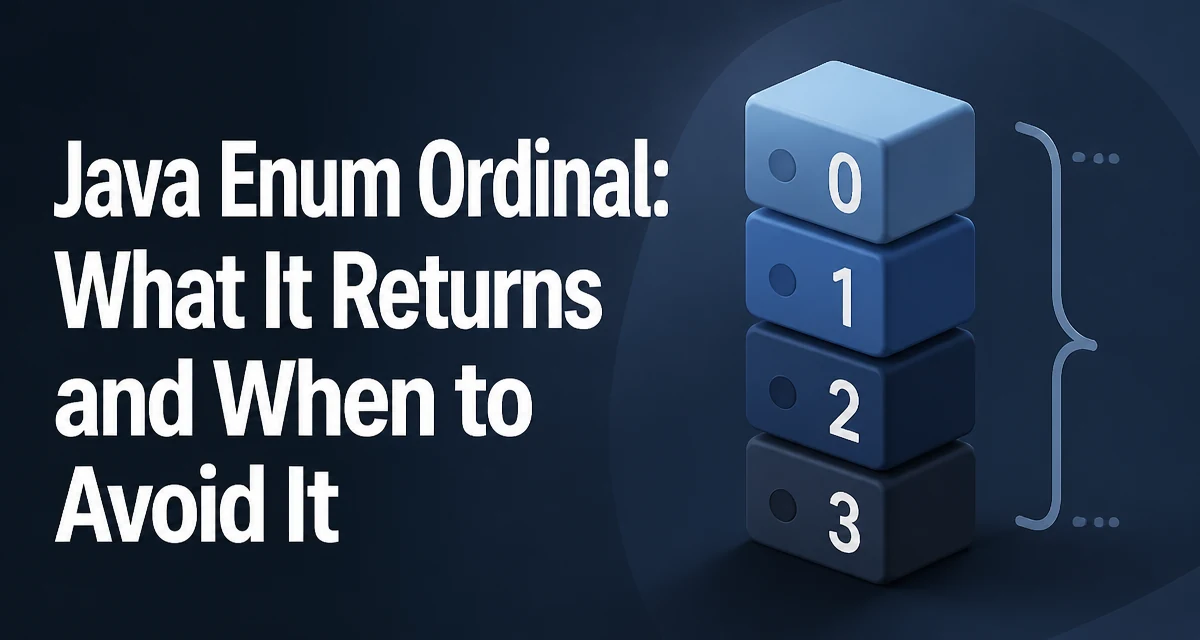
java enum ordinal requires a clear understanding of the core syntax, runtime behavior, and practical implementation patterns demonstrated in the examples below.
Every Java enum constant carries an implicit ordinal() value: the zero-based position of the constant in its declaration order. The first constant returns 0, the second returns 1, and so on. ordinal() is a final method on java.lang.Enum, so no enum type can override it. For a small enum this looks convenient, but the value is tied directly to source order, which creates real problems when enums are persisted, serialized, or reordered.
public enum Priority {
    LOW,      // ordinal 0
    MEDIUM,   // ordinal 1
    HIGH,     // ordinal 2
    URGENT    // ordinal 3
}

Priority p = Priority.HIGH;
System.out.println(p.ordinal()); // 2
How ordinal() Is Assigned
The JVM assigns ordinals at class initialization time, in the order the constants appear in the source file. The count starts at zero and increments by one for each constant. Because the method is final, you cannot change the mapping by overriding it, and the value is always derived from declaration order rather than from any semantic property of the constant.
This means the ordinal of a constant is not stable across source edits. Inserting a new constant in the middle of the declaration shifts the ordinals of every constant after it. Removing a constant shifts the ordinals of everything after it as well. The value is an implementation detail of the compiler and runtime, not a contract you can rely on across versions.
Why Persisting ordinals Breaks Stored Data
The most common failure appears when developers store ordinal() in a database column or send it as a numeric value in an API payload. The stored number has no meaning by itself; it only makes sense relative to a specific version of the enum declaration.
public enum Status {
    NEW,     // 0
    ACTIVE,  // 1
    DONE     // 2
}
If a later release inserts BLOCKED between NEW and ACTIVE, the ordinals shift:
public enum Status {
    NEW,       // 0
    BLOCKED,   // 1
    ACTIVE,    // 2
    DONE       // 3
}
A row that stored the value 2 previously meant ACTIVE; after the change it means DONE. The same problem occurs when constants are reordered. Nothing in the database or the API contract signals that the meaning changed, so the corruption is silent.
Java's default serialization for enums does not use ordinal(); it writes the constant name. The risk appears in custom serialization, ORM mapping, JSON converters, or any code that explicitly stores the numeric value. If you control every writer and reader and can guarantee the declaration never changes, the risk is contained. In practice, that guarantee rarely holds.
Using ordinal() for Ordering and Comparison
The natural ordering of enum constants follows declaration order because compareTo is implemented in terms of ordinal(). Two constants of the same enum type compare by their ordinal values, so the first declared constant is considered smaller than the second.
Priority a = Priority.LOW;
Priority b = Priority.URGENT;

System.out.println(a.compareTo(b)); // negative
System.out.println(b.compareTo(a)); // positive
System.out.println(a.compareTo(a)); // 0
This ordering is useful when declaration order matches business priority, such as severity levels or processing stages. It is also what Collections.sort and Stream.sorted use when you sort a collection of enum values without a custom comparator.
The same ordinal-based ordering is what makes EnumSet and EnumMap work efficiently, which is covered below. The key point is that ordering by ordinal is only meaningful within a single version of the enum. If the declaration order changes, the sort order changes with it.
Alternatives When You Need a Stable Identity
When a numeric value must survive across versions, give the enum an explicit field instead of relying on ordinal().
public enum Status {
    NEW(10),
    ACTIVE(20),
    DONE(30);

    private final int code;

    Status(int code) {
        this.code = code;
    }

    public int code() {
        return code;
    }
}
The explicit code is independent of declaration order. You can insert BLOCKED(15) between NEW and ACTIVE without changing the meaning of any stored value. The tradeoff is that you must guarantee uniqueness yourself; nothing in the language prevents two constants from sharing the same code.
For string-based identity, name() is often the better choice. It is stable as long as the constant name does not change, and it is self-documenting in logs and databases. The cost is larger storage and slightly slower comparisons than an integer. Choose the explicit integer field when the external contract requires a number, and choose name() when a readable string is acceptable.
Runtime Cost: EnumSet and EnumMap
ordinal() itself costs essentially nothing: it reads a field that the runtime stores with the constant. The method does not compute anything. The more interesting cost story is how EnumSet and EnumMap exploit ordinals internally.
EnumSet stores membership as a bit vector, where bit position n represents the constant with ordinal n. EnumMap stores values in an array indexed by ordinal. Both avoid hash computation and collisions, which is why they outperform their general-purpose counterparts for enum keys. This is a structural benefit of ordinals, not a claim about specific measurements.
The internal reliance on ordinals also means these collections are tied to the enum type's current declaration. They are still safe to use within a single JVM run because the ordinals are consistent for the lifetime of the loaded class. The danger only appears when ordinals cross a persistence boundary.
Common Mistakes and Edge Cases
Comparing ordinals from different enum types is a subtle bug. Because ordinal() returns int, the following compiles without any warning:
Priority p = Priority.HIGH;
Status s = Status.DONE;

if (p.ordinal() > s.ordinal()) {
    // compiles, but the comparison is meaningless
}
The two values have no shared scale. A better approach is to compare the constants themselves when they belong to the same type, or to compare explicit fields when they do not.
Another edge case is using ordinal() as a key in a regular HashMap or as an index into an array. If the enum changes, the key or index silently points to a different constant. EnumMap avoids this by tying the array to the enum type at construction time, so prefer it over manual ordinal indexing.
Adding a constant in the middle of a declaration also breaks switch statements that rely on the old numeric ordering, and it can break any code that assumes a constant is at a particular position. The compiler does not warn about these shifts because ordinals are not part of the source contract.
When ordinal() Is Acceptable
ordinal() is safe when the value never leaves the JVM and the enum declaration is under your control for the entire lifetime of the data. Internal sorting, EnumSet membership, and EnumMap lookups all use ordinals correctly because they operate on the live enum type.
It is also acceptable for short-lived data such as a temporary ranking within a single request, where the enum is not persisted and the declaration will not change during the process. In those cases, relying on ordinal() is simpler than adding an explicit field that serves no external purpose.
The decision rule is straightforward: if the numeric value will be stored, transmitted, or compared across versions, use an explicit field or name(). If it only exists inside the current JVM and the declaration is stable, ordinal() is fine. The cost of the explicit field is small, and it removes an entire class of silent data-corruption bugs.