Java Final Method: Preventing Overrides in Subclasses
java final method: Learn how the final keyword on Java methods prevents overriding, its compile-time rules, and practical use cases for stable APIs.
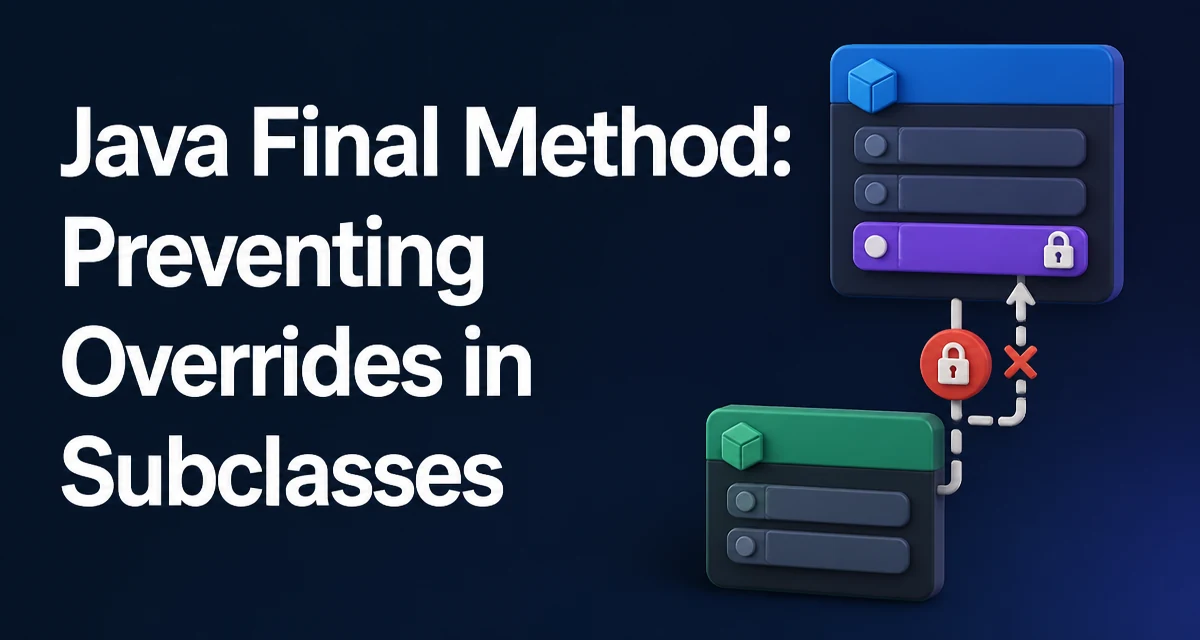
java final method requires a clear understanding of the core syntax, runtime behavior, and practical implementation patterns demonstrated in the examples below.
In Java, the final keyword on a method prevents subclasses from overriding it. This is a compile-time restriction: any attempt to override a final method in a subclass produces a compilation error. The rule is straightforward, but its implications for API design, inheritance hierarchies, and runtime behavior are worth understanding before you use it.
What Does final Mean on a Method?
When a method is declared final, it becomes part of the class's contract that cannot be changed by subclasses. The method's implementation is locked at the point of declaration. Subclasses can still inherit the method and call it, but they cannot provide a different implementation. This is different from making a class final, which prevents the class from being subclassed at all. A final method allows subclassing but restricts method overriding.
Syntax and Minimal Example
Declaring a final method is straightforward:
public class Base {
    public final void connect() {
        System.out.println("Connecting to server");
    }
}
Any subclass that tries to override connect() will fail to compile:
public class Derived extends Base {
    @Override
    public void connect() {  // Compilation error: cannot override final method
        System.out.println("Custom connection");
    }
}
The compiler error message will explicitly state that the method is final and cannot be overridden. The @Override annotation is optional but recommended; without it, the compiler still rejects the method.
Compile-Time Behavior: What the Compiler Enforces
The final keyword on a method is enforced entirely at compile time. When the compiler sees a method invocation on a reference type, it checks whether the method is final. If it is, the compiler knows the exact implementation that will run, regardless of the runtime type of the object. This allows the compiler to perform early binding instead of dynamic dispatch. In practice, the JVM may still use virtual dispatch for final methods unless the JIT compiler can prove the receiver type, but the language semantics guarantee that no subclass can alter the behavior.
Because the restriction is compile-time, there is no runtime check or exception. The behavior is deterministic: a final method always executes the same implementation, no matter what subclass instance holds it.
Why Use a Final Method: API Stability and Invariants
The primary reason to mark a method final is to protect an invariant that your class depends on. For example, a template method that defines the skeleton of an algorithm often calls helper methods. If a subclass can override the template method itself, the algorithm's structure could be broken. By making the template method final, you allow subclasses to customize specific steps (by overriding the helper methods) while preserving the overall flow.
Another common case is a method that performs security-sensitive validation. If a subclass could override it, the validation could be bypassed. Marking it final ensures that the validation logic remains in place for all instances of the class.
Final Method vs. Final Class: Scope of Restriction
A final method restricts only that method. A final class prevents subclassing entirely, which indirectly prevents overriding of any method. The choice between them depends on how much flexibility you want to give subclasses.
| Restriction | Effect | Use case |
|---|---|---|
final method | Subclass can extend the class but cannot override this method | Protect a specific invariant or algorithm step |
final class | Subclass cannot extend the class at all | Prevent any modification or ensure immutability |
If you only need to protect one method, use final on that method. If the entire class should not be extended, mark the class final. Using final on a method when the class is already final is redundant but harmless.
Common Mistakes and Misconceptions
One common mistake is assuming that a final method is also static. They are independent concepts. A static method belongs to the class, not to an instance, and is hidden (not overridden) when a subclass declares a method with the same signature. A final method is an instance method that cannot be overridden. You can have a static final method, but that combines two different restrictions.
Another misconception is that final methods cannot be called from subclasses. They can. A subclass can invoke a final method inherited from its parent without issue. The restriction only applies to overriding.
A third mistake is trying to use final to improve performance. While early binding can enable optimizations, the JIT compiler already performs aggressive inlining and devirtualization for non-final methods when it can prove the receiver type. The performance benefit of final is rarely measurable in modern JVMs. Use final for design clarity, not for micro-optimizations.
Runtime and Performance Considerations
At runtime, a final method is invoked like any other method. The JVM may or may not inline it, depending on profiling. Because the compiler knows the method cannot be overridden, it can generate more efficient code in some cases, but this is not guaranteed. The actual performance impact is negligible in most applications. The more important consequence is behavioral: final methods are safe to call in constructors because they cannot be overridden by a subclass's partially initialized state. This is a subtle but valuable property.
When to Use (and Not Use) a Final Method
Use a final method when you are designing a framework or library and you want to guarantee that a specific behavior remains consistent across all subclasses. This is common in template method patterns and in classes that manage resources or state.
Avoid final methods when you expect subclasses to need to extend or alter the behavior. Overusing final can make your class hierarchy rigid and difficult to extend. In application code, where you control all subclasses, you can often rely on code review instead of final. In public APIs, however, final provides a compile-time guarantee that prevents downstream code from breaking your intended behavior.
Final Methods and Inheritance Hierarchies
When a method is declared final in a superclass, it affects the entire hierarchy below that class. No subclass, regardless of depth, can override it. This is useful when you want to enforce a rule across all derived classes. However, it also means that if you later need to change the method's behavior, you must change the superclass; you cannot adapt it in a subclass. This is a design tradeoff between flexibility and safety.
In large codebases, final methods can make it easier to reason about behavior because you know that a call to that method always does the same thing. This reduces the cognitive load when reading code that uses the class.