Java float Type: Precision, Usage, and Pitfalls
java float type: Learn the characteristics of the Java float type: 32-bit precision, syntax, conversion rules, and common arithmetic pitfalls.
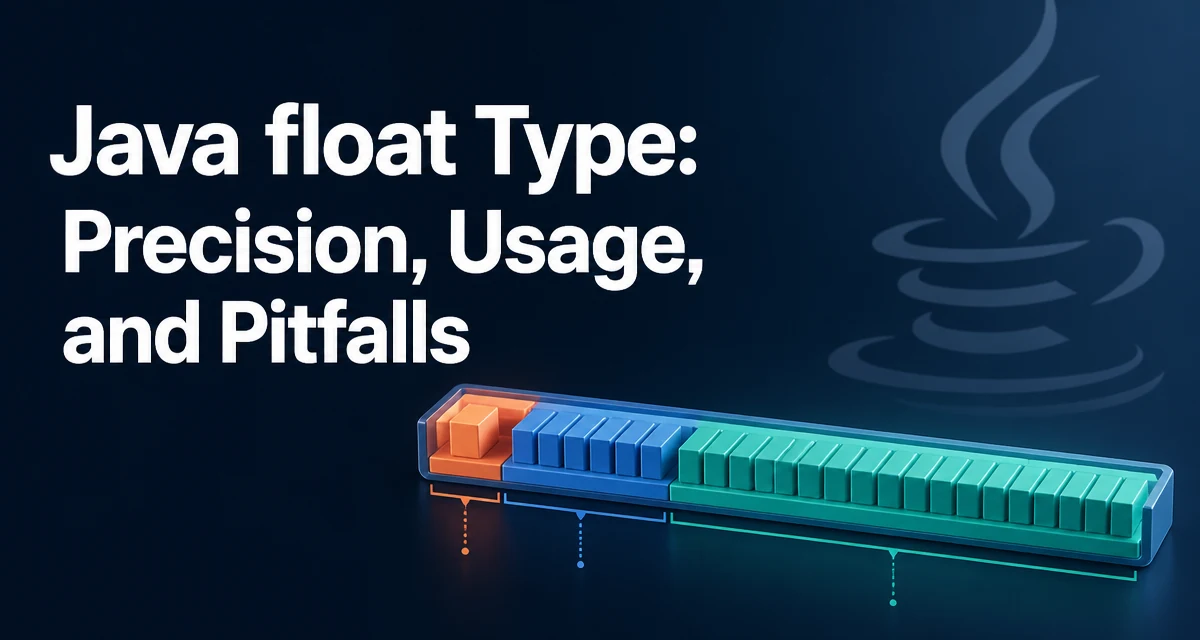
The Java float type is a 32-bit IEEE 754 single-precision floating-point number. It stores numeric values with a sign bit, an 8-bit exponent, and a 23-bit mantissa, giving it roughly 6 to 7 significant decimal digits of precision. This article explains how to work with float in Java, where it fits compared to double, and the common pitfalls that arise from its limited precision.
Size and Precision of the float Type
A float occupies 32 bits of memory, which is half of a double's 64 bits. The IEEE 754 single-precision format allocates these bits as follows: 1 bit for the sign, 8 bits for the exponent, and 23 bits for the significand (also called the mantissa). The exponent is biased, allowing the type to represent very small and very large magnitudes, from approximately 1.4e-45 to 3.4e+38.
The practical consequence is that a float can represent about 7 decimal digits reliably. For example, the value 0.1 cannot be represented exactly in binary floating-point; the stored value is a close approximation. This is not a bug in Java but an inherent property of binary floating-point arithmetic.
Declaring and Initializing float Variables
To declare a float variable, use the float keyword. Java requires an f or F suffix on floating-point literals; otherwise, the literal is treated as a double and causes a compilation error.
float temperature = 36.6f;
float pi = 3.14159F;
float scientific = 1.23e-4f;
The suffix is mandatory. Without it, the compiler reports a possible lossy conversion from double to float. This rule prevents accidental precision loss at assignment time.
Float vs. Double: When to Use Which
The choice between float and double depends on the precision and memory requirements of your application. A double provides roughly 15 to 16 decimal digits of precision and a much larger range. In most general-purpose applications, double is the default because it reduces rounding errors and is the type returned by Math methods.
Float becomes useful when memory is constrained, such as in large arrays or collections where millions of numbers are stored. For example, a 3D vertex buffer with millions of coordinates may use float to halve memory usage. In such cases, the reduced precision is acceptable if the values are within the representable range and the required accuracy is not extreme.
| Criterion | float | double |
|---|---|---|
| Size | 32 bits | 64 bits |
| Precision | ~7 decimal digits | ~15 decimal digits |
| Range | ±3.4e38 | ±1.8e308 |
| Default for literals | No, requires suffix | Yes |
| Use case | Memory-sensitive arrays, graphics, some sensor data | General arithmetic, financial calculations (with BigDecimal for exactness) |
Common Pitfalls with Floating-Point Arithmetic
Floating-point arithmetic is not exact. Operations like addition, subtraction, and multiplication can introduce rounding errors. For example, the expression 0.1f + 0.2f does not equal 0.3f exactly. This leads to the classic pitfall of comparing floats with ==.
float a = 0.1f + 0.2f;
float b = 0.3f;
System.out.println(a == b); // false
Instead of direct equality, compare the absolute difference against a small epsilon value that reflects the acceptable tolerance for your application.
float epsilon = 1e-6f;
if (Math.abs(a - b) < epsilon) {
    // treat as equal
}
The choice of epsilon depends on the magnitude of the numbers and the precision you need. For very large or very small values, a fixed epsilon may be inappropriate; consider using a relative tolerance.
Converting Between float and Other Numeric Types
Java performs implicit widening conversions from float to double, but narrowing conversions from double to float require an explicit cast and may lose precision.
double d = 3.14159265358979;
float f = (float) d; // precision loss, f becomes 3.1415927f
Conversions from int to float are implicit but can also lose precision for very large integers because a float's 23-bit mantissa cannot represent every integer exactly beyond about 2^24. For example, float f = 16777217; actually stores 16777216.0f.
When converting from float to int, the fractional part is truncated, not rounded. Use Math.round() if you need rounding.
float f = 3.99f;
int i = (int) f; // i = 3
int rounded = Math.round(f); // rounded = 4
Working with Float in Collections and APIs
The Float wrapper class provides a way to use float values in collections like List<Float> and Map<String, Float>. Autoboxing and unboxing handle the conversion automatically, but be aware of the overhead of object allocation compared to primitive arrays.
List<Float> measurements = new ArrayList<>();
measurements.add(12.5f);
float first = measurements.get(0);
For performance-critical code that processes large amounts of numeric data, prefer primitive float[] arrays over List<Float> to avoid boxing overhead and reduce memory footprint. The Float class also provides useful constants and methods, such as Float.NaN, Float.POSITIVE_INFINITY, and Float.compare(), which is helpful for sorting and comparison without encountering NaN ordering issues.
Special Values: NaN, Infinity, and Negative Zero
Float can represent special values that are not numbers. Float.NaN represents the result of undefined operations like 0.0f / 0.0f. Float.POSITIVE_INFINITY and Float.NEGATIVE_INFINITY result from overflow, such as 1.0f / 0.0f. Negative zero (-0.0f) exists and is distinct from positive zero in some comparisons.
These values require careful handling. For instance, NaN is not equal to itself, so if (x == Float.NaN) is always false. Use Float.isNaN(x) to check. When sorting or comparing, Float.compare() treats NaN as greater than all other values, which may or may not be the desired behavior. Always validate inputs from external sources before using them in arithmetic to avoid propagating NaN through your calculations.
Performance and Memory Considerations
The primary advantage of float over double is memory usage. A float[] array uses half the memory of a double[] array for the same number of elements. This can significantly reduce cache pressure and memory bandwidth when processing large datasets, such as image pixels, audio samples, or machine learning feature vectors.
However, float arithmetic is not necessarily faster than double on modern hardware. Most CPUs have native single-precision and double-precision instructions with similar throughput. The performance gain, if any, comes from reduced memory traffic and improved cache utilization, not from the arithmetic itself. Do not assume float is always faster; measure in your specific environment.
When designing a data model, consider whether the precision loss is acceptable. For example, storing geographic coordinates in float may introduce errors of a few meters, which is fine for some applications but not for others. Document the precision assumptions in your code to avoid subtle bugs later.
Practical Recommendations for Using float
Use float when memory is the limiting factor and the required precision is within its range. Typical scenarios include:
- Large arrays of sensor readings where values are known to have limited significant digits.
- Graphics and game development, where positions and colors are often stored as float.
- Interoperability with external systems that use single-precision formats, such as OpenGL or audio codecs.
Avoid float for financial calculations, where exact decimal representation is required; use BigDecimal instead. Also avoid float for accumulating values over many iterations, because rounding errors compound. If you must use float, periodically renormalize or use a more precise accumulator when possible.
When writing a public API, consider whether exposing float is appropriate. If the caller might need higher precision, providing a double-based overload or using double internally and converting at the boundary can prevent silent data loss. Document the precision characteristics clearly so that consumers understand the limitations.
Finally, remember that the float type is not a substitute for proper numerical analysis. Understanding its binary representation and the implications of rounding is essential for writing correct programs that handle real-world data.