Java Function vs Consumer: Key Differences
java function vs consumer: Understand the practical differences between Java's Function and Consumer interfaces, when to use each, and how they fit into functional pip...
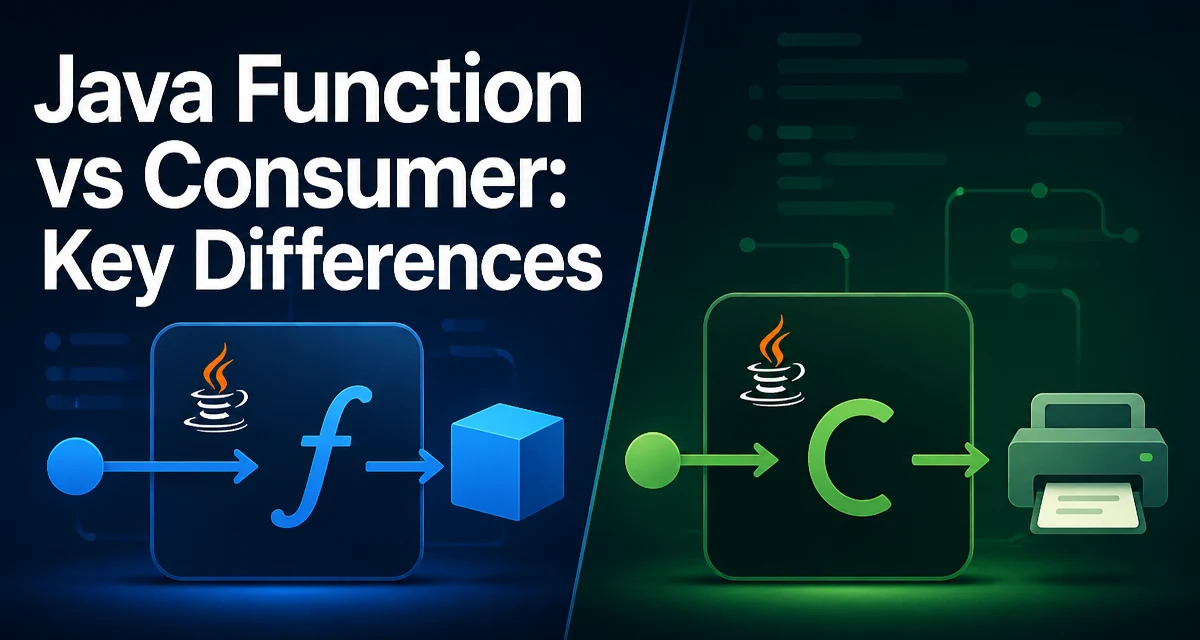
java function vs consumer requires a clear understanding of the core syntax, runtime behavior, and practical implementation patterns demonstrated in the examples below.
When you start using Java's functional interfaces, the difference between Function and Consumer is one of the first decisions you'll face. Both are central to streams and lambda expressions, but they serve different purposes. This article breaks down the practical differences, shows you how to use each, and helps you decide which one fits your code.
The Core Difference Between Function and Consumer
The java.util.function.Function<T,R> interface represents a transformation that takes an argument of type T and returns a result of type R. It's a pure mapping operation: you give it a value, and it produces another value. The java.util.function.Consumer<T> interface, on the other hand, represents an operation that accepts a single argument of type T and returns no result. Its purpose is to cause a side effect, such as printing, writing to a collection, or updating a field.
This fundamental distinction drives every other difference. A Function is used when you want to transform data, while a Consumer is used when you want to perform an action on data. In terms of the apply method, Function.apply(T) returns R, whereas Consumer.accept(T) returns void. That's the simplest way to tell them apart.
Function Syntax and Typical Use Cases
The Function interface declares the abstract method R apply(T t). You can implement it with a lambda or a method reference. A common use case is mapping elements in a stream. For example, converting a list of strings to their lengths:
List<String> names = List.of("Alice", "Bob", "Charlie");
List<Integer> lengths = names.stream()
    .map(String::length)
    .toList();
Here, String::length is a method reference that implements Function<String, Integer>. The map operation applies this function to each element and collects the results. Functions are also useful for extracting fields from objects, converting types, or computing derived values. They are pure in the sense that they should not modify the input or produce side effects; they simply return a new value.
Consumer Syntax and Typical Use Cases
The Consumer interface declares void accept(T t). It's used when you need to perform an action on each element without returning a value. A classic example is printing each element of a collection:
List<String> names = List.of("Alice", "Bob", "Charlie");
names.forEach(System.out::println);
The forEach method takes a Consumer<? super T>, and System.out::println is a method reference that implements Consumer<String>. Consumers are also used to accumulate results into a mutable container, like adding elements to a list or updating a counter. They are inherently side-effectful, which means you need to be careful about shared mutable state in concurrent contexts.
Using Function and Consumer Together in Pipelines
In real-world code, you often combine both interfaces in a single stream pipeline. A Function transforms the data, and a Consumer performs the final action. For instance, you might map a list of user objects to their email addresses and then send a notification for each one:
List<User> users = fetchUsers();
users.stream()
    .map(User::getEmail)
    .forEach(email -> sendEmail(email));
Here, User::getEmail is a Function<User, String>, and the lambda email -> sendEmail(email) is a Consumer<String>. This separation of concerns keeps the transformation logic separate from the side-effect logic, making the pipeline easier to read and test. You can also chain consumers using andThen to perform multiple actions in sequence, or chain functions with compose and andThen to build more complex transformations.
When to Choose Function Over Consumer and Vice Versa
The choice between Function and Consumer is driven by what you need the operation to do. If your operation must produce a result that will be used later—for example, to filter, sort, or collect data—then Function is the right choice. If your operation is a terminal action that doesn't produce a value, such as logging, printing, or updating an external system, then Consumer fits better.
There are also cases where you might need both. Suppose you have a method that accepts a Function to transform an input and a Consumer to handle the result. This pattern is common in callback-based APIs. The key is to respect the contract: a Function should be free of side effects to be safely reused and composed, while a Consumer is explicitly allowed to have side effects but should not return a value.
Performance and Maintainability Considerations
From a performance standpoint, both Function and Consumer are functional interfaces that rely on lambda or method reference invocation. The JVM can inline and optimize these calls, so the overhead is generally negligible compared to the work inside the operation. However, there is a subtle difference in how they are used in streams. Function is used in intermediate operations like map, which creates a new stream, while Consumer is used in terminal operations like forEach, which triggers the pipeline. This means that using a Consumer in a terminal operation doesn't affect the stream's laziness, whereas a Function in map preserves laziness until a terminal operation is invoked.
For maintainability, prefer Function for pure transformations because they are easier to test and reason about. A Function can be unit-tested in isolation without setting up external state. A Consumer often requires mocking or verifying that a side effect occurred, which is more complex. When designing your own APIs, consider whether a method should take a Function or a Consumer. If the caller needs to return a value, use Function; if not, use Consumer. This makes the intent clear and prevents misuse.
Common Mistakes and How to Avoid Them
One common mistake is using a Consumer when a Function is needed, or vice versa, because the lambda syntax looks similar. For example, writing x -> x * 2 as a Consumer would be a compile error because the lambda returns a value but accept expects void. Conversely, using a Function for a side-effectful operation like printing can lead to unexpected behavior if the function is called multiple times or lazily. Always check the interface's abstract method signature before implementing it.
Another mistake is assuming that Function and Consumer are interchangeable in stream operations. They are not. map requires a Function, while forEach requires a Consumer. If you try to pass a Consumer to map, the compiler will reject it because the return type doesn't match. Understanding the method signatures of the Stream API helps you avoid these errors.
Combining with Other Functional Interfaces
Java also provides specialized variants like BiFunction<T,U,R> and BiConsumer<T,U> for operations that take two arguments. The same principles apply: BiFunction returns a result, while BiConsumer returns void. These are useful when working with maps or reducing operations. For example, Map.merge uses a BiFunction to compute the new value, while Map.forEach uses a BiConsumer to process each key-value pair. Knowing when to use the two-argument versions is a natural extension of the Function vs Consumer decision.
In practice, you'll often see Function used with Stream.map, Optional.map, and CompletableFuture.thenApply. Consumer appears with Stream.forEach, Optional.ifPresent, and CompletableFuture.thenAccept. Recognizing these patterns helps you read and write functional code more fluently.
Final Code Example: A Practical Decision
Consider a method that processes a list of orders. You need to calculate the total price (a Function) and then log each order (a Consumer). Here's how you might structure it:
public void processOrders(List<Order> orders) {
    Function<Order, BigDecimal> totalPrice = order -> order.getQuantity()
        .multiply(order.getUnitPrice());
    Consumer<Order> logger = order -> System.out.println("Processing " + order.getId());

    orders.forEach(order -> {
        logger.accept(order);
        BigDecimal price = totalPrice.apply(order);
        // Use price for further processing
    });
}
This example shows how both interfaces coexist in a single method. The Function computes a value, and the Consumer performs a side effect. By separating them, you can test the price calculation independently and easily swap the logging implementation without touching the core logic. That's the practical value of understanding java function vs consumer—it leads to cleaner, more maintainable code.