Java Generics Wildcards Explained
java generics wildcards: Learn how Java generics wildcards work, including unbounded, upper-bounded, and lower-bounded wildcards, with practical examples and common pi...
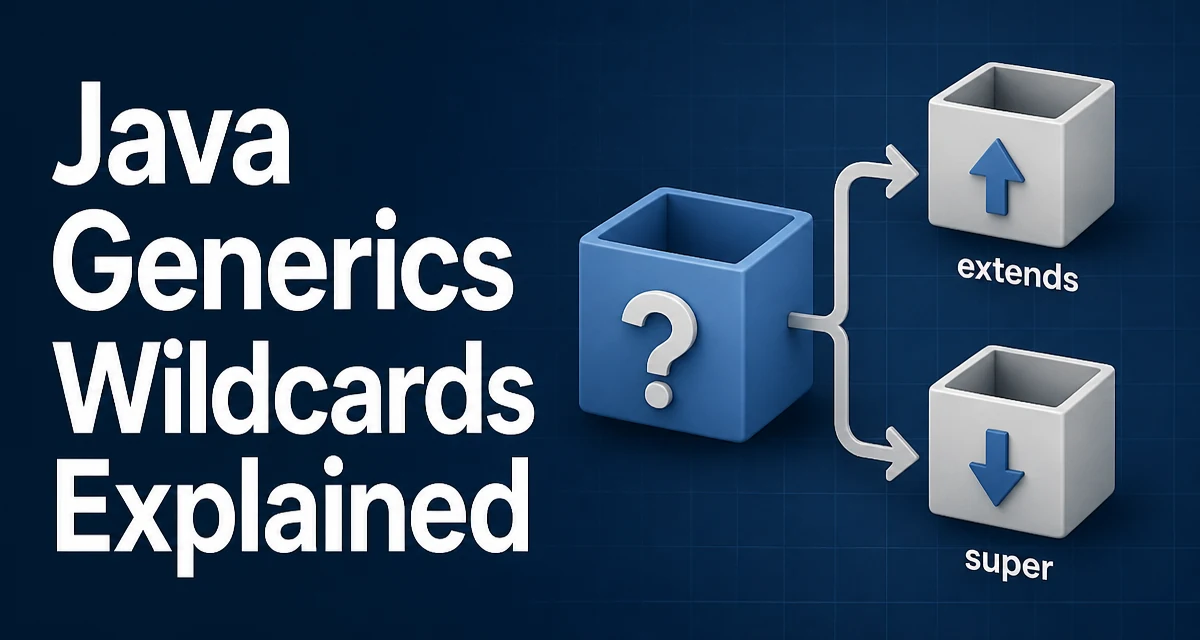
Java generics wildcards let you write flexible generic code when the exact type is unknown or when you want to accept a range of types. The question mark ? is the wildcard symbol, and it appears in three forms: unbounded (?), upper bounded (? extends T), and lower bounded (? super T). Each form solves a different problem, and choosing the wrong one often leads to compile-time errors that are confusing at first glance.
Understanding Wildcard Syntax
Wildcards appear in generic type declarations, method signatures, and variable declarations. They are not allowed in the type parameter definitions of a class or interface. For example, you cannot write class Box<?> {}. Wildcards are only used as type arguments when instantiating or referencing a generic type.
List<?> list1 = new ArrayList<String>();
List<? extends Number> list2 = new ArrayList<Integer>();
List<? super Integer> list3 = new ArrayList<Number>();
```\nIn the first line, `list1` can hold any type. In the second, `list2` can hold any type that is a subtype of `Number`. In the the third, `list3` can hold any type that is a super type of `Integer`. The wildcard appears only in the the type argument position, not in the class definition itself.

## Unbounded Wildcards

The unbounded wildcard `?` means "any type". It is useful when your code does not depend on the actual type of the collection. For example, a method that prints the size of a list does not care what the list contains.

```java
public static void printSize(List<?> list) {
    System.out.println("Size: " + list.size());
}
You can call this method with a List<String>, List<Integer>, or any other list. However, you cannot add elements to a List<?> except null because the the compiler cannot guarantee that the added element is of the correct type. This is a common source of confusion: an unbounded wildcard is not the same as a raw type. A raw List allows adding any object, but a List<?> only allows reading and does not allow adding non-null elements.
Upper Bounded Wildcards (? extends)
An upper bounded wildcard ? extends T restricts the type to be a subtype of T (including T itself). This is useful when you want to read from a collection that contains elements of a specific family of types.
public static double sumNumbers(List<? extends Number> numbers) {
    double sum = 0.0;
    for (Number n : numbers) {
        sum += n.doubleValue();
    }
    return sum;
}
n```

You can pass a `List<Integer>`, `List<Double>`, or `List<Number>` to this method. The method can safely read each element as a `Number`. However, you cannot add new elements to `numbers` because the compiler cannot know whether the actual type is `Integer`, `Double`, or some other subtype. Adding a `Number` would not be safe because the actual list might be a `List<Integer>`. This is the why `add` is not allowed for an upper bounded wildcard.

## Lower Bounded Wildcards (? super)

A lower bounded wildcard `? super T` restricts the type to be a supertype of `T` (including `T` itself). This is useful when you want to write to a collection, because you can safely add elements of type `T` to any collection that is a supertype of `T`.

```java
public static void addNumbers(List<? super Integer> list) {
    list.add(42);
}
You can pass a List<Integer>, a List<Number>, or a List<Object> to this method. The compiler knows that whatever the actual type is, it is a supertype of Integer, so adding an Integer is safe. However, when reading from a List<? super Integer>, you can only read Object elements, because the actual type could be Object or Number. This is the tradeoff: lower bounded wildcards allow writes but restrict reads to Object.
Wildcards vs Raw Types
Raw types, such as List without a type parameter, are allowed for backward compatibility but they bypass all compile-time type checking. Using a raw type can lead to ClassCastException at runtime. Wildcards, on the other hand, preserve type safety while allowing flexibility.
// Raw type - unsafe
List rawList = new ArrayList<String>();
rawList.add(42); // compiles, but may cause issues later

// Unbounded wildcard - safe
List<?> safeList = new ArrayList<String>();
// safeList.add(42); // compile error: cannot add to List<?>
In the raw case, adding an Integer to a list that was originally meant for String compiles. Later, when you retrieve an element and cast it to String, you get a runtime exception. The wildcard version prevents the unsafe add at compile time. This is why you should prefer wildcards over raw types in new code.
Common Pitfalls and Type Safety
One common pitfall is trying to use a wildcard where a fixed type parameter is needed. For example, a generic method with a type parameter can be more flexible than a wildcard because it allows you to refer to the type within the method body.
// Wildcard version - cannot refer to the type
public static void swap(List<?> list, int i, int j) {
    // Cannot get and set because the type is unknown
}

// Generic method version - can refer to the type
public static <T> void swap(List<T> list, int i, int j) {
    T temp = list.get(i);
    list.set(i, list.get(j));
    list.set(j, temp);
}
In the wildcard version, you cannot read an element and then set it back because the compiler cannot guarantee that the element you read is of the correct type. The generic method binds the type to a variable T, which allows safe read and write operations. This is a key distinction: use wildcards when you only need to read or write, but use a type parameter when you need to do both or refer to the type.
Another pitfall is confusing upper and lower bounds. The rule of thumb is: ? extends T for reading, ? super T for writing. If you need both, use a generic method. This is sometimes called the "PECS" principle (Producer Extends, Consumer Super). A producer produces elements for you to read, so you use extends. A consumer consumes elements you provide, so you use super.
Runtime Behavior and Type Erasure
Wildcards do not exist at runtime. Java erases all generic type information, including wildcards, to their leftmost bound. For an unbounded wildcard, the erasure is Object. For ? extends Number, the erasure is Number. For ? super Integer, the erasure is Object (since the lower bound is not used in erasure; the erasure is the leftmost bound, which is Object for lower bounded wildcards).
List<?> a = new ArrayList<String>();
List<? extends Number> b = new ArrayList<Integer>();
List<? super Integer> c = new ArrayList<Number>();
At runtime, all three variables are just List. The compiler uses the wildcard information only during compilation to enforce type safety. This means that wildcards have no runtime performance cost. The only cost is compile-time checking, which is what you want. There is no reflection overhead or additional memory usage. This is important for production systems where you might worry about generic flexibility slowing down your application; it does not.
Choosing the Right Wildcard for Your API
When designing a public API, the choice of wildcard affects how callers can use your methods. An upper bounded wildcard is appropriate for a method that only reads from a collection. A lower bounded wildcard is appropriate for a method that only writes to a collection. If your method both reads and writes, a generic type parameter is usually the right choice.
// Read-only
public static double average(List<? extends Number> numbers) { ... }

// Write-only
public static void fill(List<? super Integer> list, Integer value) { ... }

// Read and write
public static <T> void copy(List<? super T> dest, List<? extends T> src) { ... }
The copy method is a classic example from the Java Collections framework. It uses ? super T for the destination and ? extends T for the source. This allows copying from a List<Integer> to a List<Number> or List<Object>, which is safe because the source elements are subtypes of the destination's element type. This pattern maximizes flexibility while preserving type safety.
Maintainability and Future-Proofing
Wildcards make your code more maintainable by decoupling method signatures from concrete types. If a caller later changes the type of their collection, they do not need to change the call as long as the new type satisfies the bound. For example, a method that accepts List<? extends Number> will work with List<Integer>, List<Double>, and any future subtype of Number that you create. This reduces the need for overloads and keeps your API stable.
However, overusing wildcards can make code harder to read. If a method signature has multiple wildcards, it can become difficult to understand what is allowed. In such cases, a generic method with explicit type parameters is often clearer. The key is to use wildcards where they add flexibility without obscuring the contract.
A practical rule: start with a concrete type parameter, and only introduce a wildcard if you need to accept a broader range of types. If you find yourself writing a method that accepts List<Object> and then casting elements, you are better off with List<?> or a bounded wildcard. The compiler will guide you if you make a mistake, and the error messages, while sometimes cryptic, usually point to the exact line where the type mismatch occurs.