Java HashSet add: Behavior, Return Value, and Duplicate Handling
java hashset add: Understand HashSet.add() in Java: its return value, duplicate detection, performance characteristics, and practical usage patterns.
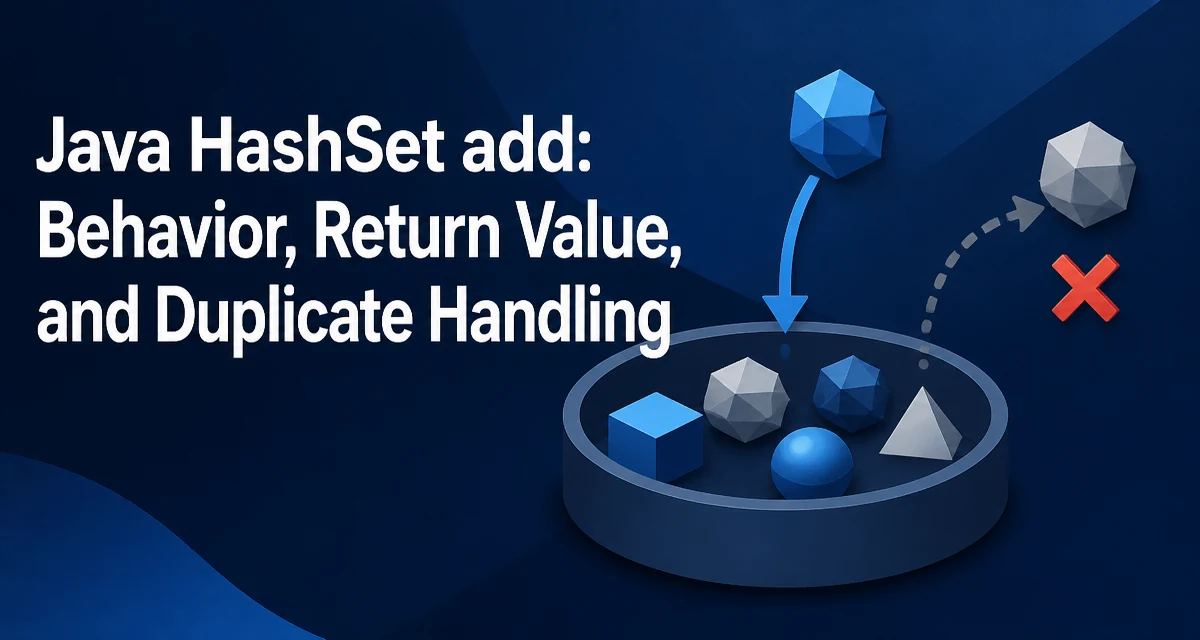
java hashset add requires a clear understanding of the core syntax, runtime behavior, and practical implementation patterns demonstrated in the examples below.
The add() method on a HashSet is deceptively simple: it inserts an element into the set and returns a boolean. But the boolean is not a formality. It tells you whether the element was actually added or was already present. This behavior is central to how HashSet enforces uniqueness, and it has direct consequences for performance and correctness in real code.
The add() Method and Its Return Value
HashSet implements the Set interface, and its add method follows the contract defined there. The method signature is:
boolean add(E e)
The return value is true if the set did not already contain the specified element. It is false if the set already contained the element. Importantly, when false is returned, the set is unchanged. The element is not added a second time.
Consider this minimal example:
Set<String> names = new HashSet<>();
boolean firstAdd = names.add("Alice");   // true
boolean secondAdd = names.add("Alice");  // false
System.out.println(names.size());         // 1
The second call returns false because "Alice" already exists. The set still has only one element. This is the core of HashSet's uniqueness guarantee.
How HashSet Detects Duplicates
HashSet is backed by a HashMap. Each element added to the set is stored as a key in the underlying map, with a constant dummy value. Duplicate detection relies on two methods on the element itself: hashCode() and equals().
When add(e) is called, the set computes e.hashCode() to locate the bucket where the element would be stored. It then compares the new element with any existing elements in that bucket using equals(). If no existing element is equal, the element is inserted. If an equal element is found, the set rejects the new one.
This means the correctness of duplicate detection depends entirely on your element class properly overriding hashCode() and equals(). If you store custom objects without overriding these methods, the set will use identity-based comparison. Two distinct instances with identical field values will be treated as different elements.
class User {
    String name;
    User(String name) { this.name = name; }
    // no hashCode() or equals() override
}

Set<User> users = new HashSet<>();
users.add(new User("Alice"));
users.add(new User("Alice"));
System.out.println(users.size()); // 2, not 1
To make HashSet treat equal objects as duplicates, override both methods consistently. The general rule is that if two objects are equal according to equals(), they must have the same hashCode().
What Happens When You Add a Duplicate
When add returns false, the existing element is retained. The new element is discarded. This is different from List.add, which always appends and allows duplicates. The behavior is also different from Map.put, which replaces the existing value for a key.
This distinction matters when you use the return value to drive logic. For example, you might want to track whether a new item was successfully inserted:
Set<String> seen = new HashSet<>();
if (seen.add(requestId)) {
    // process the request only once
} else {
    // duplicate request, skip
}
Here the boolean return value is not just a formality; it is the mechanism for deduplication. Without it, you would need a separate contains call, which is redundant and less efficient.
Performance Characteristics of add()
The average time complexity of HashSet.add is O(1), assuming a well-distributed hash function. This is because the underlying HashMap uses hash-based bucket lookup. In the worst case, when many elements collide in the same bucket, the complexity degrades to O(n) for that bucket, but modern Java implementations convert long chains to balanced trees, keeping the worst case at O(log n) for buckets that exceed a threshold.
The constant-time average behavior is the primary reason to choose HashSet over List for membership checks and deduplication. A List requires O(n) time for contains and for checking duplicates during add. For large collections, the difference is substantial.
However, the O(1) claim depends on the quality of the element's hashCode() implementation. A poor hash function that returns the same value for many objects will cause many collisions and degrade performance. Strings and standard library types have good hash functions, but custom classes need careful implementation.
Memory usage is another consideration. HashSet uses more memory than a List because it maintains the underlying HashMap structure with buckets and entries. If you only need to store a small number of elements and never check for membership, a List may be more memory-efficient. But for deduplication or frequent contains checks, the memory overhead is usually worth the speed.
Common Misconceptions About add()
One misconception is that HashSet.add replaces the existing element when a duplicate is found. It does not. The existing element remains untouched. If you need to update an element, HashSet is not the right structure; consider a Map where you can associate a key with a value and replace it.
Another misconception is that the return value is always true for the first add and false for subsequent adds. That is true only if the element is not equal to any existing element. If you add two distinct objects that are equal according to equals(), the second add returns false. If you add two distinct objects that are not equal, both return true.
A third misconception is that HashSet maintains insertion order. It does not. The iteration order is unspecified and may change when the set is resized. If you need insertion order, use LinkedHashSet. If you need sorted order, use TreeSet.
Practical Usage Patterns and Edge Cases
A common pattern is using HashSet to collect unique values from a stream or a loop. The return value can be used to filter duplicates without a separate contains check:
List<String> input = List.of("apple", "banana", "apple", "cherry");
Set<String> unique = new HashSet<>();
List<String> firstOccurrences = new ArrayList<>();
for (String item : input) {
    if (unique.add(item)) {
        firstOccurrences.add(item);
    }
}
System.out.println(firstOccurrences); // [apple, banana, cherry]
This preserves the order of first occurrences while using HashSet for deduplication.
Edge cases arise with null. HashSet permits one null element. Adding null when the set already contains null returns false. This is consistent with the general contract, but be aware that null can be stored and will be treated as a single element.
If you need to add many elements and are concerned about resizing overhead, you can pre-size the HashSet using the constructor that accepts an initial capacity and load factor. The default load factor is 0.75, meaning the set resizes when its size reaches 75% of capacity. Pre-sizing avoids repeated resizing when you know the approximate number of elements.
Set<Integer> numbers = new HashSet<>(1000); // initial capacity
This is a minor optimization, but it can reduce allocation and rehashing cost for large sets.
When working with mutable objects, be cautious. If you add an object to a HashSet and then modify its fields in a way that changes its hashCode(), the set becomes corrupted. The object will be in the wrong bucket, and contains and remove will fail to find it. This is a well-known pitfall. Use immutable objects as set elements whenever possible, or avoid modifying them after insertion.
Choosing Between HashSet and Other Collections
HashSet is the right choice when you need fast membership testing and uniqueness without caring about order. If you need to preserve insertion order, LinkedHashSet provides that with slightly more overhead. If you need sorted iteration, TreeSet gives you that at the cost of O(log n) operations.
For a simple list of elements where duplicates are allowed and you never check membership, ArrayList is more memory-efficient and has lower overhead for iteration. The decision should be based on whether you need uniqueness and how often you perform contains or add operations.
The add method's return value is a small but powerful tool. Using it directly avoids extra contains calls and makes the code more concise and less error-prone. Understanding how it works under the hood helps you avoid the pitfalls of mutable keys and poor hash functions, and it lets you make informed choices about which collection to use for a given problem.