Java HashSet: Usage, Behavior, and Performance
java hashset: Understand Java HashSet behavior: uniqueness, hashCode and equals, iteration order, performance tradeoffs, and when to choose it over other Set types.
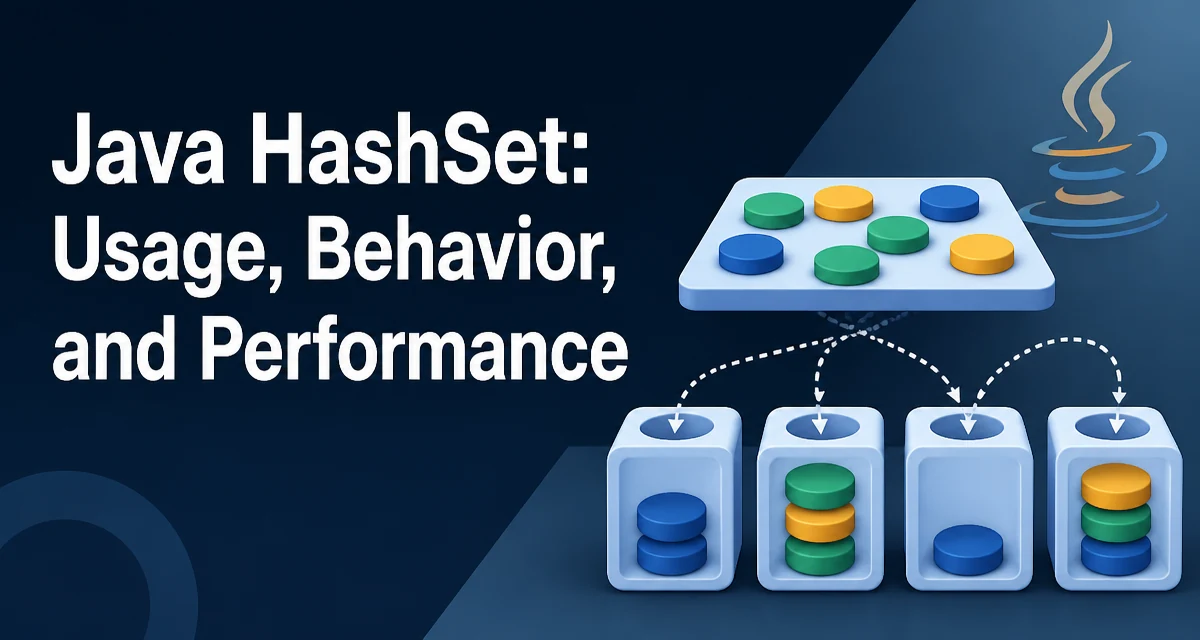
java hashset requires a clear understanding of the core syntax, runtime behavior, and practical implementation patterns demonstrated in the examples below.
A HashSet in Java is a Set implementation backed by a hash table. It stores unique elements and offers constant-time average performance for add, remove, and contains operations. The defining characteristic is that it makes no guarantee about iteration order, and the order can change when elements are added or removed.
Set<String> names = new HashSet<>();
names.add("alice");
names.add("bob");
names.add("carol");
System.out.println(names.size()); // 3
The size is 3 because each element is distinct. Adding a duplicate has no effect and returns false.
What HashSet Guarantees and What It Does Not
HashSet guarantees that the set contains no duplicate elements according to the equals method. It also provides fast membership tests. What it does not guarantee is any meaningful order. Unlike a List, which preserves insertion order, a HashSet arranges elements based on their hash codes and the current capacity of the internal table. That arrangement is an implementation detail and can shift whenever the set resizes.
This means you cannot rely on the position of an element in iteration, and you cannot index into a HashSet. If your code depends on the first or last element of a collection, a HashSet is the wrong choice.
The hashCode and equals Contract
HashSet relies on the hashCode and equals methods to determine uniqueness. When you add an element, the set computes its hash code to find the bucket, then uses equals to check whether an equivalent element already exists in that bucket.
public class User {
    private final String email;

    public User(String email) {
        this.email = email;
    }

    @Override
    public int hashCode() {
        return email.hashCode();
    }

    @Override
    public boolean equals(Object obj) {
        if (this == obj) return true;
        if (!(obj instanceof User)) return false;
        return email.equals(((User) obj).email);
    }
}
Without overriding both methods, two User objects with the same email would be treated as distinct because the default identity-based equals compares object references. If you override equals without hashCode, the set can place equivalent objects in different buckets, breaking the uniqueness guarantee entirely.
Basic Operations and Return Values
The key methods on HashSet are add, remove, and contains. Each returns a boolean that signals the outcome:
Set<String> tags = new HashSet<>();
boolean addedFirst = tags.add("java");   // true
boolean addedSecond = tags.add("java");  // false
boolean exists = tags.contains("java");  // true
boolean removed = tags.remove("java");   // true
boolean removedAgain = tags.remove("java"); // false
The add method returns true when the element was not previously present. The remove method returns true when an element was actually removed. contains performs a hash lookup and returns true when an equal element exists. These return values are useful when you need to know whether a set changed as a result of a call, such as when collecting unique items from a stream and counting new discoveries.
Iteration Order Is Not Guaranteed
HashSet does not preserve insertion order. The iteration order depends on the hash values of the elements and the internal capacity of the table, which changes as the set grows.
Set<Integer> numbers = new HashSet<>();
numbers.add(10);
numbers.add(20);
numbers.add(30);
for (Integer n : numbers) {
    System.out.println(n);
}
The output may not be 10, 20, 30. It could be 20, 10, 30 depending on the hash distribution and the current table size. If you need predictable iteration order, use LinkedHashSet for insertion order or TreeSet for sorted order.
Performance Characteristics
The average time complexity for add, remove, and contains is O(1) because the set uses a hash table with buckets. In the worst case, when many elements collide into the same bucket, operations can degrade to O(n) per lookup. Java's HashSet uses a HashMap internally, and since Java 8, buckets that grow large are converted to trees to reduce worst-case degradation.
The initial capacity and load factor affect performance. The default load factor is 0.75, meaning the table resizes when it becomes 75% full. If you know the approximate number of elements in advance, setting an appropriate initial capacity avoids repeated resizing:
Set<String> expected = new HashSet<>(1000);
Resizing involves rehashing all existing elements, which is expensive. Choosing a capacity that matches your expected data size reduces that cost. For a set that will hold roughly one thousand elements, an initial capacity of 1000 avoids most resize operations.
Null Handling and Mutable Elements
HashSet permits a single null element. Adding null more than once has no effect because the set already contains null. The contains method also handles null correctly.
Mutable elements are a more subtle problem. If you add an object to a HashSet and then modify it in a way that changes its hash code, the set will no longer find it in the correct bucket. The element becomes effectively lost:
Set<List<Integer>> sets = new HashSet<>();
List<Integer> list = new ArrayList<>();
list.add(1);
sets.add(list);
list.add(2); // hash code changes
System.out.println(sets.contains(list)); // likely false
The contains call may return false because the hash code changed after insertion. This is why elements stored in a HashSet should be effectively immutable, or at least have a stable hash code. If you must store mutable objects, remove them from the set before modifying them and re-add them afterward.
Concurrency Considerations
HashSet is not thread-safe. Concurrent modification from multiple threads can corrupt the internal structure. Use Collections.synchronizedSet to wrap it, or use ConcurrentHashMap.newKeySet() when you need a concurrent set with better scalability:
Set<String> concurrent = ConcurrentHashMap.newKeySet();
ConcurrentHashMap.newKeySet() provides thread-safe add, remove, and contains operations without locking the entire set. For read-heavy workloads, CopyOnWriteArraySet is another option, though it is expensive for writes because it copies the entire underlying array on each modification.
Choosing Between HashSet, LinkedHashSet, and TreeSet
| Set type | Ordering | Add/remove/contains | Use case |
|---|---|---|---|
| HashSet | No guaranteed order | O(1) average | Fast uniqueness checks |
| LinkedHashSet | Insertion order | O(1) average | Preserve insertion sequence |
| TreeSet | Sorted order | O(log n) | Sorted iteration or range queries |
Use HashSet when you only need uniqueness and fast lookups. Use LinkedHashSet when iteration order must match insertion order. Use TreeSet when you need sorted iteration or range queries like headSet and subSet. The choice comes down to whether ordering matters to your algorithm, because the performance difference between HashSet and LinkedHashSet is negligible while TreeSet trades constant-time operations for logarithmic ones.