Java HashSet vs LinkedHashSet: Ordering and Tradeoffs
java hashset vs linkedhashset: Compare HashSet and LinkedHashSet in Java: ordering guarantees, internal structure, memory costs, iteration behavior, and clear guidance...
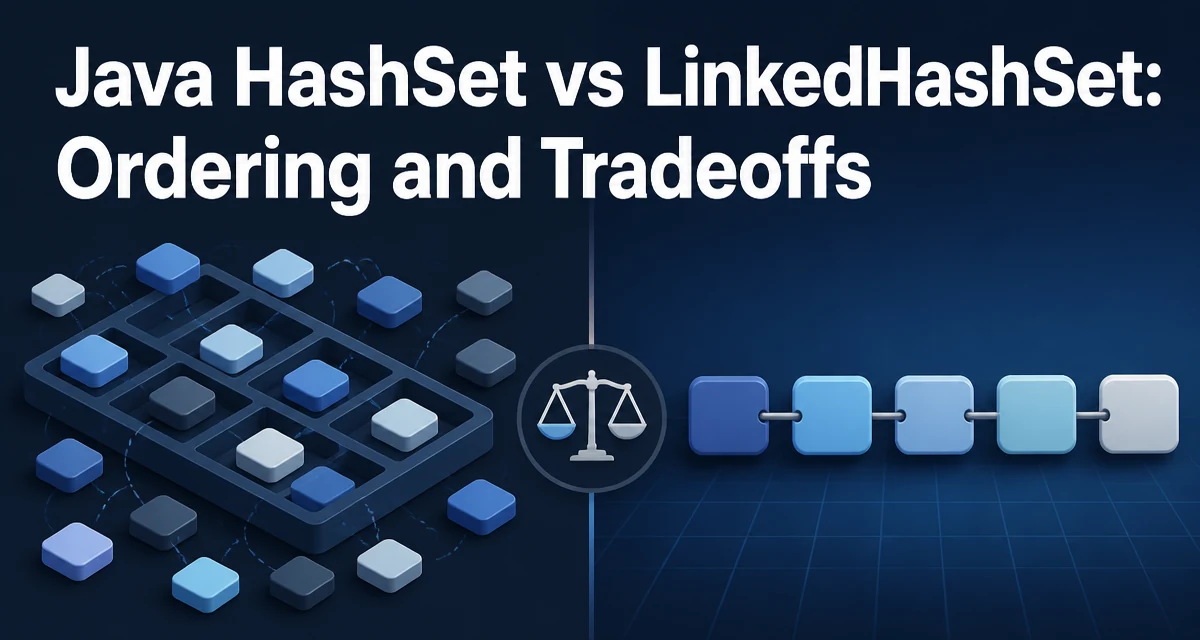
When you need a Set in Java, the default choice is usually HashSet. But LinkedHashSet exists for a specific reason: it preserves insertion order while keeping the same uniqueness guarantees. The practical question in java hashset vs linkedhashset is whether that ordering guarantee is worth the extra memory and the slightly different behavior.
The Ordering Difference That Matters
HashSet stores elements based on their hash codes. The iteration order depends on the hash values and the internal bucket layout, which means it is effectively unpredictable and can change when the set is resized. LinkedHashSet extends HashSet and adds a doubly-linked list that connects the elements in the order they were inserted.
This is the only behavioral difference between the two classes. Both implement Set, both reject duplicates, both allow at most one null element, and both have the same add, remove, and contains semantics. The ordering guarantee is the entire reason LinkedHashSet exists.
How Each Collection Is Built Internally
HashSet is backed by a HashMap instance. When you call add(element), the element is stored as a key in the backing map with a constant dummy value. LinkedHashSet extends HashSet and overrides the internal map creation so that a LinkedHashMap is used instead. The linked structure inside LinkedHashMap is what tracks insertion order.
This inheritance relationship affects the constructors. LinkedHashSet does not expose a constructor that takes initial capacity and load factor separately the way HashSet does, but it offers:
LinkedHashSet()LinkedHashSet(Collection<? extends E> c)LinkedHashSet(int initialCapacity)LinkedHashSet(int initialCapacity, float loadFactor)
The default initial capacity is 16 and the default load factor is 0.75, matching HashSet.
Iteration Behavior in Practice
Consider this example:
import java.util.HashSet;
import java.util.LinkedHashSet;
import java.util.Set;

public class SetOrderDemo {
    public static void main(String[] args) {
        Set<String> hashSet = new HashSet<>();
        Set<String> linkedHashSet = new LinkedHashSet<>();

        String[] values = {"alpha", "beta", "gamma", "delta"};

        for (String value : values) {
            hashSet.add(value);
            linkedHashSet.add(value);
        }

        System.out.println("HashSet:       " + hashSet);
        System.out.println("LinkedHashSet: " + linkedHashSet);
    }
}
The HashSet output is not guaranteed to match the insertion order. It depends on the hash codes of the strings and the current table size, so the printed order can vary across runs and across Java versions. The LinkedHashSet output, by contrast, will always be:
[alpha, beta, gamma, delta]
One subtle point: re-adding an element that is already present does not change its position in the LinkedHashSet. If you insert "alpha", then "beta", then "alpha" again, the set still contains only one "alpha" and the iteration order remains alpha, beta. The insertion order is the order of first insertion, not the order of the most recent add call.
Memory and Runtime Tradeoffs
The linked list inside LinkedHashSet adds a per-element cost. Each entry holds references to the previous and next entry, so memory usage is higher than HashSet for the same number of elements. For small sets this overhead is negligible, but for sets with hundreds of thousands of entries it can matter.
Iteration is a different story. HashSet iteration must walk every bucket and then walk the chain inside each bucket. LinkedHashSet iteration walks the linked list directly, visiting each element in constant time per element. Because it avoids bucket-by-bucket traversal, iterating a LinkedHashSet can be faster in practice, though the exact difference depends on the hash distribution and the load factor. The tradeoff is memory for predictable, direct iteration.
There is no meaningful difference in add, remove, or contains complexity. Both are O(1) on average. The linked-list maintenance in LinkedHashSet adds a small constant overhead per insertion, but it does not change the asymptotic behavior.
Choosing Between HashSet and LinkedHashSet
Use HashSet when the iteration order does not matter. This is the common case for membership checks, deduplication, and set algebra operations where you only care about what is in the set, not the order it comes back in.
Use LinkedHashSet when you need to preserve insertion order while keeping Set semantics. A typical example is a deduplication pass that must also retain the order in which elements first appeared, such as removing duplicate entries from a list while keeping the original sequence:
public static <T> List<T> dedupePreservingOrder(List<T> input) {
    Set<T> seen = new LinkedHashSet<>(input);
    return new ArrayList<>(seen);
}
This pattern is common when processing user-facing lists where the order of first occurrence carries meaning.
If you need sorted order instead of insertion order, LinkedHashSet is the wrong tool. TreeSet provides natural ordering or a custom Comparator, at the cost of O(log n) operations. The decision is therefore: HashSet for unordered membership, LinkedHashSet for insertion order, TreeSet for sorted order.
Concurrency and Modification Behavior
Neither HashSet nor LinkedHashSet is thread-safe. If multiple threads modify the set concurrently, you must synchronize externally or wrap the instance with Collections.synchronizedSet. Both classes also use fail-fast iterators: if the set is structurally modified after the iterator is created, the iterator throws ConcurrentModificationException on the next access.
The fail-fast behavior applies equally to both classes because LinkedHashSet inherits the iterator machinery from HashSet. The only difference is that the LinkedHashSet iterator also maintains the linked-list traversal, but the structural modification detection works the same way.
Edge Cases and Compatibility Notes
Both classes allow one null element. Adding a second null is a no-op because the element already exists. The equals and hashCode contracts are identical because both inherit from AbstractSet.
Serialization behavior is also equivalent. Both classes are serializable, and the serialized form preserves the elements. For LinkedHashSet, the insertion-order guarantee after deserialization is not something to rely on blindly; if order matters after round-tripping through serialization, verify the behavior on your target runtime.
One practical compatibility note: because LinkedHashSet extends HashSet, code that accepts a HashSet will also accept a LinkedHashSet. This can mask ordering assumptions. If a method signature declares HashSet and the caller passes a LinkedHashSet, the iteration order inside the method is insertion order, which may or may not be what the method expects. Prefer declaring the interface type (Set) and being explicit about ordering requirements in documentation.