How `this` Works in Java Lambdas
java lambda this keyword: Understand how `this` behaves inside Java lambda expressions, how it differs from anonymous classes, and practical implications for your code.
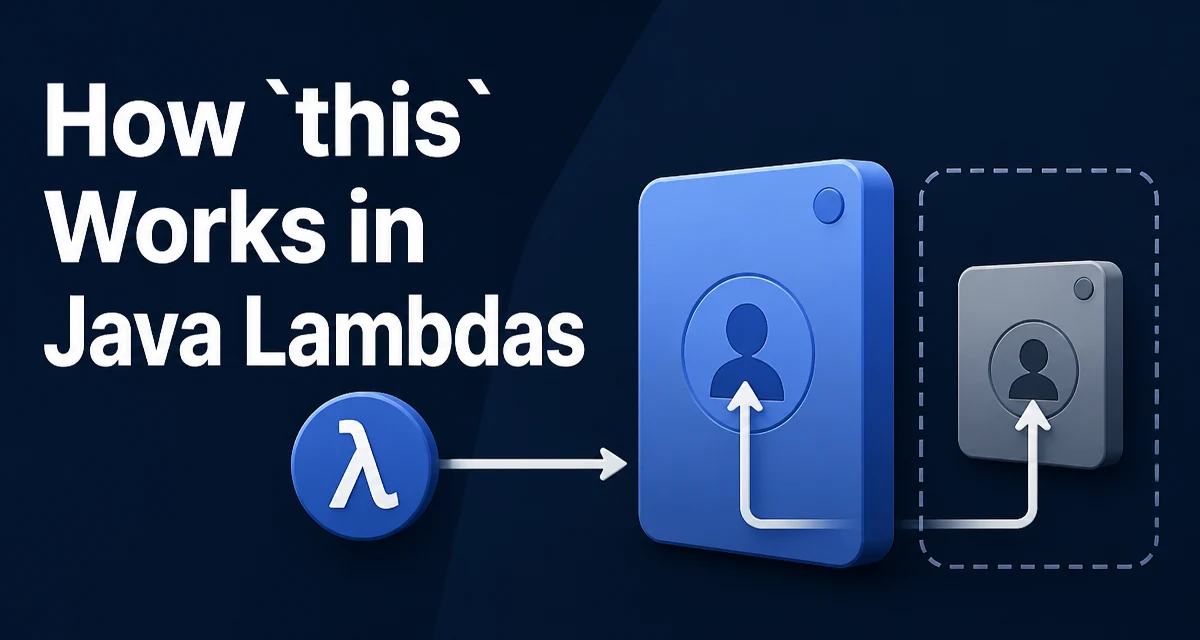
java lambda this keyword requires a clear understanding of the core syntax, runtime behavior, and practical implementation patterns demonstrated in the examples below.
When you write a lambda expression in Java, the meaning of this is a common source of confusion. Unlike anonymous inner classes, where this refers to the anonymous class instance itself, inside a lambda this refers to the enclosing instance—the object that contains the lambda. This distinction affects how you access fields, call methods, and reason about scope.
Consider a simple example:
public class Calculator {
    private int factor = 2;

    public IntUnaryOperator multiplyByFactor() {
        return value -> value * this.factor;
    }
}
Here, this.factor resolves to the factor field of the Calculator instance, not to some lambda object. This is because lambdas do not introduce a new scope for this; they are lexically scoped to the enclosing block.
Lambda this vs Anonymous Class this
To see the difference, compare the same logic implemented with an anonymous class:
public class Calculator {
    private int factor = 2;

    public IntUnaryOperator multiplyByFactor() {
        return new IntUnaryOperator() {
            @Override
            public int applyAsInt(int value) {
                return value * this.factor; // Compile error: cannot find symbol 'factor'
            }
        };
    }
}
In the anonymous class, this refers to the anonymous IntUnaryOperator instance, which has no factor field. To access the outer Calculator field, you would need Calculator.this.factor. This is a classic difference: anonymous classes create a new scope, while lambdas do not.
How this Resolves in a Lambda
Because a lambda does not create a new scope for this, any reference to this inside the lambda body is the same as this in the surrounding method or class. This means you can directly call methods of the enclosing class, access its fields, and even use this in nested lambdas without extra qualification.
For example:
public class EventHandler {
    private List<String> log = new ArrayList<>();

    public void register(Runnable action) {
        action.run();
    }

    public void process() {
        register(() -> log.add("processed"));
    }
}
The lambda accesses log directly because this.log is implied. If you need to be explicit, this.log works as well.
Common Pitfalls with this in Lambdas
One subtle issue arises when a lambda parameter or local variable shadows a field. For instance:
public class Printer {
    private String prefix = "OUT: ";

    public void print(String prefix) {
        Runnable r = () -> System.out.println(this.prefix + prefix);
        r.run();
    }
}
Here, the lambda parameter prefix shadows the field prefix. Using this.prefix explicitly accesses the field. Without this, you get the parameter. This is a common source of bugs, especially when refactoring code from anonymous classes where this had a different meaning.
Another pitfall is using this in a static context. A lambda inside a static method cannot refer to this because there is no enclosing instance. The compiler will reject it:
public class Utils {
    public static Runnable createRunnable() {
        return () -> System.out.println(this); // Compile error: 'this' cannot be referenced from a static context
    }
}
Practical Example: Using this in a Callback
A common use case is passing a method reference or lambda to a callback that needs to access the enclosing object's state. Consider a UI button that triggers an action:
public class Button {
    private Runnable onClick;
    public void setOnClick(Runnable r) { this.onClick = r; }
    public void click() { onClick.run(); }
}

public class Window {
    private int clickCount = 0;

    public void init() {
        Button button = new Button();
        button.setOnClick(() -> this.clickCount++);
    }
}
Here, this.clickCount clearly refers to the Window instance, not the lambda. This makes the code more readable and avoids the Outer.this syntax required with anonymous classes.
Performance and Maintainability Considerations
Because lambdas do not generate an extra class instance for the enclosing scope, they can be more efficient than anonymous classes in terms of object allocation. However, the main advantage is clarity: the this reference behaves predictably, reducing the chance of accidentally referencing the wrong object.
That said, capturing this in a lambda means the lambda holds a reference to the enclosing instance. If the lambda is stored long-term (e.g., in a static collection), it can inadvertently prevent garbage collection of the enclosing object. This is a memory-leak risk. Be mindful when passing lambdas that capture this to long-lived components.
When to Avoid this in Lambdas
In some situations, using this inside a lambda is unnecessary or even harmful. If the lambda does not need access to the enclosing instance, avoid capturing it. For example, a stateless lambda that only uses its parameters can be defined without referencing this. This reduces coupling and allows the lambda to be reused more freely.
Also, when you need a lambda that behaves like a method of another object, consider using a method reference instead:
public class Counter {
    private int count = 0;
    public void increment() { count++; }
    public Runnable getIncrementer() {
        return this::increment;
    }
}
This is equivalent to () -> this.increment() and is often more concise.
Comparing Lambda and Anonymous Class this Semantics
| Aspect | Lambda | Anonymous Class |
|---|---|---|
this refers to | Enclosing instance | Anonymous class instance |
| Access outer fields | Directly via this.field | Requires Outer.this.field |
| Scope | Lexical (same as enclosing) | New inner scope |
| Object allocation | Typically no separate instance | New instance per creation |
| Use in static context | Not allowed | Allowed |
This table summarizes the key differences. The most important takeaway is that this in a lambda is not a reference to the lambda itself—it is a reference to the surrounding object. Understanding this distinction helps you write correct and maintainable code, especially when refactoring between anonymous classes and lambdas.
For developers migrating from anonymous classes, the change in this semantics is often the first hurdle. Once you internalize that lambdas are lexically scoped, the behavior becomes intuitive and reduces boilerplate in your code.