Java LinkedList removeLast: Usage and Edge Cases
java linkedlist removelast: Learn how to use LinkedList.removeLast() in Java, handle empty lists correctly, and understand when this constant-time operation fits your...
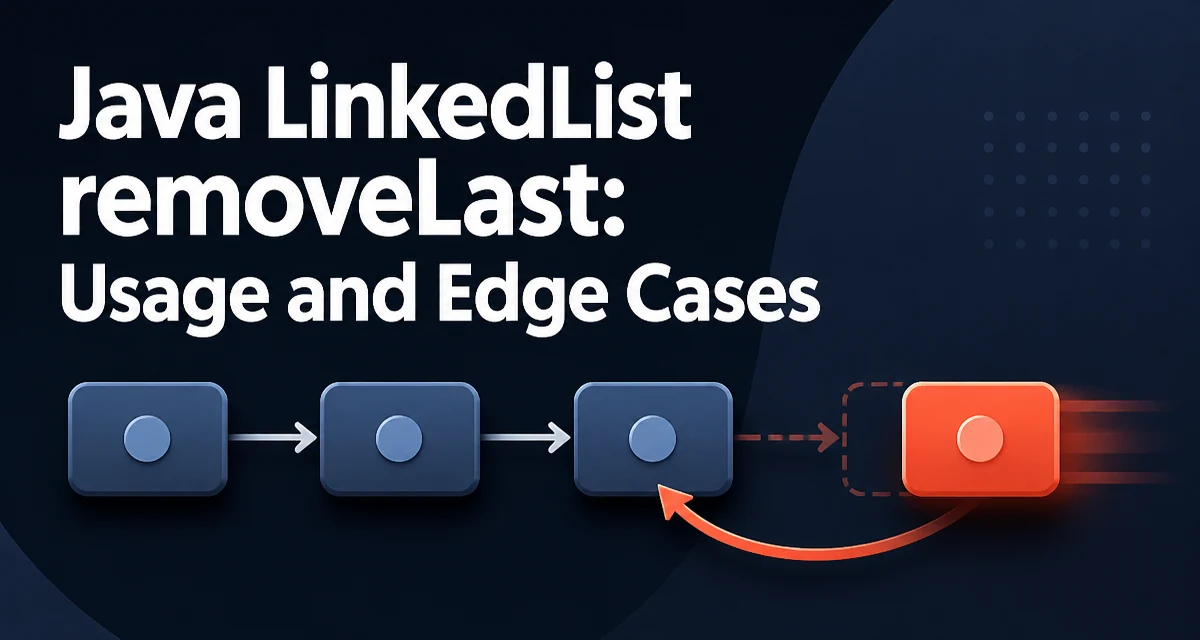
The java linkedlist removelast operation is a common pattern when you use a LinkedList as a stack or a deque. The removeLast() method removes and returns the tail element in constant time, but its behavior on an empty list and its relationship to other removal methods are easy to get wrong.
How removeLast() Works on a LinkedList
removeLast() operates directly on the linked structure. The list maintains a reference to its tail node, so the method does not traverse the list. It unlinks the tail, updates the tail reference to the previous node, clears the removed node's link, and decrements the size.
LinkedList<String> tasks = new LinkedList<>();
tasks.add("parse-config");
tasks.add("load-data");
tasks.add("render-output");

String last = tasks.removeLast();
System.out.println(last);        // render-output
System.out.println(tasks.size()); // 2
The method returns the removed element, so you can use the value immediately. The list is modified in place; no new list is allocated.
removeLast() Versus pollLast() for Empty Lists
The main distinction between removeLast() and pollLast() is behavior on an empty list. removeLast() throws NoSuchElementException when the list has no elements. pollLast() returns null instead. This matters when an empty state is a normal condition in your code, such as draining a work queue.
LinkedList<String> queue = new LinkedList<>();

// Throws NoSuchElementException
String a = queue.removeLast();

// Returns null
String b = queue.pollLast();
If an empty list is an expected state, pollLast() avoids exception handling. If an empty list indicates a programming error, removeLast() surfaces the problem immediately and makes the failure visible.
Removing the Last Element Without removeLast()
If your variable is typed as List rather than LinkedList, you cannot call removeLast() directly. The method is declared on LinkedList and on the Deque interface, not on List. You can still remove the last element using the index-based API:
List<String> items = new LinkedList<>();
items.add("first");
items.add("second");

String last = items.remove(items.size() - 1);
This works because List declares remove(int index). The runtime cost differs: on a LinkedList, remove(int) must traverse from the head to the requested index, which is O(n). The dedicated removeLast() method is O(1) because the tail is directly accessible.
If you only need the value without removal, getLast() returns the tail element without modifying the list.
Runtime Cost of Removing the Last Element
removeLast() runs in constant time. The operation involves updating the tail reference and the predecessor's next pointer. No traversal, no shifting of elements, and no array resizing occurs.
An ArrayList also removes its last element in constant time, but for a different reason: it decrements the size and nulls the last slot in its backing array. The difference shows up in memory layout. A LinkedList stores each element in a separate node with two pointers, which increases memory usage and hurts cache locality. An ArrayList stores elements contiguously, which is friendlier to the CPU cache.
For most workloads, the choice between LinkedList and ArrayList should be based on the full pattern of operations, not just end-removal. If you primarily append and remove from the end, ArrayList is often the better default.
Common Mistakes When Removing the Last Element
One frequent error is assuming that removeLast() is safe on an empty list. It is not; it throws NoSuchElementException. If you are draining a list in a loop, check isEmpty() before each removal or use pollLast().
Another mistake is using removeLast() on a variable typed as List that actually holds an ArrayList. The code will not compile unless you change the variable type to LinkedList or Deque. If you need the operation to work across list implementations, use the index-based removal and accept the traversal cost on LinkedList.
A third issue is confusing removeLast() with removeFirst(). When you are implementing a stack or queue, the distinction determines the order in which elements are processed. removeLast() combined with addLast() gives LIFO order, while removeFirst() combined with addLast() gives FIFO order.
When LinkedList Is the Right Choice for This Operation
Use removeLast() on a LinkedList when you need constant-time removal from both ends and you are already using the list as a deque. The LinkedList class implements Deque, so methods like addFirst(), addLast(), removeFirst(), and removeLast() are all available.
If your data structure only needs end operations and you do not need insertion or removal in the middle, consider ArrayDeque. It provides the same end operations in constant time with better memory locality and lower overhead per element. LinkedList is preferable when you also need indexed access or when you need to insert and remove elements at arbitrary positions, even though those operations are O(n).
The decision is not about which method is faster in isolation. It is about the full set of operations your code performs and how the collection is accessed. If you need a deque with occasional indexed access, LinkedList is a reasonable choice. If you only need a stack or queue, ArrayDeque is usually the better fit.