Java LinkedList: Usage, Performance, and Tradeoffs
java linkedlist: Understand Java LinkedList: how it works, common operations, performance tradeoffs, and when to choose it over ArrayList in real applications.
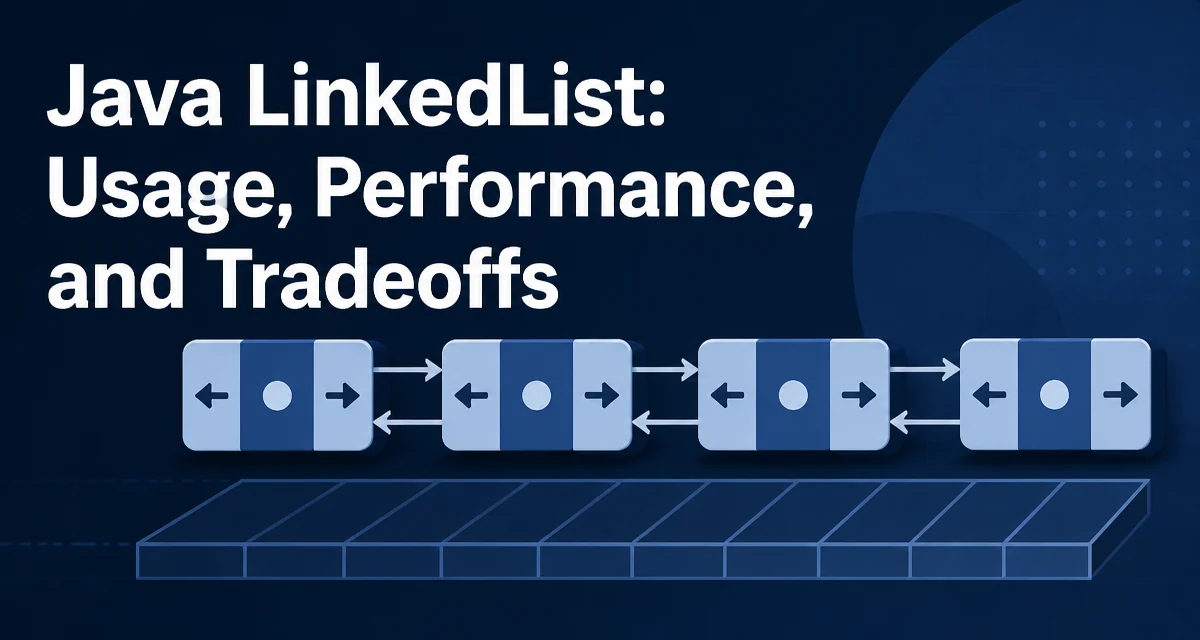
java linkedlist requires a clear understanding of the core syntax, runtime behavior, and practical implementation patterns demonstrated in the examples below.
The java.util.LinkedList class implements both the List and Deque interfaces, providing a doubly-linked list that supports efficient insertion and removal at both ends. This article explains how LinkedList behaves, where its performance advantages apply, and when another collection such as ArrayList is a better fit.
How LinkedList Stores Elements
Unlike ArrayList, which stores elements in a contiguous array, LinkedList stores each element in a separate node object. Each node holds a reference to the element, a reference to the previous node, and a reference to the next node. This structure makes LinkedList a doubly-linked list.
The node overhead is significant. Every element you add requires an additional object for the node, plus two references. For a collection of large objects, this overhead is relatively small, but for many small objects, the memory footprint can be noticeably larger than an ArrayList of the same size.
Common Operations and Their Costs
The performance of LinkedList operations depends on the position of the element you are accessing or modifying.
Adding and Removing at the Ends
Adding an element at the beginning or end of the list is an O(1) operation because LinkedList keeps references to both the first and last nodes. The same applies to removing the first or last element. This is the primary reason to choose LinkedList over ArrayList when your workload involves frequent insertions or deletions at the front.
LinkedList<String> list = new LinkedList<>();
list.addFirst("first");
list.addLast("last");
String first = list.removeFirst();
String last = list.removeLast();
Accessing Elements by Index
Accessing an element at a specific index is O(n) because the list must traverse from either the head or the tail, whichever is closer. The implementation checks the index against the size and starts from the appropriate end. For random access patterns, ArrayList is far more efficient because it can compute the memory offset directly.
LinkedList<String> list = new LinkedList<>();
// ... add elements ...
String element = list.get(1000); // traverses up to 1000 nodes
Inserting and Removing in the Middle
If you already have a reference to a node (for example, via an iterator), inserting or removing at that position is O(1). However, finding the node by index still requires traversal. In practice, if you need to insert or remove in the middle frequently, you should consider whether a different data structure, such as a TreeSet or a custom structure, better fits your access pattern.
LinkedList vs ArrayList: When to Choose Which
The decision between LinkedList and ArrayList is not about one being universally faster. It depends on your dominant operation mix.
| Operation | ArrayList | LinkedList |
|---|---|---|
| Get by index | O(1) | O(n) |
| Add at end | Amortized O(1) | O(1) |
| Add at beginning | O(n) (shifts) | O(1) |
| Remove from middle by index | O(n) (shifts) | O(n) (traverse) |
| Memory per element | Low (array) | High (node) |
Use ArrayList when you need fast indexed access and your list size is relatively stable. Use LinkedList when you frequently add or remove from the front or when you need a double-ended queue. However, for most list-like use cases, ArrayList is the default recommendation because it provides better cache locality and lower memory overhead.
Iteration and Modification: Fail-Fast Behavior
Like most Java collections, LinkedList is fail-fast. If you modify the list structurally (adding or removing elements) while iterating over it using an Iterator, the iterator will throw a ConcurrentModificationException. This behavior is not specific to LinkedList; it is a general contract in the Java Collections Framework.
To modify the list during iteration, use the iterator's own remove method, which adjusts the internal modification count safely.
LinkedList<String> list = new LinkedList<>();
list.add("a");
list.add("b");
Iterator<String> it = list.iterator();
while (it.hasNext()) {
    String s = it.next();
    if (s.equals("a")) {
        it.remove(); // safe
    }
}
Using LinkedList as a Queue or Deque
Because LinkedList implements Deque, it can be used as a queue or stack. The Deque interface provides methods like offerFirst, offerLast, pollFirst, and pollLast, which are useful for double-ended operations. In single-threaded code, LinkedList is a straightforward choice for a simple queue, but for concurrent scenarios you should use ConcurrentLinkedDeque or a blocking queue from the java.util.concurrent package.
Deque<String> deque = new LinkedList<>();
deque.offerFirst("first");
deque.offerLast("last");
String first = deque.pollFirst();
String last = deque.pollLast();
Performance and Memory Considerations
LinkedList has two major performance drawbacks compared to ArrayList: cache locality and memory overhead. Array elements are stored contiguously, so the CPU cache can prefetch them efficiently. Linked nodes are scattered across memory, causing cache misses during traversal. This makes even O(n) operations on ArrayList often faster in practice than the same operations on LinkedList, especially for large lists.
Memory overhead is also higher. Each node adds a 24-byte object header (on typical JVMs) plus two references, which can be substantial for lists containing millions of small objects. If memory is a constraint, ArrayList is almost always the better choice.
Common Pitfalls and Misconceptions
A frequent misconception is that LinkedList is faster for all insertion and removal operations. That is only true when you are operating at the ends or when you already hold a node reference. Inserting in the middle still requires traversal, which is O(n). Another pitfall is using get(index) in a loop, which turns an O(n) operation into O(n²) because each call traverses from the beginning.
// Bad: O(n²) for n elements
for (int i = 0; i < list.size(); i++) {
    System.out.println(list.get(i));
}

// Better: use an iterator or enhanced for-loop
for (String s : list) {
    System.out.println(s);
}
When LinkedList Is the Right Choice
Choose LinkedList when your application requires a double-ended queue or when you frequently add and remove from the front of a list. It also works well when you need to insert elements in the middle but already have an iterator positioned at the insertion point. For all other list operations, ArrayList provides better performance and lower memory usage. The decision should be driven by your actual access patterns, not by a general preference for one collection over another.