Java List Add: Methods, Behavior, and Performance
java list add: Learn how to add elements to a Java List using add(), addAll(), and index-based insertion, and understand the behavior and performance of ArrayList and...
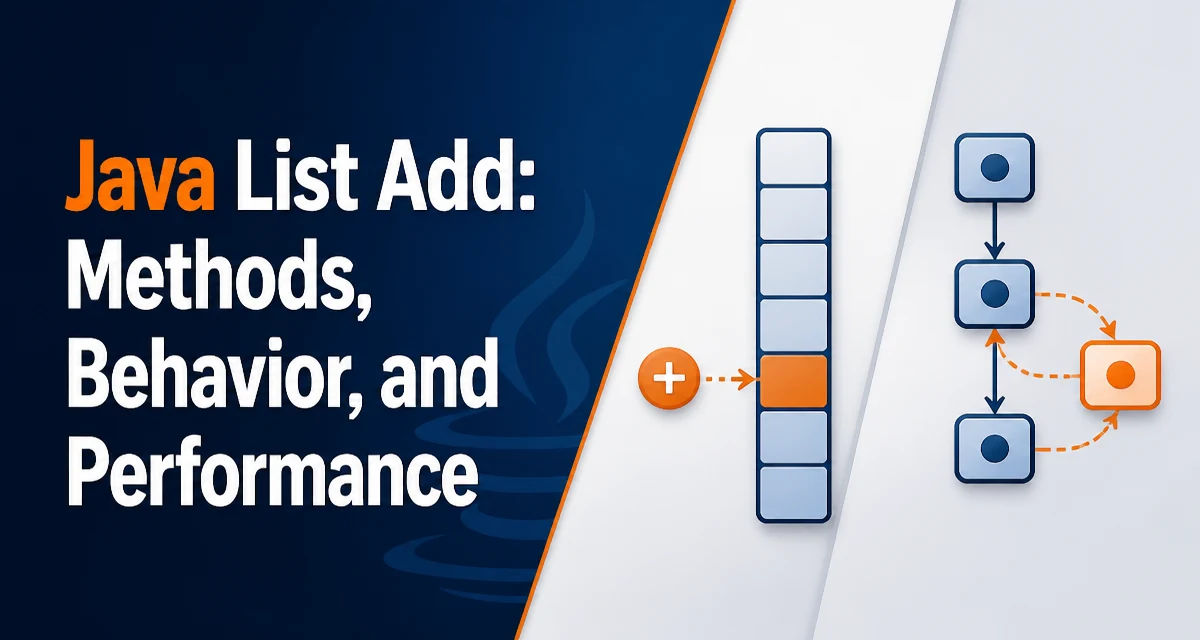
When working with Java collections, the java list add operation is one of the most frequently used actions. The List interface provides several ways to insert elements, and the choice of method and implementation can affect both correctness and performance. This article walks through the core add methods, how different List implementations behave, and what to consider when deciding how to add elements in your Java code.
The add() Method: Basic Usage
The List interface defines two overloads of the add method. The first appends an element to the end of the list:
List<String> names = new ArrayList<>();
names.add("Alice");
names.add("Bob");
After these calls, names contains ["Alice", "Bob"]. The second overload inserts an element at a specified index, shifting any subsequent elements to the right:
names.add(1, "Charlie");
// names is now ["Alice", "Charlie", "Bob"]
The index must be between 0 and the current size of the list, inclusive. Passing an index outside that range throws an IndexOutOfBoundsException. This overload is useful when you need to maintain a specific order, but it comes with a cost: shifting elements can be expensive for large lists, as discussed later.
Adding Multiple Elements with addAll()
When you need to add a collection of elements at once, the addAll method is more convenient than repeated add calls. It also has two overloads:
List<Integer> numbers = new ArrayList<>();
numbers.add(1);
numbers.add(2);

List<Integer> more = Arrays.asList(3, 4, 5);
numbers.addAll(more); // appends all elements

numbers.addAll(1, Arrays.asList(10, 20)); // inserts at index 1
The first addAll(Collection<? extends E> c) appends the collection at the end. The second inserts at a given index, shifting the existing elements. Both methods throw NullPointerException if the collection is null, and IndexOutOfBoundsException for an invalid index. Using addAll is often clearer than a loop, but be aware that it copies references from the source collection; it does not create deep copies of the objects.
How List Implementations Affect Add Behavior
The List interface has multiple implementations, and the underlying data structure changes how add behaves internally. The two most common are ArrayList and LinkedList.
ArrayList uses a resizable array. Appending to the end is usually fast because it simply writes to the next available slot. When the array is full, a new larger array is allocated and all existing elements are copied over. This resizing operation is amortized constant time, meaning that over many appends the average cost per operation is O(1). Inserting at an arbitrary index requires shifting all subsequent elements one position to the right, which is O(n) in the worst case.
LinkedList stores elements as nodes, each holding a reference to the previous and next node. Adding at the beginning or end is O(1) because the list maintains direct references to the head and tail. Adding at an arbitrary index requires traversing the list from the head or tail to find the insertion point, which is O(n). Additionally, each node has extra memory overhead compared to an array slot.
Consider this example:
List<String> arrayList = new ArrayList<>();
arrayList.add(0, "first"); // shifts all existing elements

List<String> linkedList = new LinkedList<>();
linkedList.add(0, "first"); // inserts a new node at the head
For a list with many elements, the ArrayList insertion at index 0 will be significantly slower because every element must be moved. The LinkedList operation is constant time, but it pays a memory cost per element.
Null Elements and Type Safety
A List can contain null elements unless the implementation explicitly forbids it. Most standard implementations like ArrayList and LinkedList allow null. However, some specialized lists, such as those returned by List.of() (Java 9+) or Arrays.asList() with fixed-size backing arrays, do not allow null or may throw UnsupportedOperationException for structural modifications.
List<String> fixed = Arrays.asList("a", "b");
fixed.add("c"); // throws UnsupportedOperationException

List<String> immutable = List.of("a", "b");
immutable.add("c"); // throws UnsupportedOperationException
When using generics, the compiler enforces type safety at compile time. For example, a List<String> cannot accept an Integer without a cast. This is a major advantage over raw types, which bypass compile-time checks and can lead to ClassCastException at runtime.
Performance Considerations for List Add Operations
The performance of add depends on the implementation, the insertion point, and the current size of the list. For ArrayList, appending to the end is amortized O(1) because the occasional resize is spread across many appends. Inserting in the middle or at the beginning is O(n) due to element shifting. For LinkedList, adding at the beginning or end is O(1), but adding at an arbitrary index is O(n) because of traversal.
These differences matter in real applications. If you frequently insert at the beginning of a large list, LinkedList may be a better choice. If you mostly append and occasionally read by index, ArrayList is usually more efficient and uses less memory. There is no universal "best" implementation; the right choice depends on your access patterns.
It's also worth noting that ArrayList has a capacity that can be preallocated using the constructor new ArrayList<>(initialCapacity). This avoids repeated resizing when you know the approximate number of elements in advance. For example:
List<Integer> values = new ArrayList<>(1_000_000);
for (int i = 0; i < 1_000_000; i++) {
    values.add(i);
}
This can reduce the overhead of array copies during resizing, though the overall complexity remains the same.
Common Mistakes and Edge Cases
One common mistake is using an index that is out of bounds. The add(int index, E element) method accepts an index equal to the current size, which appends the element, but any index greater than that throws IndexOutOfBoundsException. For example:
List<String> list = new ArrayList<>();
list.add(1, "x"); // throws IndexOutOfBoundsException because size is 0
Another edge case is modifying a list while iterating over it. If you use an iterator and call add on the list directly, you will get a ConcurrentModificationException. Instead, use ListIterator which supports an add method that inserts at the iterator's current position:
List<String> names = new ArrayList<>(List.of("A", "B"));
ListIterator<String> it = names.listIterator();
it.next();
it.add("C"); // inserts after the current element
This is safe because the iterator updates its own state. Also, be careful with lists returned by Arrays.asList(): they have a fixed size, so add and remove throw UnsupportedOperationException, even though set works.
Choosing the Right List for Your Add Pattern
To decide which List implementation to use, analyze how your code adds elements. If you primarily append to the end and access elements by index, ArrayList is the standard choice. It offers fast random access and low memory overhead. If you frequently insert or remove at the beginning, or if you need to insert in the middle often, LinkedList may be better because it avoids shifting elements. However, LinkedList has higher memory per element and slower index-based access.
For example, a queue-like workload that adds to the tail and removes from the head is a good fit for LinkedList. A log collector that appends entries and occasionally reads them all is better served by ArrayList. In most real-world applications, ArrayList is the default because the performance characteristics are predictable and the memory footprint is smaller. Use LinkedList only when profiling or design indicates that head insertions are a bottleneck.
Ultimately, the java list add operation is straightforward in syntax, but its behavior and cost vary with the list implementation and the position of insertion. Understanding these differences helps you write code that is both correct and efficient.