Java Logical Operators: &&, ||, and ! Explained
java logical operators: Understand Java logical operators &&, ||, and !, including short-circuit evaluation, precedence, and common mistakes in real validation code.
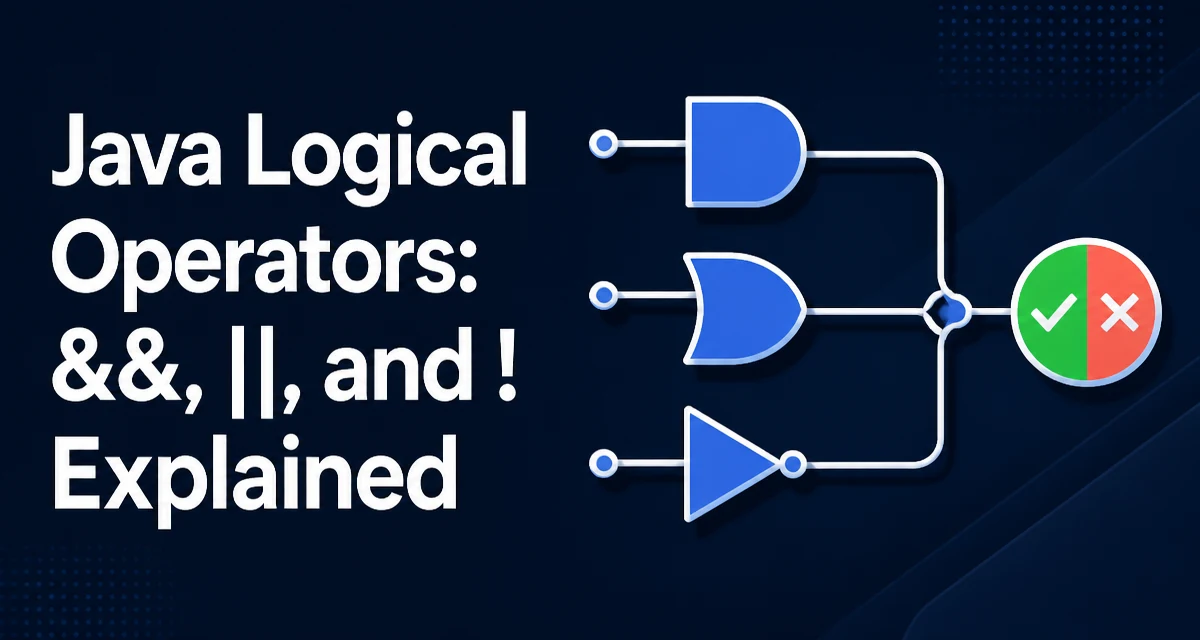
Java logical operators evaluate boolean expressions and combine conditions into a single true or false result. The three operators are && (logical AND), || (logical OR), and ! (logical NOT). They appear in nearly every conditional statement, loop guard, and validation check in Java code.
The Three Core Logical Operators
&& returns true only when both operands are true. || returns true when at least one operand is true. ! inverts the boolean value of its single operand.
boolean isAdult = age >= 18;
boolean hasPermission = user.isAdmin() || user.isOwner();

if (isAdult && hasPermission) {
    // both conditions must hold
}

if (!isAdult) {
    // the negation of isAdult
}
The operands of && and || must be boolean expressions. Unlike some languages where integers or objects can be coerced to boolean, Java requires an explicit comparison or a boolean variable.
Short-Circuit Evaluation and Its Side Effects
&& and || evaluate their right operand only when necessary. For &&, if the left operand is false, the result is false regardless of the right operand, so the right side is never evaluated. For ||, if the left operand is true, the result is true, and the right side is skipped.
if (list != null && list.size() > 0) {
    // safe: list.size() only runs when list is not null
}

if (user == null || user.getAccount() == null) {
    // safe: user.getAccount() only runs when user is not null
}
This short-circuit behavior is what makes null checks before method calls safe. Without it, the right operand would throw a NullPointerException whenever the left operand is null.
The skipped evaluation also means side effects on the right side never execute. A method call with a side effect, such as incrementing a counter or writing to a log, is silently omitted when the left operand already determines the result.
if (isValid(input) && logAttempt(input)) {
    // logAttempt is never called when isValid returns false
}
If the side effect must always run, evaluate it separately before the condition.
Logical Operators vs Bitwise Operators
Java also provides & and | for boolean operands. These are bitwise operators when applied to integers, but when both operands are boolean, they perform logical AND and OR without short-circuiting.
boolean result = isReady() & isConfigured();
Both operands are always evaluated. This matters when the right operand has a side effect that must run, or when the right operand must be evaluated to detect an error. In most condition checks, && and || are the correct choice because they avoid unnecessary work and prevent null-related failures.
The difference is subtle and easy to miss in a code review. A & where && was intended can cause a NullPointerException or an unnecessary method call on every evaluation.
Operator Precedence and Grouping
Precedence determines how operators bind when parentheses are absent. ! has higher precedence than &&, which has higher precedence than ||.
boolean result = a || b && c;
// equivalent to a || (b && c)
The && binds tighter than ||, so b && c is evaluated first. This is the same precedence relationship as multiplication before addition in arithmetic expressions.
Relying on this precedence is common, but explicit parentheses make the intent visible to the next developer. A condition like a || b && c is correct but forces the reader to recall the precedence table. Writing a || (b && c) removes the ambiguity.
The ! operator binds tightly to its immediate operand. !a && b means (!a) && b, not !(a && b).
Common Mistakes with Logical Operators
A frequent error is writing if (x == 1 || 2) when the intent is to test whether x equals either value. The expression 1 || 2 is not a valid boolean expression because 2 is not boolean. The correct form is x == 1 || x == 2.
Another mistake is using & and | for boolean logic when short-circuiting was intended. This usually happens after converting code from another language or when copying a bitwise expression.
Assigning the result of a comparison to a boolean variable is straightforward, but confusing the assignment operator with the equality operator produces a compile error in Java, which is preferable to the silent behavior seen in some other languages.
boolean valid = (status == ACTIVE) && (retries < MAX_RETRIES);
The parentheses around each comparison are optional because == binds tighter than &&, but they improve readability.
Runtime Cost and When It Matters
The runtime cost of && and || is minimal: a branch and possibly a jump in the generated bytecode. The more significant cost comes from the expressions being evaluated. Short-circuiting reduces the number of method calls and field accesses when the left operand already decides the result.
if (expensiveCheck() && cheapCheck()) {
    // expensiveCheck runs every time; cheapCheck runs only when expensiveCheck is true
}
Ordering operands so that the cheaper or more likely short-circuiting check comes first reduces total work. For &&, put the check most likely to be false first. For ||, put the check most likely to be true first. This is a micro-optimization, but in hot paths such as request validation or loop conditions, it can avoid repeated method calls.
The JIT compiler may inline simple getters and fold constant conditions, but relying on that is not a substitute for writing conditions that avoid unnecessary evaluation.
Combining Logical Operators in Real Validation Code
A realistic validation method often combines all three operators.
public boolean canProcessOrder(Order order) {
    return order != null
        && order.getStatus() != OrderStatus.CANCELLED
        && (order.getTotal() > 0 || order.isGiftCard())
        && !order.isExpired();
}
Each line tests one concern. The null check comes first so later method calls are safe. The || group handles the case where either condition is acceptable. The ! operator inverts the expiry check.
This pattern keeps validation logic readable and prevents the same checks from being duplicated across callers. The short-circuit order also ensures that order.getStatus() is never called on a null order.