Java Math ceil floor: Rounding Direction Explained
java math ceil floor: Learn how Java's Math.ceil and Math.floor round doubles, handle negative numbers and edge cases, and when to use each method.
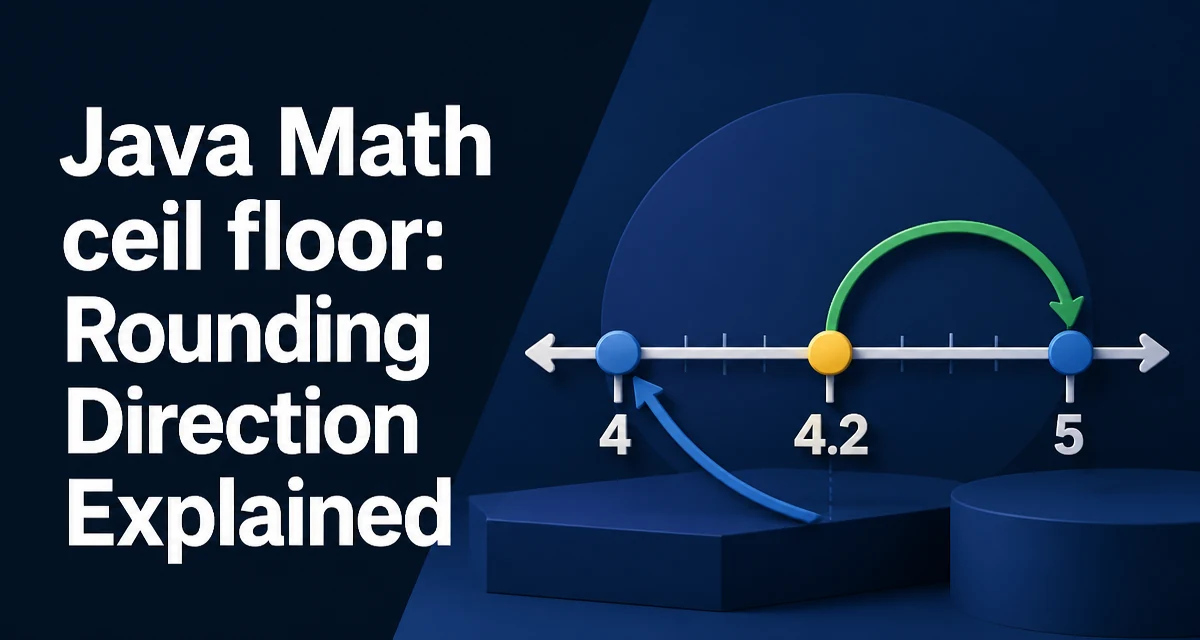
When you need to round a double to a whole number in Java, java math ceil floor give you explicit control over the rounding direction. Unlike Math.round, which rounds to the nearest integer, Math.ceil always rounds toward positive infinity and Math.floor always rounds toward negative infinity. Both methods are part of java.lang.Math and are available in every Java runtime, so they require no extra imports or dependencies.
The Core Behavior of Math.ceil and Math.floor
Math.ceil(double a) returns the smallest (closest to negative infinity) double value that is greater than or equal to a. Math.floor(double a) returns the largest (closest to positive infinity) double value that is less than or equal to a. The return type is double, not int or long, which matters when you assign the result.
double value = 4.2;
System.out.println(Math.ceil(value));  // 5.0
System.out.println(Math.floor(value)); // 4.0
The methods work on the entire double range. For a positive input, ceil moves the value up to the next integer boundary, and floor moves it down. For a value that is already an integer, both methods return the same integer as a double.
Handling Negative Numbers Correctly
The rounding direction becomes more interesting with negative inputs. Math.ceil rounds toward positive infinity, so it moves a negative number closer to zero. Math.floor rounds toward negative infinity, so it moves a negative number farther from zero.
double negative = -4.2;
System.out.println(Math.ceil(negative));  // -4.0
System.out.println(Math.floor(negative)); // -5.0
This is a common source of confusion. If you expect ceil to always round "up" in the sense of increasing the numeric value, remember that "up" means toward positive infinity. Similarly, floor always moves toward negative infinity. For negative numbers, this means ceil(-4.2) is -4.0 (larger than the input), and floor(-4.2) is -5.0 (smaller than the input).
Edge Cases: Zero, NaN, and Infinity
The Java Language Specification defines specific behavior for non-finite and zero arguments. If the argument is NaN, both methods return NaN. If the argument is positive or negative infinity, they return the same infinity. For positive zero and negative zero, the result is the same zero with the same sign.
System.out.println(Math.ceil(Double.NaN));      // NaN
System.out.println(Math.floor(Double.POSITIVE_INFINITY)); // Infinity
System.out.println(Math.ceil(-0.0));            // -0.0
These edge cases rarely appear in everyday arithmetic, but they are important when you process data from external systems or sensor readings. A NaN value will propagate through the calculation, so you should validate inputs if your domain can produce them.
Rounding Direction and the Role of Math.rint
Java also provides Math.rint, which rounds to the nearest integer and returns a double, but it breaks ties by rounding to the even neighbor. This is different from Math.round, which returns a long (or int when given a float) and rounds half up. The choice among these methods depends on the rounding rule your application requires.
| Method | Return type | Rounding rule | Typical use |
|---|---|---|---|
Math.ceil | double | Toward positive infinity | Minimum number of pages |
Math.floor | double | Toward negative infinity | Maximum items that fit in a bin |
Math.round | long/int | Nearest integer, half up | General rounding to nearest |
Math.rint | double | Nearest integer, ties to even | Statistical calculations |
This table is a concise reference for deciding which method fits your rounding requirement.
Practical Usage Patterns in Real Code
A common use of Math.ceil is computing the number of pages or chunks needed to hold a set of items. For example, if you have totalItems and a fixed pageSize, the number of pages is:
int totalItems = 101;
int pageSize = 10;
int pageCount = (int) Math.ceil((double) totalItems / pageSize);
The cast to int is necessary because Math.ceil returns a double. Without the cast, the assignment would fail to compile. The division must be performed on double values, or you will get integer truncation before ceil can act.
Math.floor is useful when you need to limit a value to a lower bound, such as calculating the maximum number of items that fit in a container without exceeding its capacity:
double capacity = 10.0;
double itemSize = 3.0;
int maxItems = (int) Math.floor(capacity / itemSize);
Here capacity / itemSize is 3.333..., and floor gives 3.0, which is the correct maximum count.
Casting to Integer and Overflow Risks
Because Math.ceil and Math.floor return double, you often cast the result to int or long. This cast can silently overflow if the result exceeds the target type's range. For example, (int) Math.ceil(Double.MAX_VALUE) will produce 2147483647, the maximum int, because the conversion saturates. This behavior is defined by the Java language, but it can lead to incorrect business logic if you do not anticipate it.
If your calculation can produce values outside the int range, use long instead. For very large doubles, even long may be insufficient, and you should reconsider whether an integer representation is appropriate. The same caution applies when you use Math.round, which returns a long to reduce overflow risk.
Choosing Between Math.ceil, Math.floor, and Math.round
The correct method depends on the rounding rule your problem requires. Use Math.ceil when you need the smallest integer that is greater than or equal to a value, such as allocating enough capacity or calculating a page count. Use Math.floor when you need the largest integer that is less than or equal to a value, such as determining how many whole items fit in a space. Use Math.round when you want the nearest integer and the fractional part is 0.5 or greater rounds up.
For negative numbers, verify that the direction matches your domain. A banking application might need Math.floor for debits and Math.ceil for credits, depending on how you want to favor the customer. There is no universal "correct" rounding method; the choice is a business rule that you must encode explicitly.