Java Method Declaration: Syntax and Structure
java method declaration: A practical breakdown of Java method declaration syntax: modifiers, return types, parameters, varargs, overloading, and common compile errors.
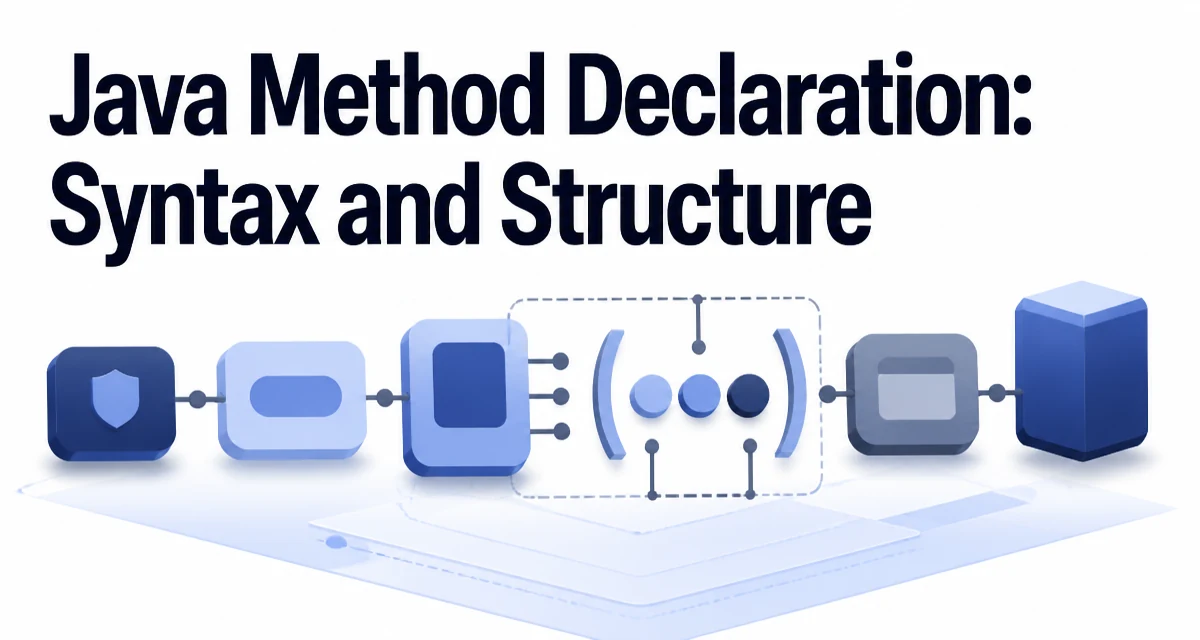
The Structure of a Java Method Declaration
A Java method declaration follows a fixed order that the compiler enforces. Every part of the declaration has a specific role, and rearranging them produces a compile error.
[modifiers] returnType methodName(parameterList) [throws exceptionList] {
    // method body
}
The modifiers come first, followed by the return type, the method name, the parameter list in parentheses, an optional throws clause, and finally the method body in braces.
A minimal complete declaration:
public int add(int a, int b) {
    return a + b;
}
This declares a method named add that takes two int parameters and returns an int. The public modifier makes it accessible from any class in the application.
Access Modifiers: Visibility Rules
Java provides four access modifiers that control which code can call a method:
public— accessible from any class in any packageprotected— accessible within the same package and from subclassesprivate— accessible only within the declaring class- package-private (no modifier) — accessible only within the same package
The choice of access modifier affects the API surface of a class. A private method is an implementation detail; it can be renamed, changed, or removed without affecting callers outside the class. A public method becomes part of the contract other code depends on, so changing its signature can break callers.
A common rule is to start with private and widen visibility only when a method genuinely needs to be called from outside the class.
Static, Final, and Other Non-Access Modifiers
Beyond access modifiers, a method declaration can include:
static— the method belongs to the class rather than to an instancefinal— the method cannot be overridden in a subclassabstract— the method has no body and must be implemented by a subclasssynchronized— the method acquires the monitor lock before executingnative— the method body is implemented in platform-specific code
The static modifier is the most frequently used of these. A static method is invoked through the class name rather than through an instance:
public class MathUtils {
    public static int square(int value) {
        return value * value;
    }
}
Calling it:
int result = MathUtils.square(9);
A static method cannot access instance fields or call instance methods directly, because it has no this reference. This restriction is a common source of compile errors for developers new to Java.
Return Types: void, Primitives, and References
The return type appears immediately before the method name. It can be:
void— the method returns nothing- a primitive type such as
int,boolean, ordouble - a reference type such as
String,List<String>, or a custom class
A method declared with void does not need a return statement, but it may use return; to exit early:
public void logIfNegative(int value) {
    if (value >= 0) {
        return;
    }
    System.out.println("Negative: " + value);
}
A method with a non-void return type must return a value on every code path that reaches the end of the method. The compiler enforces this rule, so a missing return statement is a compile error rather than a runtime failure.
Parameters and Method Overloading
The parameter list declares the types and names of values the method accepts. Parameter names are local to the method body and have no effect on how callers invoke the method.
Method overloading allows multiple methods in the same class to share a name, as long as their parameter lists differ in type, count, or order:
public class Calculator {
    public int add(int a, int b) {
        return a + b;
    }

    public double add(double a, double b) {
        return a + b;
    }

    public int add(int a, int b, int c) {
        return a + b + c;
    }
}
The return type is not part of the method signature. Two methods that differ only in return type cannot coexist in the same class, because the compiler cannot distinguish them when a call's result is discarded.
Varargs: Variable-Length Parameter Lists
A method can accept a variable number of arguments using varargs syntax. The varargs parameter must be the last parameter in the list:
public static int sum(int... values) {
    int total = 0;
    for (int value : values) {
        total += value;
    }
    return total;
}
Callers can pass any number of arguments, including none:
sum();
sum(1);
sum(1, 2, 3, 4);
Behind the scenes, the varargs parameter is treated as an array. The method body iterates over it exactly as it would over an int[]. A method that accepts an array and a method that accepts varargs cannot both be declared with the same name and parameter type, because the compiler treats them as the same signature.
Common Declaration Mistakes
Several declaration errors appear frequently in Java code.
A missing return statement on a non-void method:
public int divide(int a, int b) {
    if (b != 0) {
        return a / b;
    }
    // compile error: missing return statement
}
The compiler rejects this because the method can reach its end without returning a value. The fix is to add a return statement for the remaining path.
A method that tries to change a parameter and expects the caller to see the change:
public void increment(int value) {
    value++;
}
Java passes primitives by value, so the caller's variable is unchanged. The method must return the new value instead:
public int increment(int value) {
    return value + 1;
}
Declaring a method with the same signature as an existing method but a different return type also fails to compile, because the return type is not part of the signature.
Declaration Style and Maintainability
Method declarations are the primary unit of behavior in a Java class, and their style affects how easily the class can be maintained.
A method name should describe what the method does, not how it does it. calculateTotal is clearer than doStuff. A method that performs a single task with a clear name is easier to test and reuse than a method that mixes several responsibilities.
The throws clause is part of the declaration and should list only checked exceptions the method can actually throw. Declaring overly broad exception types such as throws Exception forces callers to handle exceptions they cannot meaningfully recover from and hides the method's actual failure modes.
Parameter count matters for readability. A method with more than three or four parameters becomes difficult to call correctly, because callers must remember the order and meaning of each argument. When a method genuinely needs many inputs, grouping related values into a small class or record improves the declaration:
public record SearchCriteria(String query, int limit, boolean includeArchived) {}

public List<Document> search(SearchCriteria criteria) {
    // implementation
}
This keeps the method declaration short and makes call sites self-documenting.