Java Method Syntax: Parameters, Returns, and Overloading
java method syntax: Learn the exact Java method syntax for declarations, parameters, return types, varargs, and overloading with practical examples and common errors.
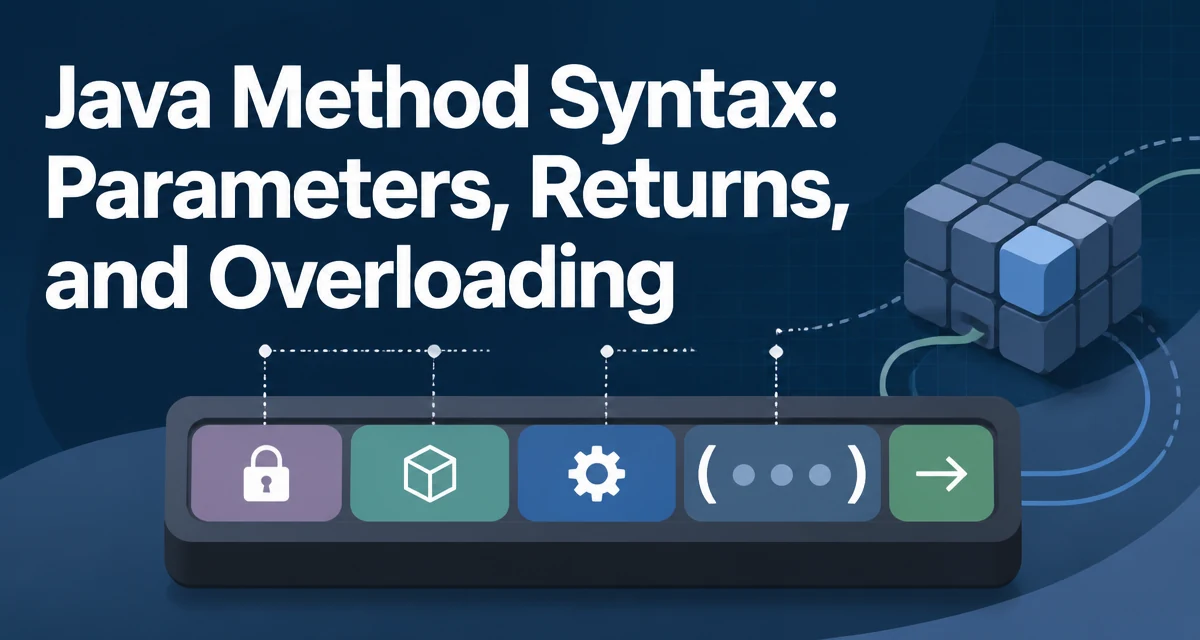
The core of Java method syntax is a fixed component order in the declaration, and the compiler rejects any deviation. The standard form is:
public static int calculateTotal(int price, int quantity) {
    return price * quantity;
}
Reading left to right: public is the access modifier, static is a behavior modifier, int is the return type, calculateTotal is the method name, and (int price, int quantity) is the parameter list. The body sits between braces and contains the statements executed when the method is called.
The only mandatory components are the return type, the method name, the parentheses, and the body. Modifiers and parameters are optional. A method with no parameters still requires empty parentheses:
public String getServerName() {
    return this.serverName;
}
The return type cannot be omitted, even when the method returns nothing. That case uses the void keyword, which is covered later in this article.
Modifiers and Their Effect on Visibility
Access modifiers determine which classes can call a method. Java provides four levels:
| Modifier | Accessible from |
|---|---|
public | Any class in any package |
protected | Same package, plus subclasses in other packages |
| (none) | Same package only (package-private) |
private | Only the declaring class |
Choosing the narrowest access level that satisfies the callers keeps the method's implementation free to change later. A private helper can be renamed, reordered, or removed without affecting other classes.
Beyond access, the most common behavior modifiers are static, final, abstract, and synchronized. A static method belongs to the class rather than an instance, so it cannot access instance fields or call instance methods directly. A final method cannot be overridden in a subclass. An abstract method has no body and must be implemented by a concrete subclass. A synchronized method acquires the monitor of the receiver object before executing, which serializes concurrent calls on that object.
Modifiers can appear in any order, but the conventional order is access modifier first, then the rest. Following that convention makes declarations easier to scan.
Parameters and Argument Passing
Java passes every argument by value. For primitive types, the method receives a copy of the value. For reference types, the method receives a copy of the reference, which points to the same object.
public void applyDiscount(Product product, double percent) {
    product.setPrice(product.getPrice() * (1 - percent));
    percent = 0; // no effect on the caller's variable
}
The setPrice call mutates the Product instance the caller passed, because both the caller and the method hold references to the same object. Reassigning percent inside the method does not change the caller's variable, because percent is a copy.
This distinction is a frequent source of confusion. Passing an object does not allow the method to replace the caller's reference; it only allows mutation of the object's internal state. To return a new object, the method must return it explicitly.
Parameters are also subject to definite assignment. A parameter is always initialized with the argument supplied at the call site, so the compiler never complains about an uninitialized parameter inside the method body.
Return Types and the void Keyword
Every method declares a return type, and every non-void method must return a value on every code path. The compiler enforces this rule, so a method that conditionally returns will fail to compile if any path falls through.
public boolean isAvailable(Product product) {
    if (product == null) {
        return false;
    }
    return product.getStock() > 0;
}
The void keyword marks a method that performs work without producing a result:
public void logRequest(String endpoint) {
    logger.info("Request received for {}", endpoint);
}
A void method can still use return; to exit early, but it cannot return a value. Mixing the two is a compile error.
For methods that return a reference type, returning null is allowed unless the method is annotated with a nullness contract that forbids it. Callers should check for null when the method's contract does not guarantee a non-null result.
Varargs for Flexible Argument Counts
Varargs let a method accept zero or more arguments of a single type. The syntax places an ellipsis after the type:
public static double average(double... values) {
    if (values.length == 0) {
        return 0;
    }
    double sum = 0;
    for (double value : values) {
        sum += value;
    }
    return sum / values.length;
}
Inside the method, values is treated as an array. The caller can pass individual arguments, an array, or nothing at all:
double a = average(10, 20, 30);
double b = average(new double[] {1, 2, 3});
double c = average();
A varargs parameter must be the last parameter in the list. Declaring it anywhere else produces a compile error. Overloading with varargs is legal but can create ambiguity when a call matches both a fixed-arity method and a varargs method; the compiler prefers the fixed-arity version.
Method Overloading and Compile-Time Resolution
Overloading lets multiple methods share a name when their parameter lists differ. The return type is not part of the signature, so two methods cannot differ only by return type.
public static int add(int a, int b) {
    return a + b;
}

public static double add(double a, double b) {
    return a + b;
}
The compiler selects the most specific applicable method at compile time based on the argument types. Calling add(1, 2) resolves to the int version, while add(1.5, 2.5) resolves to the double version. This resolution is entirely static; it does not depend on the runtime type of the arguments.
Overloading is useful for providing sensible defaults or handling related input types, but excessive overloading with similar signatures makes call sites harder to read. When overloads begin to differ only in the number of parameters, consider whether a single varargs method or a differently named method would be clearer.
Common Syntax Errors and Their Causes
The most frequent syntax errors in method declarations come from a small set of misunderstandings.
Omitting the return type is the first. A declaration like public calculateTotal(int price) is invalid because the compiler cannot tell whether calculateTotal is a method name or a type. The return type must always be present, including void.
Forgetting a return statement in a non-void method is the second. The compiler reports "missing return statement" when any path through the method can reach the end without returning. The fix is to ensure every branch returns, or to restructure the logic so a single return covers all cases.
Placing a varargs parameter anywhere except the last position is the third. The compiler rejects the declaration because the array expansion would be ambiguous.
A fourth error is confusing parameter names with field names. Assigning price = price inside a method assigns the parameter to itself and leaves the field unchanged. Using this.price = price disambiguates the field from the parameter.
Keeping Method Syntax Maintainable
The syntax rules are fixed, but how you apply them affects maintainability. A method that is short, has a descriptive name, and declares its parameters clearly is easier to reason about than one that packs multiple responsibilities into a single body.
Prefer small parameter lists. A method with more than three or four parameters becomes hard to call correctly, especially when several parameters share a type. When that happens, group related values into a small immutable object and pass that instead.
Use the most specific return type that callers need. Returning a broad type such as Object forces callers to cast and hides the method's contract. Returning a narrow, well-defined type keeps call sites readable.
Finally, keep access modifiers as restrictive as the callers require. A method that is public when only the same class uses it creates a wider API surface than necessary, and changing it later can break external callers. Starting with private and widening only when a real need appears keeps the class's public contract small.