Java Multi-Catch: Catch Multiple Exceptions Cleanly
java multi catch: Learn how Java multi-catch simplifies exception handling by catching multiple exception types in one block, with syntax, limitations, and practical e...
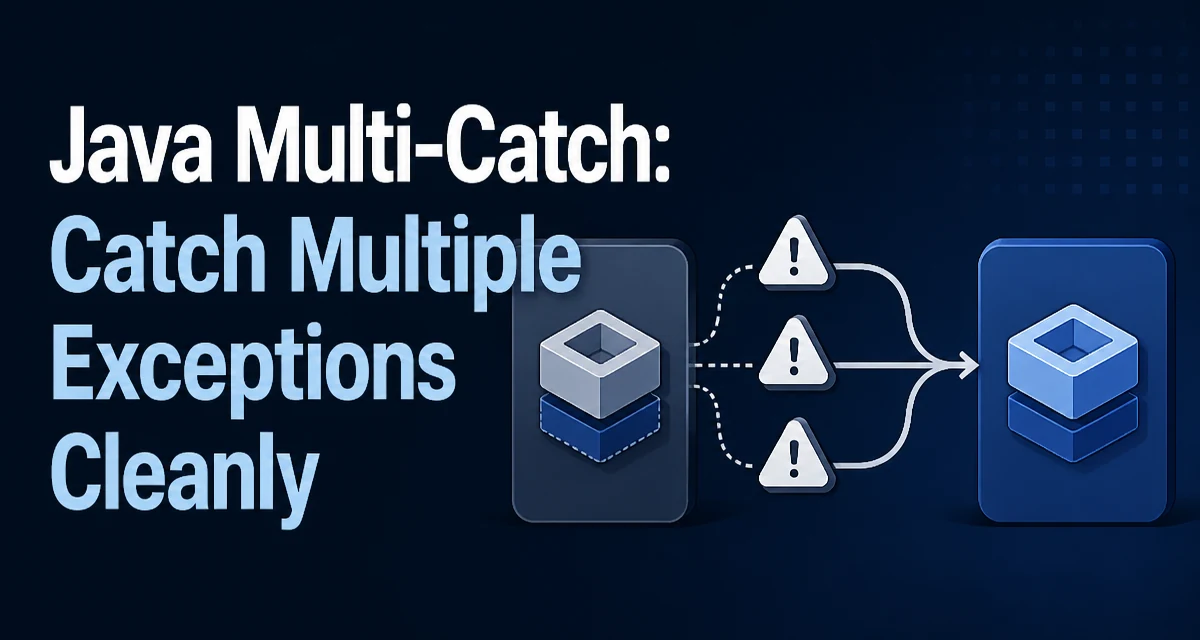
Java multi catch, introduced in Java 7, lets you handle multiple exception types in a single catch block when those types are not subclasses of each other. This reduces repetitive catch blocks and makes error handling more readable. Instead of writing several catch blocks that perform the same logic, you can group the exception types with a pipe (|) and share one handler.
Basic Syntax of Multi-Catch
The syntax follows the standard try-catch structure, but the catch parameter lists multiple exception types separated by |:
try {
    // code that may throw different exceptions
} catch (IOException | SQLException e) {
    // shared handling logic
    System.err.println("Operation failed: " + e.getMessage());
}
The exception variable e is implicitly final. You cannot assign a new value to it inside the block, which prevents accidental reassignment and keeps the behavior predictable.
How Multi-Catch Handles Exception Types
When an exception is thrown, the runtime checks each catch block in order. With multi-catch, the first catch block whose exception type matches the thrown exception is selected. The match is based on the actual exception class, not the declared types. If the thrown exception is a subclass of one of the listed types, it will be caught as well, provided the subclass is not also listed explicitly.
For example, FileNotFoundException is a subclass of IOException. If you catch IOException | SQLException, a FileNotFoundException will be caught by the IOException branch because it is an IOException. This behavior is identical to separate catch blocks, but the shared handler runs only once.
The Exception Variable Is Effectively Final
In a multi-catch block, the exception variable is effectively final. This means you cannot reassign it, and you can use it inside lambda expressions or anonymous inner classes if needed. This constraint is enforced by the compiler. Attempting to assign a new value results in a compilation error:
try {
    // risky code
} catch (IOException | SQLException e) {
    e = new IOException(); // compile error: cannot assign a value to final variable e
}
This design avoids ambiguity about which exception is being handled and makes the code easier to reason about. If you need to wrap the exception, create a new variable instead.
When Multi-Catch Cannot Be Used
You cannot combine exception types that have a subclass relationship in the same multi-catch block. The compiler rejects such combinations because the catch would be redundant or ambiguous. For example, this is invalid:
try {
    // code
} catch (FileNotFoundException | IOException e) { // error: alternatives in a multi-catch statement cannot be related by subclassing
}
The rationale is that FileNotFoundException is already an IOException, so catching both would mean the same handler applies to both, but the compiler forces you to choose the more general type. This rule prevents misleading code that suggests distinct handling when there is none.
Multi-Catch vs. Separate Catch Blocks
Separate catch blocks allow different handling per exception type. Multi-catch is appropriate when the handling logic is identical. Consider this scenario where you read a configuration file and parse a number:
// Separate catch blocks
catch (IOException e) {
    logError("Failed to read config", e);
} catch (NumberFormatException e) {
    logError("Invalid number in config", e);
}

// Multi-catch
catch (IOException | NumberFormatException e) {
    logError("Failed to process config", e);
}
If the actions are the same, multi-catch reduces duplication. However, if you need to differentiate the error message or recovery steps, separate blocks are clearer. Multi-catch does not replace separate blocks; it complements them for cases where the response is identical.
Using Multi-Catch with Custom Exceptions and Re-throwing
Multi-catch works with custom exception classes as long as they are not in a subclass relationship. You can also re-throw the exception with a more general type if the method signature allows it. Since Java 7, the compiler performs precise re-throw analysis: if you re-throw the exception variable from a multi-catch, the compiler knows the exact types that can be thrown and only requires those in the method's throws clause.
public void process() throws IOException, SQLException {
    try {
        // risky operations
    } catch (IOException | SQLException e) {
        log(e);
        throw e; // compiler knows it's either IOException or SQLException
    }
}
This is more precise than declaring a broad Exception type. The method signature reflects the actual exceptions, which helps callers handle them appropriately.
Performance and Maintainability Considerations
Multi-catch does not introduce runtime overhead. The compiled bytecode is equivalent to having separate catch blocks; the JVM handles the exception table entries efficiently. The benefit is primarily at the source level: less duplication, fewer lines, and a single place to modify when the handling logic changes.
From a maintainability perspective, multi-catch reduces the risk of inconsistent handling. If you update the shared logic, you only change it once. However, be cautious when grouping exceptions that have different recovery semantics. If you later need to differentiate, you must split the block, which is a small refactor.
Another subtle point: the exception variable's type is the common supertype of the listed exceptions. In the example with IOException | SQLException, e is of type Exception (the least upper bound). This means you can only call methods available on Exception, not methods specific to IOException or SQLException. If you need type-specific methods, you must cast or use separate catch blocks.
Common Mistakes and Edge Cases
One common mistake is trying to catch exceptions that are not mutually exclusive, as shown earlier. Another is assuming the exception variable is not final and attempting to reassign it. Also, remember that multi-catch only works within a single try block; you cannot use it to catch exceptions from different try blocks.
An edge case occurs when an exception type is an interface. Java allows catching interface types, and you can combine them with class types as long as no subclass relationship exists. For example, you could catch Closeable | AutoCloseable if your code throws both, but this is rare.
Finally, multi-catch does not change the order of exception matching. If you have multiple catch blocks, the first matching one wins. Multi-catch is just a shorthand for a single catch block with multiple types; it does not affect the order of evaluation among different catch blocks.
When designing error handling, use multi-catch for genuinely shared responses. If the handling logic diverges, separate blocks are clearer. The feature is most useful in I/O operations, parsing, and any code that interacts with multiple APIs that throw unrelated checked exceptions.