Java Multilevel Inheritance: How It Works and When to Use It
java multilevel inheritance: Understand how Java multilevel inheritance chains classes, when it improves design, and when composition is a safer alternative.
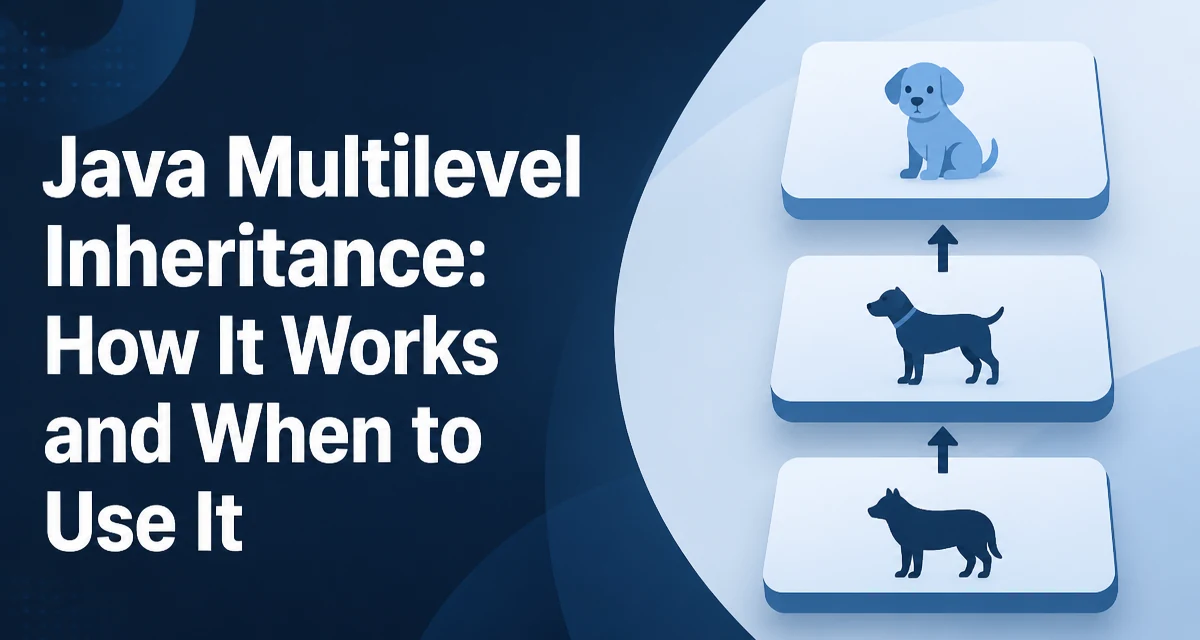
When a class extends another class that already extends a third class, the resulting hierarchy is an example of java multilevel inheritance. This is a common pattern in Java because the language supports a single inheritance chain per class, which means that a class can have exactly one direct superclass. In multilevel inheritance, that direct superclass itself has its own superclass, forming a chain that can extend arbitrarily deep.
The most immediate effect of such a chain is that a subclass inherits fields and methods from every ancestor up the chain. If class Puppy extends Dog and Dog extends Animal, then Puppy inherits not only members declared in Dog, but also members declared in Animal. This is not a special mode of inheritance; it is the ordinary behavior of the Java type system applied repeatedly.
A Minimal Multilevel Hierarchy
To see the mechanics clearly, consider a small example that models three levels of an animal hierarchy.
class Animal {
    protected String name;

    public Animal(String name) {
        this.name = name;
    }

    public void eat() {
        System.out.println(name + " is eating.");
    }
}
The Animal class declares a field and a method. Next, Dog extends Animal and adds behavior that is more specific to dogs.
class Dog extends Animal {
    public Dog(String name) {
        super(name);
    }

    public void bark() {
        System.out.println(name + " says woof.");
    }
}
Now Puppy extends Dog and adds another level of specificity.
class Puppy extends Dog {
    public Puppy(String name) {
        super(name);
    }

    public void play() {
        System.out.println(name + " is playing.");
    }
}
The chain is Animal -> Dog -> Puppy. The important point is that Puppy has access to eat(), bark(), and play(), even though those methods are declared in different classes at different levels of the hierarchy. The name field, because it is protected, is visible to Puppy as well.
How Constructors Behave Across Levels
A critical detail of multilevel inheritance is constructor chaining. When you instantiate Puppy, the constructors for Animal, Dog, and Puppy all execute. Java enforces that each constructor calls a constructor of its direct superclass, either explicitly or implicitly through a no-argument call.
In the example above, Puppy calls super(name), which invokes the Dog(String) constructor. That constructor also calls super(name), invoking Animal(String). This chaining ensures that every level initializes its own state before the next level uses it.
If a superclass does not have a no-argument constructor, every subclass constructor must explicitly call a matching superclass constructor with the required arguments. Otherwise the code will not compile. This is not unique to multilevel inheritance, but it becomes more visible when the chain is longer because each level must be satisfied.
Method Overriding and the super Keyword
Method overriding behaves the same in a multilevel hierarchy as in a simple two-level inheritance. A subclass can override a method from any ancestor, not just its immediate superclass. Consider an override added at the Dog level.
class Dog extends Animal {
    @Override
    public void eat() {
        System.out.println(name + " eats dog food.");
    }
}
Now any Puppy instance uses the Dog version of eat() unless Puppy overrides it again. The override is inherited; it does not require a subclass to explicitly re-implement the method.
The super keyword allows a method to call an overridden method from any direct or indirect superclass? In fact, super refers only to the immediate superclass. To call a method two levels up, you must chain super calls through the intermediate class.
class Puppy extends Dog {
    @Override
    public void eat() {
        super.eat(); // Calls Dog.eat()
        System.out.println("Puppy also drinks milk.");
    }
}
If you want to invoke Animal.eat() directly from Puppy, there is no direct syntax. You would need Dog to expose a method that calls super.eat(), or Puppy can call super.super.eat() which is not valid Java. This is a practical constraint of the single-inheritance model. The chain deliberately limits access to the immediate superclass to keep the type system predictable.
Type Compatibility and Casting
Multilevel inheritance introduces a set of is-a relationships. A Puppy is a Dog, a Dog is an Animal, and therefore a Puppy is also an Animal. The Java compiler uses these relationships to allow assignment from a subclass reference to a superclass reference.
Puppy puppy = new Puppy("Rex");
Dog dog = puppy;
Animal animal = puppy;
All of these assignments are valid because the Puppy object is also a Dog and an Animal. The reference type only determines which members are directly accessible. Through an Animal reference, you can call eat(), but not bark() or play(), even though the underlying object supports them. To call the subclass-specific methods, you need a narrower reference type, usually obtained with an explicit cast.
Animal animal = new Puppy("Rex");
if (animal instanceof Puppy p) {
    p.play();
}
The instanceof pattern-matching form introduced in Java 16 avoids an explicit cast and is generally cleaner than the older explicit cast style. When you cast down the hierarchy, you must be certain about the runtime type; an incorrect cast throws a ClassCastException at runtime.
Field Hiding and Static Members
Fields are not polymorphic in Java. When a subclass declares a field with the same name as a field in an ancestor, the new field hides the old one, but the hide does not apply across method calls in the way overriding does.
class Animal {
    protected int legs = 4;
}

class Dog extends Animal {
    protected int legs = 4; // Hides Animal.legs
}

class Puppy extends Dog {
    public void printLegs() {
        System.out.println(legs); // Resolves to Dog.legs
    }
}
If Puppy needs to access the Animal field, it must do so through a method that is declared in Animal and uses that field. For example, an Animal method that reads legs would see the Animal version because field access is based on the class that declares the method, not the runtime type of the object.
Static methods are also inherited but not overridden in the polymorphic sense. A subclass can declare a static method with the same signature as a static method in an ancestor, and that method will hide the ancestor's version. The choice of which method executes depends on the reference type, not the object's runtime type.
When Multilevel Inheritance Becomes a Problem
Multilevel inheritance is not inherently bad, but deep hierarchies often introduce coupling and maintenance costs. A change to a base class that is several levels up can affect many subclasses that never directly interact with that base class. For example, adding an abstract method to Animal forces every concrete subclass at every level to implement it, or to be declared abstract itself.
The classic alternative is composition. Instead of building a chain of is-a relationships, you compose behavior through fields and interfaces. A class that implements an interface and delegates to a helper object can often achieve the same functionality with less coupling.
interface Playable {
    void play();
}

class Puppy extends Dog implements Playable {
    private PlayBehavior playBehavior = new PlayBehavior("ball");

    @Override
    public void play() {
        playBehavior.start();
    }
}
This approach keeps the inheritance chain shallow and allows behavior to be swapped or extended without touching the parent classes. However, composition has its own costs. It often requires more classes and more delegation code. For small, stable hierarchies, direct multilevel inheritance may be simpler and more readable.
Avoid Overly Deep Hierarchies in Production Code
In production systems, a hierarchy that spans more than three or four levels usually indicates that the modeling boundaries are too broad. The Java standard library itself rarely uses deep inheritance chains; collections and I/O classes tend to stay within two or three levels. That is not an accident. Deep chains make it harder to reason about which implementation of a method actually runs when you call it through a base reference.
The @Override annotation becomes essential in such chains. It helps the compiler catch signatures that do not actually override anything, and it documents the intent. Without it, a method with a slightly different parameter type silently becomes an overload, which is a common source of confusion when a hierarchy grows.
Multilevel inheritance is a legitimate tool when the generalization hierarchy is real and stable. For example, a UI framework with Component, Container, and Panel classes is generally understood. As soon as the hierarchy begins to require behavior that does not fit the is-a relationship, such as adding methods that are only meaningful to some branches, it is a sign to refactor toward composition or to extract interfaces.
A practical guard is to keep the deepest level of the hierarchy focused on concrete behavior. If a leaf class needs to reuse logic from more than one branch, Java cannot express that through multiple class inheritance, and you must rely on interfaces and delegation. Prefer interfaces to define contracts at each level, and let the inheritance chain provide the shared state and implementation. That keeps the hierarchy understandable and gives the compiler and runtime clear boundaries about what is polymorphic and what is not.