Java Optional map: Transform Values Safely
java optional map: Learn how to use Optional.map to transform values safely in Java, including chaining, flatMap for nested optionals, and practical edge cases.
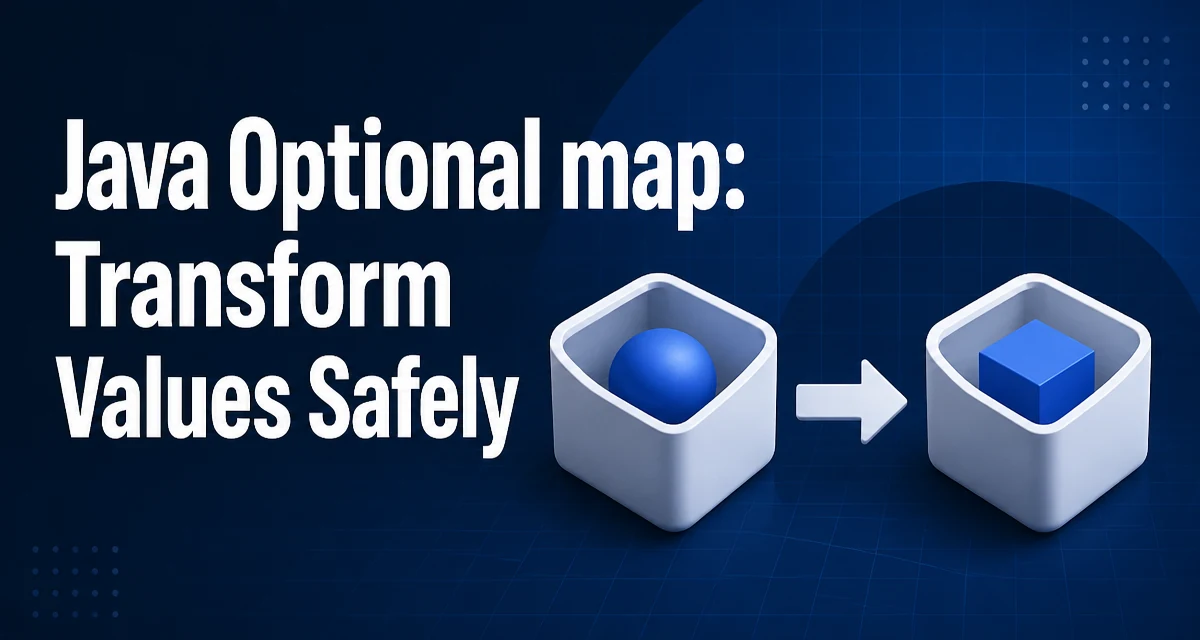
When you work with Optional in Java, the most common task is to transform the value inside if it exists, without writing explicit null checks. The map method does exactly that: it applies a function to the value if present, and returns an Optional describing the result. If the Optional is empty, map returns an empty Optional without invoking the function.
This is the core of java optional map usage. It lets you build a pipeline of transformations where each step is optional-aware, and you never have to check isPresent() manually.
Basic Syntax and a Minimal Example
The signature of map is:
<U> Optional<U> map(Function<? super T, ? extends U> mapper)
It takes a Function that maps the contained value from type T to type U. The result is wrapped in a new Optional. If the original Optional is empty, the mapper is never called and an empty Optional is returned.
Here is a minimal example:
Optional<String> name = Optional.of("alice");
Optional<Integer> length = name.map(String::length);
length will contain Optional.of(5). If name were Optional.empty(), then length would also be empty.
The function passed to map can be a lambda, a method reference, or any Function implementation. The key point is that the transformation is applied only when a value exists.
Chaining map Calls to Transform Values
Because map returns an Optional, you can chain multiple map calls to apply a sequence of transformations. Each step receives the output of the previous step, and the whole chain short-circuits if any intermediate Optional is empty.
Consider a scenario where you parse a string to an integer, then double it, then convert to a string:
Optional<String> raw = Optional.of("42");
Optional<String> result = raw
    .map(Integer::parseInt)
    .map(n -> n * 2)
    .map(String::valueOf);
The result is Optional.of("84"). If raw were empty, all subsequent map calls would be skipped, and result would be empty.
This chaining is the idiomatic way to avoid nested if blocks and temporary variables. It reads as a linear pipeline, which is easier to follow than a series of null checks.
Handling Nested Optionals with flatMap vs map
One common pitfall is when the mapper itself returns an Optional. If you use map in that situation, you end up with a nested Optional<Optional<U>>. For example:
Optional<String> id = Optional.of("123");
Optional<Optional<User>> user = id.map(this::findById);
Here findById returns Optional<User>. The result is Optional<Optional<User>>, which is awkward to work with. You would need to unwrap it manually.
The correct method for flattening nested optionals is flatMap. It applies the mapper and then flattens the result into a single Optional:
Optional<User> user = id.flatMap(this::findById);
Use flatMap whenever the transformation function returns an Optional. This is a common source of confusion, and understanding the difference is essential for writing clean java optional map code.
Combining map with filter and orElse
map is often used together with filter and orElse to build complete validation and fallback logic. For example, you might want to extract a field, validate it, and provide a default value:
Optional<Order> order = findOrder();
String status = order
    .map(Order::getStatus)
    .filter(s -> s.equals("SHIPPED"))
    .orElse("UNKNOWN");
Here map extracts the status, filter keeps only the value if it matches, and orElse supplies a fallback when the Optional is empty (either because the order is absent or the status did not match).
This pattern is powerful because it keeps the entire logic in a single expression. It also makes the empty case explicit: you always know what the default is.
When map Is the Wrong Choice: Performance and Maintainability
While map is convenient, it is not always the best choice. One consideration is that each map call creates a new Optional object. In a hot loop that processes millions of values, this allocation overhead can be measurable, though usually minor. If you are working with primitive streams, prefer OptionalInt, OptionalLong, or OptionalDouble to avoid boxing.
More importantly, overusing map can hurt readability when the transformation logic is complex. If the mapper contains multiple statements or throws checked exceptions, a traditional if block may be clearer. For example:
Optional<String> config = getConfig();
if (config.isPresent()) {
    String value = config.get();
    // complex logic that may throw
}
In such cases, forcing the logic into a lambda makes the code harder to debug and test. Use map for simple, pure transformations. Reserve more complex processing for explicit control flow.
Another maintainability concern is that map hides the possibility of null inside the mapper. If your mapper returns null, map will produce an empty Optional, which may be surprising. For example:
Optional<String> name = Optional.of("alice");
Optional<String> upper = name.map(s -> null);
upper will be empty, not contain null. This is often desirable, but if you need to distinguish between an absent original value and a mapper that produced null, you must handle it differently.
Common Mistakes and Edge Cases
One frequent mistake is calling get() on an Optional without checking isPresent(). Even with map, you might be tempted to do:
String result = optional.map(String::toUpperCase).get();
This throws NoSuchElementException if the Optional is empty. Always use orElse, orElseGet, or orElseThrow to handle the empty case.
Another edge case is the interaction with null inputs. If you create an Optional with Optional.of(null), it throws NullPointerException. Use Optional.ofNullable when the value might be null.
Also, be careful when using map with methods that return Optional but you actually want the nested structure. In rare cases, you might intentionally want Optional<Optional<T>> to represent a two-level absence. But for most code, flatMap is the right tool.
Finally, remember that map is not a replacement for exception handling. If the mapper throws an exception, it propagates immediately; map does not catch it. So ensure your transformation functions do not throw unchecked exceptions unless you handle them upstream.