Java || Operator: Short-Circuit Logic Explained
java || operator: Understand how the Java || operator works, including short-circuit behavior, precedence, and common pitfalls.
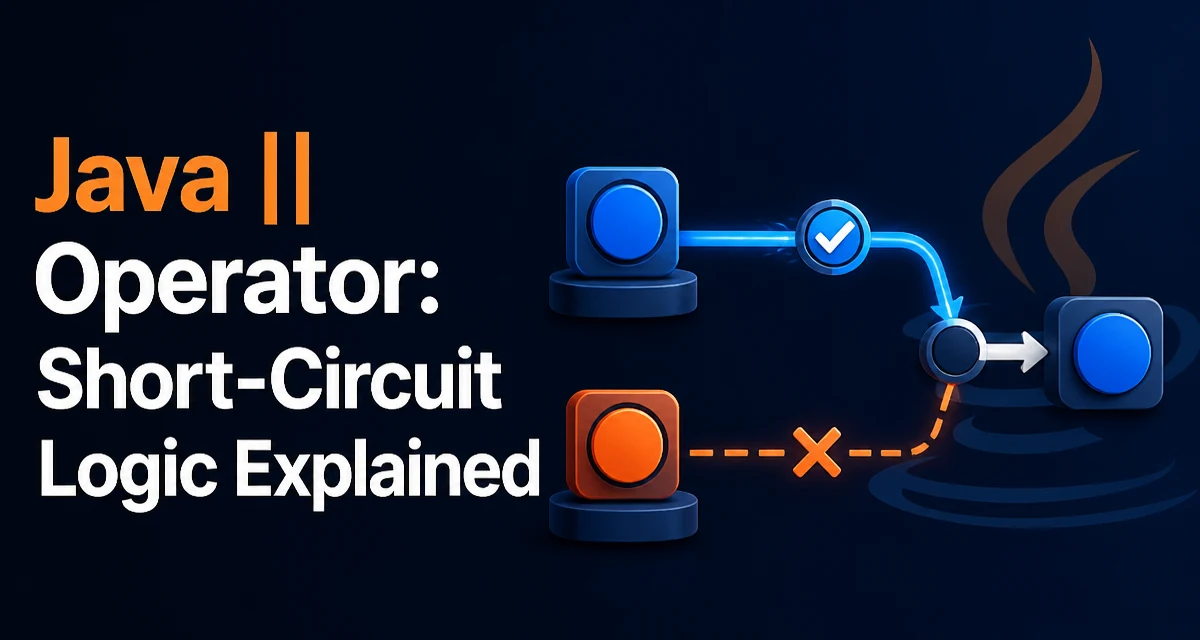
The java || operator is the logical OR used to combine two boolean expressions. It returns true if either operand is true, and false only when both are false. The critical detail is that it short-circuits: if the left operand evaluates to true, the right operand is never evaluated. This behavior has practical consequences for performance, side effects, and error handling.
How the || Operator Evaluates Operands
The || operator requires both operands to be of type boolean or Boolean (with unboxing). It evaluates the left operand first. If that value is true, the result is true without touching the right operand. If the left operand is false, the right operand is evaluated to determine the result.
boolean a = true;
boolean b = false;
boolean result = a || b; // true, b never evaluated
In the example above, b is not evaluated because a is already true. This is not just an optimization; it changes program behavior when the right operand contains side effects or throws exceptions.
Short-Circuit Evaluation and Side Effects
Because the right operand may be skipped, any side effects inside it are conditional. Consider a method that increments a counter or logs an event:
int counter = 0;
boolean flag = true;
boolean result = flag || (++counter > 0);
System.out.println(counter); // 0, not 1
The increment never happens because flag is true. This is often desirable, but it can cause subtle bugs if you assume the right side always runs. For example, if you rely on a method to validate input and also to update state, short-circuiting may skip the update.
if (isValid(input) || saveToDatabase(input)) {
    // proceed
}
If isValid returns true, saveToDatabase is never called. If that method has important side effects, the behavior is incorrect. Always ensure that the right operand of || is free of side effects unless you explicitly want conditional execution.
Operator Precedence and Grouping
The || operator has lower precedence than && (logical AND). This means that in an expression without parentheses, && is evaluated first. For example:
boolean result = a || b && c;
This is parsed as a || (b && c), not (a || b) && c. If you need a different grouping, use parentheses explicitly. Relying on precedence rules can make code harder to read, especially when mixing && and || in the same condition.
// Clear and explicit
boolean result = (a || b) && c;
Precedence also affects how || interacts with assignment and ternary operators. The assignment operator = has lower precedence than ||, so boolean x = a || b; works as expected. However, mixing || with bitwise | is a common source of confusion.
Common Mistakes: Single | vs Double ||
The single pipe | is a bitwise OR. When applied to booleans, it also returns a boolean, but it does not short-circuit. Both operands are always evaluated. This subtle difference can cause performance issues and unexpected side effects.
boolean a = true;
boolean b = false;
boolean result = a | (++counter > 0); // counter becomes 1
Using | instead of || is rarely intentional. It may appear in code that was ported from a language with different semantics or from a developer who does not know the distinction. Always prefer || for logical OR unless you specifically need both sides evaluated.
Another mistake is using || with non-boolean values. Java does not allow implicit conversion from numbers or objects to boolean. The following will not compile:
// Compilation error: incompatible types
if (1 || 0) { }
You must write explicit comparisons, such as if (x != 0 || y != 0). This is different from languages like JavaScript or Python where truthiness exists.
Null Safety and Boolean Unboxing
When using Boolean objects with ||, Java unboxes them to primitive boolean. If the Boolean reference is null, a NullPointerException is thrown during unboxing. This can happen when the left operand is a Boolean variable that is null.
Boolean nullable = null;
boolean result = nullable || true; // NullPointerException
Even if the right operand is true, the unboxing of nullable happens first, so the exception occurs. To avoid this, use a null check before the logical OR:
boolean result = (nullable != null && nullable) || true;
But note that && also short-circuits, so nullable != null protects the unboxing. This pattern is common when dealing with nullable Boolean fields from databases or external APIs.
Performance and Readability Considerations
Short-circuiting can improve performance by avoiding expensive method calls. If the left operand is often true, the right side is skipped. This is beneficial when the right operand involves a costly computation, such as a database query or a complex regex match.
if (isCached() || fetchFromDatabase()) {
    // use data
}
```n
However, do not over-optimize. The primary reason to use `||` is logical correctness, not performance. Overusing it to hide expensive operations can make code less readable. If the right operand is a method call with side effects, the short-circuit behavior can be a trap. Prefer explicit `if-else` statements when the control flow is complex.

Readability also suffers when you chain many `||` conditions. Consider extracting each condition into a well-named boolean variable:

```java
boolean isAdmin = user.hasRole("ADMIN");
boolean isOwner = resource.getOwner().equals(user);
boolean isModerator = user.hasRole("MODERATOR");

if (isAdmin || isOwner || isModerator) {
    // allow action
}
This makes the intent clearer than a long line of || expressions.
Alternatives and When to Use Them
In some cases, a ternary operator or a stream operation can replace || with more expressive code. For example, checking if any element in a collection satisfies a condition:
boolean hasPositive = numbers.stream().anyMatch(n -> n > 0);
This is more declarative than a loop with ||. However, for simple boolean combinations, || is the most direct tool. Use it when you need a single boolean result from two or more conditions. Avoid using || to combine complex expressions that would be clearer as separate statements.
Another alternative is the Objects.equals method for null-safe equality checks, but that is not a replacement for ||; it is a different operation.
The || Operator in Modern Java Contexts
Java 8 and later introduced lambda expressions and streams, which often replace explicit loops and || chains. For instance, anyMatch is a short-circuiting terminal operation that behaves similarly to || but works on streams. It also stops processing as soon as a match is found, which is analogous to short-circuit evaluation.
boolean found = list.stream().anyMatch(item -> item.isValid());
In switch expressions (Java 14+), you can use case labels with multiple constants, but || is not used there. The || operator remains essential for traditional boolean logic in if statements, while loops, and return expressions.
Understanding the java || operator fully means knowing not only its syntax but also its evaluation order, side-effect implications, and precedence rules. This knowledge prevents subtle bugs and leads to more predictable code.