Java Primitive vs Reference Types: Key Differences
java primitive vs reference types: Understand how Java primitive and reference types differ in memory, assignment, equality, and performance, and when to use each.
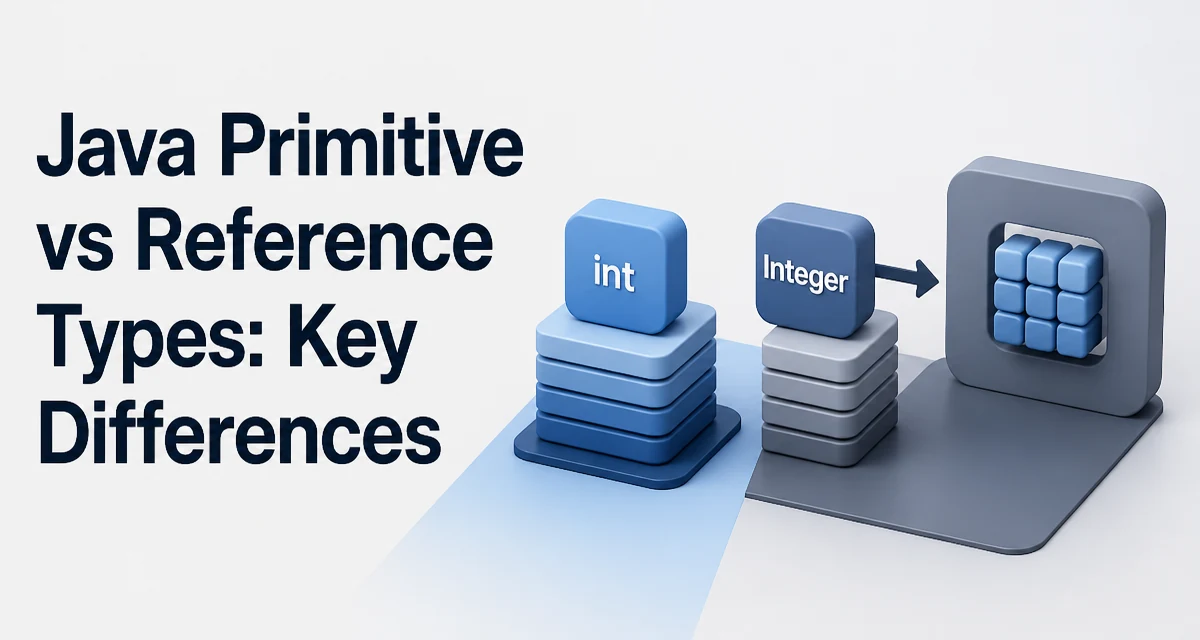
When you declare a variable in Java, the type determines whether it holds a value directly or a reference to an object. This distinction between java primitive vs reference types affects memory usage, assignment behavior, equality checks, and even performance. Misunderstanding it leads to subtle bugs that are hard to trace.
Memory Allocation and Storage
Primitive types—byte, short, int, long, float, double, char, and boolean—store their actual values directly in the stack when declared as local variables. For instance, int count = 5; places the value 5 on the stack. The memory required is fixed and determined by the type: int uses 4 bytes, long uses 8, and so on.
Reference types, on the other hand, store a reference (essentially a memory address) on the stack, while the actual object resides on the heap. When you write String name = "Java";, the variable name holds a reference to a String object allocated in heap memory. The reference size is typically 4 or 8 bytes depending on the JVM and architecture, but the object itself may occupy variable space.
This distinction becomes critical when you consider arrays and collections. An array of int stores contiguous primitive values, while an array of Integer stores references to Integer objects, each with its own heap allocation. The latter consumes significantly more memory due to object headers and alignment.
Assignment and Copy Semantics
When you assign a primitive variable to another, the value is copied. For example:
int a = 10;
int b = a;
b = 20;
System.out.println(a); // prints 10
Changing b does not affect a because each variable holds its own copy of the value.
With reference types, assignment copies the reference, not the object. Consider:
int[] arr1 = {1, 2, 3};
int[] arr2 = arr1;
arr2[0] = 99;
System.out.println(arr1[0]); // prints 99
Both arr1 and arr2 point to the same array object. Modifying through one reference is visible through the other. This aliasing behavior is fundamental to Java's object model and can lead to unintended side effects if you forget that you are sharing mutable state.
Equality Checks: == vs equals()
For primitives, the == operator compares the actual values. For references, == compares the references—whether they point to the same object. This is a common source of confusion.
String s1 = new String("hello");
String s2 = new String("hello");
System.out.println(s1 == s2);      // false, different objects
System.out.println(s1.equals(s2)); // true, same content
Primitive comparison is straightforward: int x = 5; int y = 5; x == y is true. But with reference types, you must use .equals() to compare logical content, unless you deliberately want reference identity. The default equals() implementation in Object uses ==, so custom classes should override it to provide meaningful equality.
Null Handling and Default Values
Reference types can hold null, meaning they point to no object. Primitives cannot be null; they always have a default value. For instance, an uninitialized int field defaults to 0, a boolean to false, and a char to '\u0000'. This difference affects how you design APIs and handle missing data.
Consider a method that returns a value. If it returns a primitive int, you cannot represent "no result" without a sentinel like -1. With Integer, you can return null. However, using null requires null checks to avoid NullPointerException. This tradeoff is central to the choice between primitives and their wrapper classes.
Autoboxing and Unboxing Costs
Java automatically converts between primitives and their wrapper types (e.g., int to Integer) through autoboxing and unboxing. While convenient, this conversion has runtime costs. Each autoboxing operation allocates a new object on the heap, increasing memory pressure and triggering garbage collection.
Integer sum = 0;
for (int i = 0; i < 1000000; i++) {
    sum += i; // autoboxing and unboxing on each iteration
}
In this loop, sum += i unboxes sum to an int, adds i, and then autoboxes the result back into a new Integer object. This creates a million Integer instances, which is far less efficient than using a primitive int accumulator. For performance-sensitive code, avoid autoboxing in tight loops.
Choosing Between Primitives and References
The decision depends on context. Use primitives when you need simple numeric or boolean values, especially in calculations, and when null is not a valid state. Use reference types (wrappers or custom classes) when you need to represent the absence of a value, use collections (which only accept objects), or require methods like parseInt or compareTo.
Generics also force the use of reference types. List<int> is not valid; you must use List<Integer>. This is a practical constraint that often leads to autoboxing overhead when storing primitive-like data in collections. For large collections of numeric data, consider specialized libraries like Trove or use arrays to avoid boxing overhead.
Performance and Garbage Collection Considerations
Primitives are stored on the stack and have no garbage collection overhead. Reference types involve heap allocation, which costs time and memory, and eventually requires GC to reclaim unused objects. The impact is most visible in high-frequency operations or large data structures.
A common pattern is to use primitive arrays for performance-critical numeric processing. For example, a double[] is far more memory-efficient than a Double[] because it avoids per-element object overhead. When dealing with millions of values, this difference can be orders of magnitude in both memory and access speed.
However, reference types are necessary when you need polymorphism, nullability, or object identity. The key is to be deliberate: use primitives unless you have a concrete reason to use a wrapper. In modern Java, value types (Project Valhalla) aim to blur this line, but until they are available, the distinction remains a core part of Java's type system.
Understanding these differences helps you write code that behaves predictably and performs well. Pay attention to assignment semantics, equality, and the cost of boxing in loops. These details, while subtle, determine whether your application scales gracefully or suffers from avoidable memory and CPU overhead.