Using Java PriorityQueue in Production Code
java priorityqueue: Learn how to use Java PriorityQueue effectively in production: ordering, comparator behavior, performance tradeoffs, and concurrency limitations.
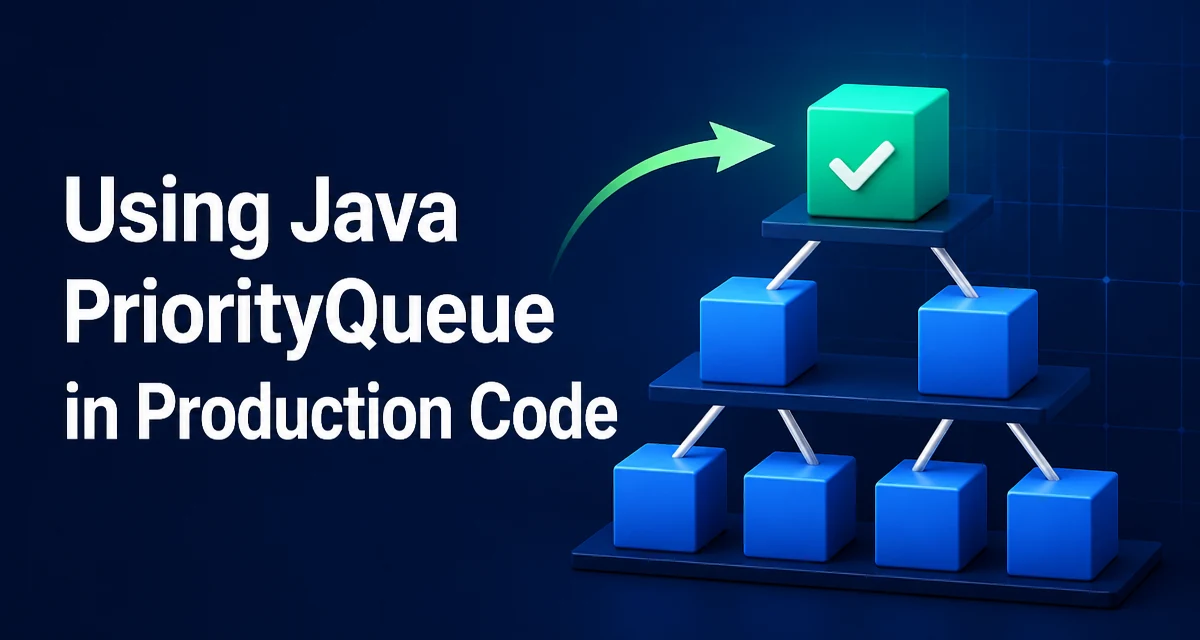
java priorityqueue requires a clear understanding of the core syntax, runtime behavior, and practical implementation patterns demonstrated in the examples below.
Java's PriorityQueue is a heap-based implementation of the Queue interface that orders elements according to their natural ordering or a custom Comparator. It's a workhorse for algorithms like Dijkstra's shortest path, task scheduling, and top-K problems. But using it correctly in production requires understanding its specific contract, which differs from a sorted list or a TreeSet in important ways.
The Contract: Ordering, Not Sortedness
A PriorityQueue does not maintain a fully sorted sequence at all times. It only guarantees that the head of the queue is the smallest (or greatest) element according to the ordering. Internally, it uses a binary heap, which means that iteration order is arbitrary and not sorted. This is a common misconception that leads to bugs when developers iterate over the queue expecting sorted output.
For example, the following code prints the elements in heap order, not sorted order:
PriorityQueue<Integer> pq = new PriorityQueue<>(List.of(5, 1, 4, 2, 3));
for (int v : pq) {
    System.out.print(v + " "); // Output is not guaranteed to be sorted
}
To retrieve elements in sorted order, you must repeatedly call poll(), which removes the head. This is a key distinction from a List that you sort manually or a TreeSet that maintains order on insertion.
Choosing the Right Collection for Your Needs
Before using java priorityqueue, it's worth checking whether it is the right tool. The following table summarizes common collection choices for ordered data:
| Collection | Ordering Guarantee | Primary Use Case |
|---|---|---|
PriorityQueue | Head is smallest; no full sort | Repeatedly retrieving the smallest/largest element |
TreeSet | Fully sorted on insertion | Maintaining a unique, sorted set of elements |
ArrayList + sort | Sorted after explicit sort | One-time sorting of a batch of elements |
ArrayDeque | Insertion order | FIFO or LIFO operations with no ordering logic |
Use a PriorityQueue when you need efficient access to the highest-priority element and don't need the rest sorted. If you need to iterate in sorted order frequently, a TreeSet or a sorted List may be more appropriate.
Custom Ordering with Comparator
By default, PriorityQueue uses natural ordering via Comparable. If your elements do not implement Comparable, or you need a different ordering, supply a Comparator at construction time.
Consider a task scheduler where each task has a priority and a timestamp. You want the highest-priority task first, but if priorities tie, the earlier-created task should come first:
record Task(int priority, long createdAt) {}

Comparator<Task> byPriorityThenAge = Comparator
        .comparingInt(Task::priority)
        .thenComparingLong(Task::createdAt);

PriorityQueue<Task> queue = new PriorityQueue<>(byPriorityThenAge);
The comparator defines what "higher priority" means. In this case, lower int values mean higher priority. If you want the opposite, reverse the comparator with Comparator.reverseOrder() or comparingInt(...).reversed(). Always test the comparator with your actual data, because a mis-specified comparator leads to subtle ordering bugs.
poll() vs peek() vs remove()
Three methods interact with the head of the queue, and they behave in distinct ways:
peek()returns the head without removing it, ornullif empty.poll()returns and removes the head, ornullif empty.remove()removes and returns the head but throwsNoSuchElementExceptionif empty.
A common pattern is to loop until the queue is empty, using poll():
while (!pq.isEmpty()) {
    Task next = pq.poll();
    // process next
}
Using peek() followed by poll() in two steps is redundant; poll() already returns the element. Choosing between poll() and remove() depends on whether an empty queue is an expected condition or an error.
Performance Characteristics and Memory
PriorityQueue offers O(log n) time for enqueue (offer/add) and dequeue (poll/remove), and O(1) for peek. This is efficient for a typical priority-based workload, but it's not a substitute for a fully sorted data structure when you need sorted iteration frequently.
Creating a PriorityQueue from an existing collection using the constructor is O(n) — it heapifies the collection in linear time. This is much faster than inserting elements one by one, which would be O(n log n). So if you have all elements upfront, pass them to the constructor:
List<Integer> numbers = // ...
PriorityQueue<Integer> pq = new PriorityQueue<>(numbers);
Memory-wise, PriorityQueue is backed by an array that grows dynamically, similar to ArrayList. This means memory allocation and copying occur during growth, but the average cost remains acceptable for most applications.
Concurrency Limitations
PriorityQueue is not thread-safe. If multiple threads access it concurrently, or if one thread modifies it while another reads, you must externalize synchronization. Two common strategies exist:
- Wrap the
PriorityQueuewithCollections.synchronizedQueue()for simple mutual exclusion. - Use
PriorityBlockingQueue, which implements theBlockingQueueinterface and provides thread-safe operations with blockingtake()methods.
PriorityBlockingQueue is the better choice for producer-consumer patterns where the consumer blocks for the next item. However, its iterator is still weakly consistent, meaning it may not reflect all changes after the iterator was created.
BlockingQueue<Task> queue = new PriorityBlockingQueue<>(byPriorityThenAge);
// Safe to share across threads
Remember that priority ordering in PriorityBlockingQueue is the same as in PriorityQueue; the extra functionality is only about thread safety.
Common Pitfalls and How to Avoid Them
One frequent mistake is mutating an element after it has been added to the queue. The heap property is based on the element's location at insertion time, so changing a field that affects ordering corrupts the heap. The queue will not re-heapify automatically. If an element's priority can change, remove it, update it, and re-insert it.
Another pitfall is using a mutable Comparator that produces inconsistent results. For example, if the comparator depends on external state that changes, the order may break, leading to unpredictable poll() results. Use immutable comparators where possible.
Finally, note that PriorityQueue does not allow null elements. Adding a null throws NullPointerException, even if the comparator claims to handle null. Always ensure the enqueued elements are non-null, or handle nulls explicitly in the comparator (and accept the risk).
When Not to Use a PriorityQueue
If you need to repeatedly find the median of a growing dataset, a priority queue can be part of the solution (e.g., using two heaps), but for a static dataset a sorted array is simpler. If you need the top-K items frequently, a PriorityQueue is a good fit, but for a one-time top-K query, a partial sort using Arrays.sort or a custom quickselect may be faster.
If your access pattern is mostly reading the head without removal, a PriorityQueue is still efficient, but if you need to access multiple elements in order without removing them, this structure is not suitable — you would have to copy the queue and poll from the copy, which defeats the purpose.
Custom Priority Semantics: Stable Ordering
A common need is a stable ordering for equal-priority elements — for instance, to preserve FIFO order among tasks with the same priority. PriorityQueue does not guarantee stability. To achieve FIFO for equal priorities, add a sequence number to the element and use a comparator that breaks ties by this sequence:
record Task(int priority, long sequence) {}

Comparator<Task> comparator = Comparator
        .comparingInt(Task::priority)
        .thenComparingLong(Task::sequence);

long seq = 0;
PriorityQueue<Task> queue = new PriorityQueue<>(comparator);
queue.offer(new Task(1, seq++));
queue.offer(new Task(2, seq++));
queue.offer(new Task(1, seq++));
Now the two priority-1 tasks will be polled in the order they were added. This pattern is simple and effective, and it avoids any dependency on iteration order.
Using PriorityQueue for a Top-K Problem
A classic use for java priorityqueue is to find the top-K largest elements in a stream. For a min-heap of size K, you can keep the largest K elements by replacing the smallest when a larger one arrives:
private static List<Integer> topK(Stream<Integer> stream, int k) {
    PriorityQueue<Integer> minHeap = new PriorityQueue<>(k);
    stream.forEach(value -> {
        if (minHeap.size() < k) {
            minHeap.offer(value);
        } else if (value > minHeap.peek()) {
            minHeap.poll();
            minHeap.offer(value);
        }
    });
    return new ArrayList<>(minHeap); // Not sorted
}
The resulting list is not sorted, but it contains the top-K elements. If sorted order is required, sort the list afterward. The heap approach runs in O(n log k) time, which is efficient when k is small compared to n.
Integration with Comparators from Java 8
The Comparator utility methods introduced in Java 8 greatly simplify writing comparators for PriorityQueue. Instead of implementing a verbose anonymous class, use chained comparators:
class Task {
    int priority;
    LocalDateTime createdAt;
}

Comparator<Task> comparator = Comparator
        .comparingInt(Task::getPriority)
        .thenComparing(Task::getCreatedAt);
This works well with records or plain classes. Ensure the getters return types that are Comparable or supply a second comparator for those fields. The chaining makes the ordering logic readable and less prone to errors.
Final Thoughts
java priorityqueue is a versatile data structure, but its behavior is precise: it guarantees order only at the head, is not thread-safe by default, and breaks if elements are mutated after insertion. When used with the right comparator and a clear understanding of its performance, it can elegantly solve algorithmic and scheduling problems in production code.