Java Queue offer(): Insert Without Exceptions
java queue offer: Understand Java's Queue.offer() method: what it returns, how it differs from add(), and when to use it for bounded queue insertion.
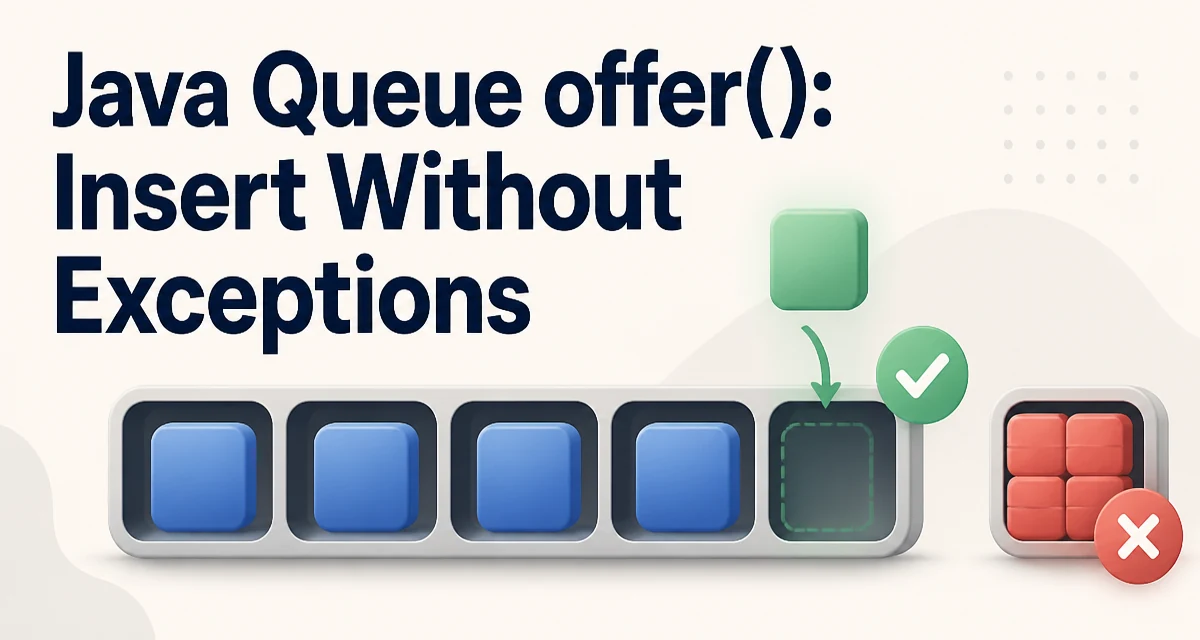
java queue offer requires a clear understanding of the core syntax, runtime behavior, and practical implementation patterns demonstrated in the examples below.
What offer() Returns and Why It Matters
In Java, Queue.offer() is the method you call when you want to insert an element and learn whether the insertion succeeded without catching an exception. The Queue<E> interface defines offer(E e) to return a boolean: true when the element was added, false when the queue could not accept it.
Queue<String> queue = new ArrayBlockingQueue<>(2);
boolean added = queue.offer("task-1");
When the queue has room, offer() returns true and the element is placed at the tail. When the queue is full, it returns false and the element is not added. No exception is thrown in either case. This behavior is what separates offer() from add() in the Queue interface.
The Contract Behind offer() and add()
The Queue interface defines both offer() and add() for insertion, but they differ in how they report failure. add() throws IllegalStateException when the queue cannot accept the element. offer() returns false instead.
Both methods are part of the same interface, so every queue implementation provides both. The choice between them comes down to how you want capacity failures to surface in your code: as an exception you catch, or as a boolean you check.
How Different Queue Implementations Handle offer()
Not every queue behaves the same way when you call offer(). The behavior depends on whether the implementation is bounded or unbounded.
| Implementation | Capacity | offer() behavior when full |
|---|---|---|
LinkedList | Unbounded | Always returns true (unless element is null) |
PriorityQueue | Unbounded | Always returns true (unless element is null) |
ArrayBlockingQueue | Bounded | Returns false when full |
LinkedBlockingQueue | Optional bound | Returns false when full |
ConcurrentLinkedQueue | Unbounded | Always returns true (unless element is null) |
For unbounded implementations, offer() will essentially never return false because there is no capacity limit. The only failure case is a NullPointerException when the element is null, since most queue implementations do not permit null elements.
Handling the Return Value Correctly
The return value of offer() is the only signal you get about whether the element was accepted. Ignoring it means you may believe an element was queued when it was not.
Queue<String> queue = new ArrayBlockingQueue<>(3);

if (queue.offer("request-1")) {
    // Element was accepted
} else {
    // Queue is full; handle the rejection
    logger.warn("Queue is full, request rejected");
}
In a producer-consumer scenario, a false return from offer() typically means the consumer is not keeping up. The producer should either retry after a delay, drop the element, or switch to a blocking insertion method such as put() from BlockingQueue.
When to Use offer() Instead of add()
Use offer() when the queue is bounded and you want to handle capacity failures gracefully. This is common in work queues with a maximum size, rate-limited processing pipelines, and scenarios where rejecting or dropping work is acceptable.
Use add() when the queue is unbounded and you want capacity failures to surface as exceptions for immediate handling, or when you rely on NullPointerException for null elements. For unbounded queues, the practical difference between the two methods is small, since offer() rarely returns false.
Common Mistakes and Edge Cases
One common mistake is assuming offer() blocks when the queue is full. It does not. offer() is a non-blocking method; it returns immediately with false when the queue cannot accept the element. If you need blocking behavior, use put() from the BlockingQueue interface.
Another mistake is calling offer(null). Most queue implementations throw NullPointerException for null elements, so offer() does not return false for null input — it throws. Check for null before calling offer() if your data may contain null values.
Performance and Runtime Considerations
offer() is a non-blocking operation for all standard Queue implementations. For LinkedList and ArrayBlockingQueue, the cost is O(1). For PriorityQueue, insertion is O(log n) because the heap structure must be maintained.
Because offer() returns a value instead of throwing an exception, it avoids the overhead of exception construction and stack-trace capture when the queue is full. This makes it the preferred insertion method in high-throughput paths where capacity limits are expected to be hit occasionally.