Java Queue poll: How to Use It Correctly
java queue poll: Understand how poll() works on Java queues, its return value, differences from remove() and peek(), and when to use it.
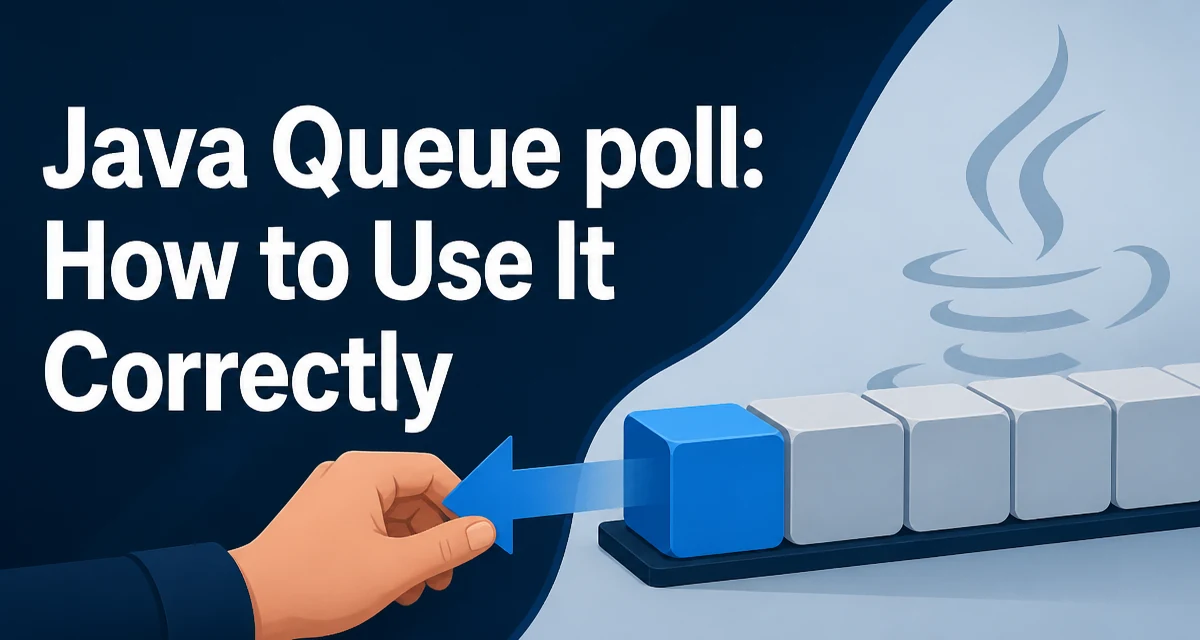
java queue poll requires a clear understanding of the core syntax, runtime behavior, and practical implementation patterns demonstrated in the examples below.
The poll() method on a Java Queue retrieves and removes the head of the queue, or returns null if the queue is empty. It is one of the most commonly used queue operations, but its behavior differs subtly from remove() and peek(). This article explains exactly what poll() does, how it behaves across different queue implementations, and where developers typically go wrong.
How poll() Differs from remove() and peek()
The Queue interface defines three methods for accessing the head element:
poll()returns the head and removes it, or returnsnullif the queue is empty.remove()also returns and removes the head, but throwsNoSuchElementExceptionif the queue is empty.peek()returns the head without removing it, and returnsnullif the queue is empty.
The choice between poll() and remove() depends on how you want to handle the empty case. poll() is safer when an empty queue is a normal condition, while remove() signals an error condition. peek() is useful when you need to inspect the head without consuming it.
Using poll() in a Loop to Drain a Queue
A common pattern is to drain a queue until it is empty. Because poll() returns null when the queue has no elements, you can use it directly in a condition:
Queue<String> tasks = new LinkedList<>();
tasks.add("task1");
tasks.add("task2");

String task;
while ((task = tasks.poll()) != null) {
    System.out.println("Processing: " + task);
}
This loop continues until poll() returns null, which signals that the queue is empty. Note that this approach assumes the queue does not contain null elements. If your queue can legitimately hold null, this loop will terminate prematurely. We'll discuss that nuance later.
poll() on Different Queue Implementations
The Queue interface is implemented by several classes, each with different characteristics. The behavior of poll() itself is consistent—it removes the head and returns it—but the underlying data structure affects performance and ordering.
LinkedListimplementsQueuewith a doubly-linked list.poll()runs in constant time, O(1), and maintains FIFO order.ArrayDequeis a resizable array-based deque. It also offers O(1)poll()and is often more memory-efficient thanLinkedList.PriorityQueueorders elements by natural order or a provided comparator.poll()removes the smallest (or highest-priority) element and runs in O(log n) time because the heap must be restructured.ConcurrentLinkedQueueis a thread-safe, lock-free queue.poll()is also O(1) and safe for concurrent access, but it does not permitnullelements.
For most FIFO use cases, ArrayDeque is a solid choice because it avoids the overhead of node objects and offers good cache locality. If you need thread safety, ConcurrentLinkedQueue or a blocking queue is appropriate.
Handling null Elements and the Meaning of null Return
The poll() method returns null to indicate an empty queue. This creates an ambiguity: if your queue can contain null as a legitimate element, you cannot distinguish between an empty queue and a null element at the head. Most queue implementations, including ArrayDeque and ConcurrentLinkedQueue, explicitly forbid null elements. LinkedList allows null, but it is rarely a good practice to store null in a queue.
If you must support null elements, you should use remove() and catch NoSuchElementException, or check isEmpty() before calling poll(). However, the cleaner approach is to avoid null elements altogether and use a sentinel value or a wrapper object.
Timeouts and Blocking Queues: poll(time, unit)
The BlockingQueue interface adds a timed version of poll():
BlockingQueue<String> queue = new ArrayBlockingQueue<>(10);
String element = queue.poll(2, TimeUnit.SECONDS);
This call waits up to the specified time for an element to become available. If no element arrives within the timeout, it returns null. This is useful in producer-consumer scenarios where you want to avoid indefinite blocking. The timed poll() is a key difference from the regular poll() that returns immediately.
Performance Characteristics of poll()
The time complexity of poll() depends on the implementation. For LinkedList and ArrayDeque, it is O(1). For PriorityQueue, it is O(log n) because removing the head requires re-heapification. For concurrent queues like ConcurrentLinkedQueue, poll() is lock-free and typically O(1) under low contention, but can degrade under heavy contention due to retries.
In a single-threaded context, ArrayDeque is often the fastest choice because it uses an array and avoids node allocation. In a multi-threaded context, ConcurrentLinkedQueue provides thread safety without blocking, but you must ensure that no null elements are added.
Common Mistakes When Using poll()
One frequent mistake is using poll() in a loop without checking for null when the queue might be empty, leading to NullPointerException when you try to use the result. Another is assuming that poll() blocks when the queue is empty; it does not—only the timed version on BlockingQueue blocks. A third mistake is using poll() on a PriorityQueue and expecting FIFO order; the order depends on the comparator.
Also, be careful when mixing poll() with peek() in the same loop. If you call peek() to inspect the head and then poll() to remove it, you must handle the case where the queue becomes empty between the two calls in a concurrent setting. In such cases, use a lock or a single atomic operation.