Java Queue Remove: poll() vs remove() Explained
java queue remove: Understand the difference between remove() and poll() in Java's Queue interface, including empty-queue behavior, remove(Object) semantics, and imple...
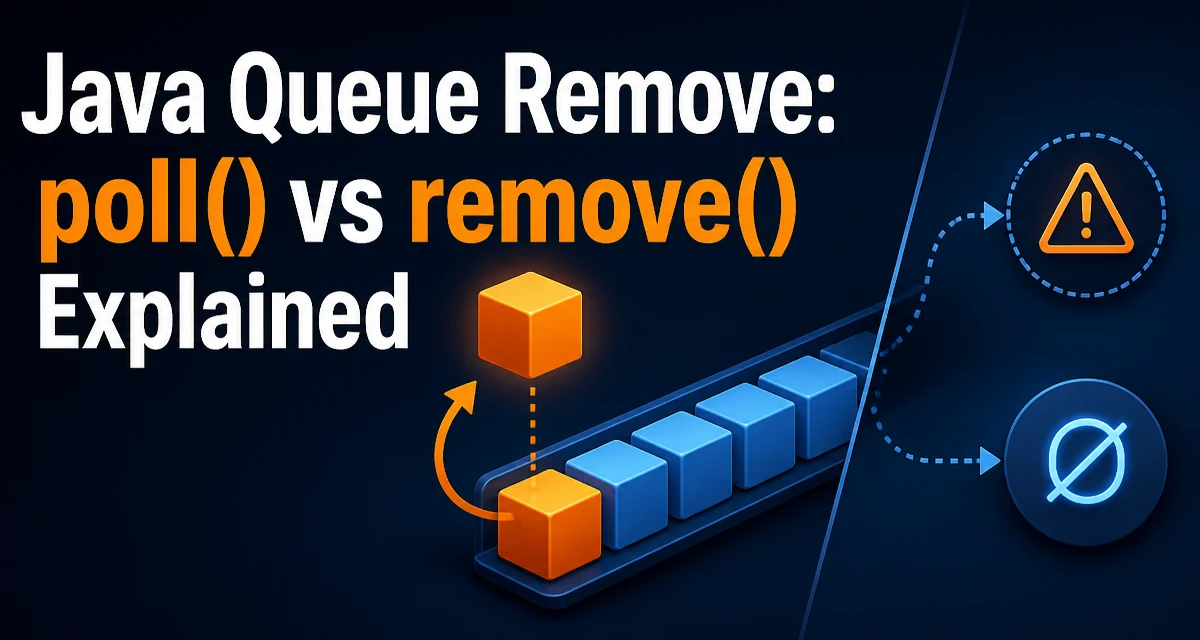
When you need to take an element off a Java Queue, the remove() method is the most direct option, but it carries a behavior that surprises many developers: on an empty queue, remove() throws NoSuchElementException rather than returning a sentinel value. That single difference between remove() and poll() determines which method belongs in which code path. A complete picture of java queue remove means knowing both methods, the remove(Object) overload, and how each queue implementation changes the cost and behavior of removal.
The Two Methods That Remove the Head
The Queue interface defines two methods for removing the head element: remove() and poll(). Both retrieve and remove the head, and both return the element that was removed. The signatures are identical:
E remove();
E poll();
The difference is in the empty-queue case. remove() throws NoSuchElementException when the queue is empty. poll() returns null instead. This is not a subtle implementation detail; it is the contract of the interface, and every implementation follows it.
Queue<String> queue = new ArrayDeque<>();
String value = queue.poll();    // returns null
String value2 = queue.remove(); // throws NoSuchElementException
The choice between the two is therefore a choice about how you want empty-queue conditions to surface. If an empty queue is an exceptional state that indicates a bug in the calling code, remove() will fail loudly. If an empty queue is a normal condition that the caller expects to handle, poll() lets the code branch on a null return.
What Happens When the Queue Is Empty
The empty-queue behavior deserves closer attention because it is the most common source of confusion. remove() throws NoSuchElementException, a runtime exception, so the compiler will not force you to handle it. A queue that is drained faster than it is filled will produce this exception at runtime, often in a loop that assumed the queue always had elements.
Queue<Integer> tasks = new LinkedList<>();
tasks.add(1);
tasks.add(2);

tasks.remove(); // returns 1
tasks.remove(); // returns 2
tasks.remove(); // throws NoSuchElementException
poll() avoids this entirely by returning null. The tradeoff is that null is a valid value in some queue implementations. LinkedList permits null elements, so a null return from poll() does not tell you whether the queue was empty or whether it contained a null element. ArrayDeque forbids null elements, so poll() returning null unambiguously means the queue is empty. If you use LinkedList and must distinguish these cases, check isEmpty() before calling poll(), or use remove() when the queue is expected to be non-empty.
remove(Object) Removes a Specific Element
The Queue interface also inherits remove(Object) from Collection. This overload does not touch the head; it searches for the first element that equals the argument and removes it. It returns true if an element was removed and false otherwise.
Queue<String> queue = new ArrayDeque<>();
queue.add("first");
queue.add("second");

boolean removed = queue.remove("second");   // true
boolean notFound = queue.remove("missing"); // false
This method is easy to confuse with remove() because the names are identical and the parameter is optional from the caller's perspective. The two methods have completely different semantics: remove() operates on the head and returns the removed element, while remove(Object) scans the entire queue and returns a boolean. Calling queue.remove() and queue.remove("value") are different operations with different contracts.
remove(Object) uses equals() for comparison, so elements must implement equals() correctly for this method to work as expected. If the element type relies on identity equality, the method will only remove the exact same object reference.
How Implementations Change Removal Behavior
The Queue interface defines the contract, but the implementation determines the cost and the constraints. ArrayDeque is the most common general-purpose choice. Its remove() and poll() operate on the head in constant amortized time. It does not permit null elements, so poll() returning null is a reliable empty-queue signal. remove(Object) on ArrayDeque requires a linear scan, so it is O(n).
LinkedList also implements Queue. Its remove() and poll() are O(1) for the head, and it permits null elements. The ambiguity of a null return from poll() is the main practical difference.
PriorityQueue is a different case. The head is the smallest element according to the queue's comparator, so remove() and poll() remove the highest-priority element, not the element that was added first. remove(Object) on a PriorityQueue is O(n) for the scan, and the subsequent heap restructuring adds its own cost.
| Implementation | remove() / poll() cost | remove(Object) cost | Null elements allowed |
|---|---|---|---|
| ArrayDeque | O(1) amortized | O(n) | No |
| LinkedList | O(1) | O(n) | Yes |
| PriorityQueue | O(log n) | O(n) + heap fix | No |
The practical takeaway: if you need to remove an arbitrary element by value, the queue is the wrong data structure. A HashSet or LinkedHashSet gives you O(1) removal by value. A queue's strength is ordered access to the head, and remove(Object) works against that strength.
Choosing Between remove() and poll() in Production Code
The decision between remove() and poll() should follow the expected state of the queue at the call site.
Use remove() when an empty queue is a genuine error condition. For example, a worker that pulls a task from a queue that must contain work, or a parser that consumes tokens from a queue that was validated before processing. The exception makes the failure visible and prevents the code from silently processing a null value.
Use poll() when the queue may legitimately be empty and the caller has a fallback. A common pattern is a polling loop that checks for work and sleeps when the queue is empty:
while (running) {
    Task task = taskQueue.poll();
    if (task == null) {
        Thread.sleep(100);
        continue;
    }
    task.execute();
}
This pattern only works cleanly when the queue cannot contain null elements, which is true for ArrayDeque and PriorityQueue but not for LinkedList. If null elements are possible, poll() alone is not enough; check isEmpty() first.
There is also a middle option: peek() followed by remove(). This lets you inspect the head without removing it, decide whether to process it, and then remove it. The two calls are not atomic, so this pattern is only safe in single-threaded code.
Performance and Runtime Considerations
The performance of removal depends almost entirely on which method you call and which implementation you use. remove() and poll() on ArrayDeque and LinkedList are O(1) for the head. remove(Object) is O(n) on every standard queue implementation because the element must be located by scanning. On PriorityQueue, remove(Object) also triggers heap restructuring after the element is found, so the constant factor is higher than a simple array shift.
If your code calls remove(Object) inside a loop, the total cost becomes O(n²) for n elements. Replacing the queue with a LinkedHashSet when order matters, or a HashSet when it does not, reduces each removal to O(1) average.
There is also a subtle memory consideration. When remove() or poll() removes the head of an ArrayDeque, the underlying array slot is cleared to null, which allows the element to be garbage collected. The same applies to remove(Object). If you hold references to queue elements elsewhere, removal from the queue does not prevent those references from keeping the objects alive; the queue only releases its own reference.
Common Failure Modes
The most frequent mistake is calling remove() without checking whether the queue is empty, then catching NoSuchElementException as a control-flow mechanism. Catching an exception for normal flow is slower than a null check and obscures the actual logic. If the queue can be empty, use poll().
Another failure mode is using remove(Object) when the intent was to remove the head. The code compiles, the names look similar, and the behavior is completely different. If you see a boolean being ignored, you are likely calling remove(Object).
A third issue appears with PriorityQueue when the comparator is inconsistent with equals(). remove(Object) searches using equals(), while the heap order is determined by the comparator. If two elements compare as equal under the comparator but are not equals(), remove(Object) may fail to find an element that is logically present in the queue. This is a known trap when using PriorityQueue with custom comparators.
When a Different Data Structure Is Better
If the dominant operation in your code is removing a specific element by value, a queue is the wrong choice. The queue's contract is about head access, and remove(Object) is a convenience inherited from Collection, not an optimized operation. A LinkedHashSet preserves insertion order and removes by value in O(1) average time. A Deque used as a stack gives you head access at both ends. Choose the structure by the operation that dominates your workload, not by the convenience of a single method name.