Java Queue vs Deque: Choosing the Right Collection
java queue vs deque: Understand the differences between Java Queue and Deque, their implementations, and when to use each for efficient data handling.
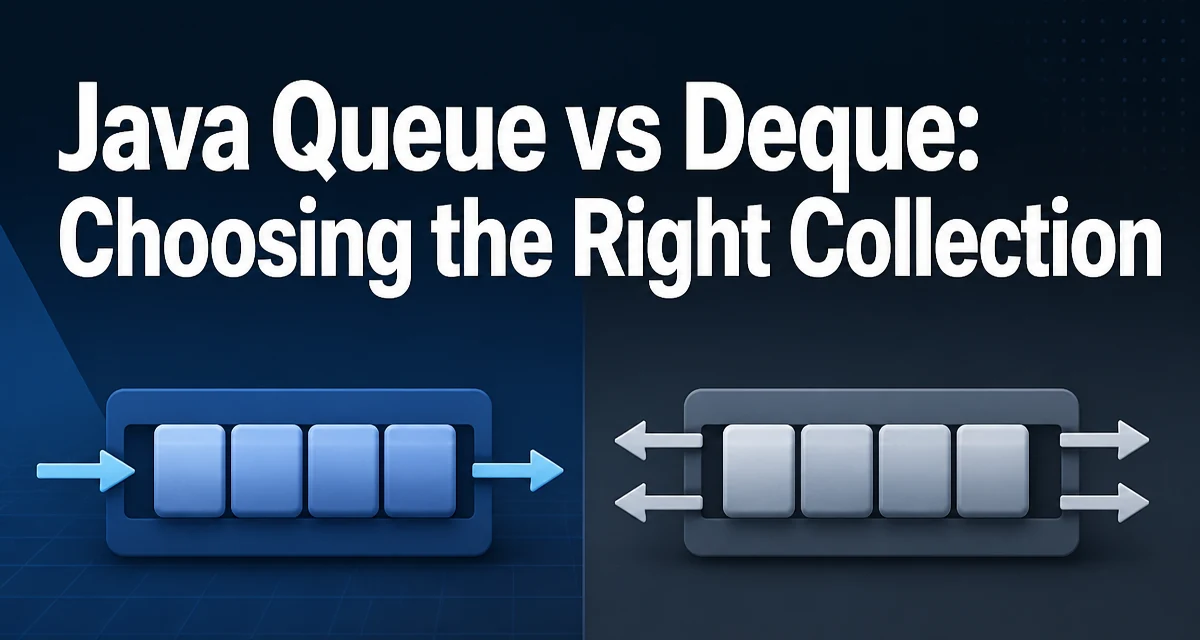
When you need to manage a collection of elements in a specific order, the Java Collections Framework offers two interfaces that look similar at first: Queue and Deque. The choice between them affects which operations are available, how elements are added and removed, and which implementations you can use. The java queue vs deque decision is not about which is better overall, but about which matches the data flow you need to implement.
What Queue and Deque Define in the Java Collections Framework
Queue is an interface that models a single-ended collection designed for holding elements prior to processing. It typically follows a FIFO (first-in, first-out) order, but the interface itself does not mandate that. The core operations are add/offer to insert, remove/poll to retrieve and remove the head, and element/peek to inspect the head without removal. Each method has two variants: one that throws an exception on failure, and one that returns a special value (null or false).
Deque (double-ended queue) extends Queue and adds support for element insertion and removal at both ends. It provides methods like addFirst, addLast, removeFirst, removeLast, getFirst, and getLast. Because a Deque can operate as a FIFO queue, a LIFO stack, or a double-ended data structure, it is more flexible than a plain Queue.
Here is a minimal declaration of both interfaces:
Queue<String> queue = new LinkedList<>();
Deque<String> deque = new ArrayDeque<>();
Both are interfaces, so the concrete implementation determines the underlying behavior and performance.
Key Behavioral Differences: FIFO vs Double-Ended Access
The most significant difference is the set of allowed operations. A Queue restricts you to one end for insertion and the opposite end for removal. This is sufficient for a classic producer-consumer pattern or a task scheduler where the oldest item is processed first.
A Deque removes that restriction. You can add to the front or back, and remove from the front or back. This enables use cases such as a sliding window, a palindrome checker, or a work-stealing queue where workers take tasks from either end.
The following table summarizes the primary operations:
| Operation | Queue | Deque |
|---|---|---|
| Insert head | Not supported | addFirst / offerFirst |
| Insert tail | add / offer | addLast / offerLast |
| Remove head | remove / poll | removeFirst / pollFirst |
| Remove tail | Not supported | removeLast / pollLast |
| Inspect head | element / peek | getFirst / peekFirst |
| Inspect tail | Not supported | getLast / peekLast |
If your code only needs FIFO behavior, a Queue reference is enough. Using a Deque when you only need one-ended access adds no immediate harm, but it broadens the API surface and can mislead future maintainers about your intent.
Common Implementations and Their Tradeoffs
The most frequently used implementations are LinkedList, ArrayDeque, and PriorityQueue. Each has different characteristics.
LinkedList implements both Queue and Deque. It is a doubly-linked list that offers constant-time insertion and removal at either end, but it has higher memory overhead per element because each node stores references to the previous and next nodes. It also suffers from poor cache locality compared to an array-based structure.
ArrayDeque implements Deque and is backed by a resizable array. It provides amortized constant-time operations for adding and removing at both ends. It is generally faster than LinkedList for queue and stack operations because it avoids node allocation and pointer chasing. ArrayDeque does not allow null elements, which is a constraint you must remember.
PriorityQueue implements Queue but not Deque. It orders elements according to their natural ordering or a provided Comparator, rather than insertion order. This is useful when you need to process the highest-priority element first, not the oldest.
Here is an example of using ArrayDeque as a stack:
Deque<Integer> stack = new ArrayDeque<>();
stack.push(10);
stack.push(20);
int top = stack.pop(); // returns 20
The push and pop methods are inherited from the Deque interface and behave exactly like a LIFO stack.
Choosing Between Queue and Deque for Your Data Flow
The decision should be driven by the operations you actually need. If you only need to append to one end and consume from the other, a Queue is the correct abstraction. It clearly communicates that the collection is a queue, and it prevents accidental use of double-ended operations that could break the intended order.
If you need to add or remove from both ends, or if you want the flexibility to switch between FIFO and LIFO behavior without changing the collection type, use a Deque. For example, a recent-items list that evicts the oldest item when it grows too large can use addLast and removeFirst.
Another common scenario is when you need a stack. While Stack exists in Java, it is legacy and synchronized. ArrayDeque is the recommended replacement for stack behavior in single-threaded code.
Consider this decision rule: use Queue when the order is strictly one-way, and use Deque when you need double-ended access or want to choose between FIFO and LIFO at runtime. If you need priority ordering, PriorityQueue is the appropriate Queue implementation.
Performance and Memory Characteristics
The performance of Queue and Deque operations depends on the concrete implementation, not the interface. ArrayDeque is typically the fastest for both queue and stack operations because it uses a circular array and avoids allocating a node for each element. LinkedList has higher per-element memory cost and can be slower due to pointer indirection and cache misses.
PriorityQueue uses a heap, which gives O(log n) insertion and removal, while ArrayDeque and LinkedList give O(1) amortized for add/remove at ends. This is a fundamental difference: if you need priority ordering, you cannot use a simple FIFO queue.
Memory usage also varies. ArrayDeque grows its internal array dynamically, which may temporarily use more memory than needed. LinkedList allocates a new node for every element, which is predictable but heavier. If you are handling many small objects, ArrayDeque is usually more memory-efficient.
No benchmark numbers are provided here because actual performance depends on the JVM, heap size, and access patterns. The key is to understand the algorithmic complexity and memory layout of each implementation.
Concurrency Considerations
Neither Queue nor Deque implementations are thread-safe by default. If multiple threads access the same collection, you must synchronize externally or use a concurrent variant.
For Queue, Java provides ConcurrentLinkedQueue (a thread-safe FIFO) and BlockingQueue implementations like ArrayBlockingQueue and LinkedBlockingQueue for producer-consumer patterns. For Deque, there is ConcurrentLinkedDeque, and LinkedBlockingDeque for blocking double-ended operations.
When you choose between Queue and Deque in a concurrent context, the same behavioral rules apply. Use a BlockingQueue when you need blocking put and take methods. Use a BlockingDeque when you need to add or remove from both ends with blocking behavior.
A common mistake is to assume that LinkedList or ArrayDeque are thread-safe because they are part of the Collections Framework. They are not. Always check the concurrency requirements before selecting an implementation.
Practical Example: Using Deque as a Sliding Window
A practical use case that highlights the advantage of Deque over Queue is maintaining a sliding window of recent elements. Suppose you want to keep the last N items seen in a stream. A Deque lets you add new items to the tail and remove the oldest from the head without needing a separate index.
Deque<Integer> window = new ArrayDeque<>();
int maxSize = 5;

void add(int value) {
    window.addLast(value);
    if (window.size() > maxSize) {
        window.removeFirst();
    }
}
This code uses addLast to append and removeFirst to evict the oldest element. With a plain Queue, you would have the same operations, but the API would not allow you to inspect or remove from the tail, which is sometimes needed for more complex window logic.
Another example is implementing a deque-based palindrome checker:
boolean isPalindrome(String s) {
    Deque<Character> chars = new ArrayDeque<>();
    for (char c : s.toCharArray()) {
        chars.addLast(c);
    }
    while (chars.size() > 1) {
        if (!chars.removeFirst().equals(chars.removeLast())) {
            return false;
        }
    }
    return true;
}
Here, the ability to remove from both ends is essential. A Queue would not allow this because it cannot remove from the tail.
Common Mistakes and Edge Cases
One common mistake is using null elements with ArrayDeque. The ArrayDeque implementation rejects null because it uses null internally to detect empty slots. If you need to store null, use LinkedList or a different structure.
Another mistake is confusing the add and offer methods. In Queue, add throws an exception if the queue is full (in bounded implementations), while offer returns false. For Deque, addFirst and addLast throw exceptions, while offerFirst and offerLast return false. Choose the variant based on how you want to handle capacity limits.
Iteration order is also important. A Queue does not guarantee iteration order for all implementations; PriorityQueue iterates in a heap order, not insertion order. A Deque iterates from head to tail, which is predictable for ArrayDeque and LinkedList. If you rely on iteration order, verify the implementation's behavior.
Finally, when you use a Deque as a stack, remember that the push method adds to the head and pop removes from the head. This is the same as addFirst and removeFirst. Using addLast and removeLast would give you a queue-like behavior, which is not what a stack expects.