Java Recursive Method: Base Cases and Stack Depth
java recursive method: Learn how to write a Java recursive method with a proper base case, understand call stack behavior, and decide when recursion beats iteration.
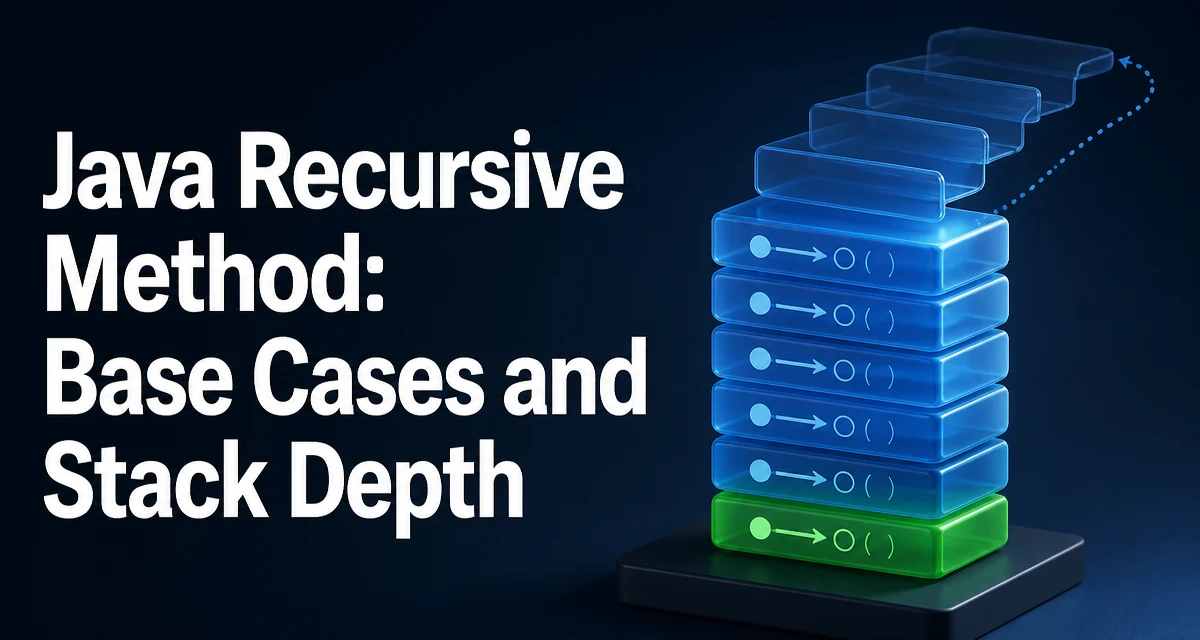
A Java recursive method is a method that calls itself to solve a problem by breaking it into smaller subproblems. The key to using recursion correctly is to define a clear base case that stops the recursion and a recursive case that moves toward that base case. This article explains how to structure recursive methods, how the call stack behaves, and where recursion is the right tool in Java.
What Is a Recursive Method in Java?
A recursive method in Java is any method that invokes itself within its own body. The call is not a loop; it creates a new stack frame for each invocation. This approach is natural for problems that have a self-similar structure, such as tree traversal, combinatorial generation, and divide-and-conquer algorithms. The method must have two parts: a base case that returns a result without further recursion, and a recursive case that calls the method again with modified arguments.
public int factorial(int n) {
    if (n <= 1) {
        return 1; // base case
    }
    return n * factorial(n - 1); // recursive case
}
The base case prevents infinite recursion. Without it, the method would keep calling itself until the JVM throws a StackOverflowError. The recursive case must change the arguments so that each call moves closer to the base case.
The Base Case and Recursive Case
Every recursive method needs a condition that stops the recursion. This is the base case. It is usually the smallest possible input for which the answer is known directly. The recursive case defines how the problem is reduced. For example, in a factorial calculation, the base case is n <= 1 and the recursive case is n * factorial(n - 1). The base case must be reachable for all valid inputs. If the input is negative and the base case checks n <= 1, the recursion never ends for negative numbers. Always validate inputs before entering the recursion, or design the base case to cover the entire domain.
Factorial: A Minimal Recursive Method
Factorial is the classic example for understanding recursion. The method below computes n! using recursion. It is simple, but it illustrates the mechanics of stack frames and return values.
public static long factorial(int n) {
    if (n <= 1) {
        return 1;
    }
    return n * factorial(n - 1);
}
When you call factorial(5), the JVM pushes a frame for n=5. That frame calls factorial(4), which pushes another frame, and so on until factorial(1) returns 1. Then each frame multiplies its n by the returned value and returns the result up the stack. The order of operations is important: the multiplication happens after the recursive call returns. This is not tail recursion, because there is an operation after the recursive call.
How the Call Stack Behaves During Recursion
Each recursive call creates a new stack frame that stores local variables, parameters, and the return address. The stack grows with each call and shrinks when a call returns. The depth of the stack is limited by the JVM's default stack size, which is platform-dependent. If the recursion is too deep, the JVM throws a StackOverflowError. This is not an exception you can catch and recover from reliably; it indicates that the program's stack memory is exhausted.
The stack depth also affects memory usage. A recursive method that uses O(n) stack space for input size n can quickly exhaust the stack for large inputs. For example, computing factorial(100000) would likely overflow the stack. In contrast, an iterative loop uses constant stack space.
Common Recursion Pitfalls in Java
Two frequent mistakes cause recursive methods to fail. The first is missing or incorrect base case. If the base case is never reached, the method calls itself indefinitely. The second is a recursive case that does not move toward the base case. For instance, if you accidentally call factorial(n) instead of factorial(n - 1), the recursion never terminates.
Another subtle issue is using mutable state across recursive calls. If a recursive method modifies a shared field, the behavior can be unpredictable because each call operates on the same object. Prefer passing state as parameters and returning new values. This keeps the recursion pure and easier to reason about.
Recursion vs. Iteration: How to Choose
Recursion is not always the best choice. Iterative loops use less memory and avoid stack overflow for large inputs. However, recursion often produces cleaner code for naturally recursive structures like trees and graphs. The decision depends on the problem's structure and the depth of recursion.
| Criterion | Recursion | Iteration |
|---|---|---|
| Stack usage | O(depth) | O(1) |
| Code clarity | Better for recursive structures | Better for linear operations |
| Risk of stack overflow | High for deep recursion | None |
| Performance | Slightly slower due to method calls | Faster for simple loops |
Use recursion when the problem has a recursive definition and the depth is limited, such as balanced binary trees. Use iteration when the depth could be large or when performance is critical. Many recursive algorithms can be rewritten iteratively with an explicit stack, but that often adds complexity.
Tail Recursion and Why Java Does Not Optimize It
Tail recursion occurs when the recursive call is the last operation in the method, and the method returns its result directly. In languages like Scala or Kotlin, the compiler can optimize tail recursion into a loop, avoiding stack growth. Java does not perform this optimization. Even if you write a method where the recursive call is the last statement, the JVM still creates a new stack frame for each call.
public static int tailFactorial(int n, int acc) {
    if (n <= 1) {
        return acc;
    }
    return tailFactorial(n - 1, n * acc);
}
This is tail-recursive, but Java will still overflow the stack for large n. Therefore, you cannot rely on tail-call optimization in Java. If you need deep recursion, convert it to an iterative loop or use an explicit stack data structure.
Memory and Stack Depth Considerations
Recursion consumes memory proportional to the maximum recursion depth. Each stack frame holds the method's local variables and parameters. For a method that recurses n times, the memory usage is roughly n times the frame size. This can be significant for large inputs. The default stack size in Java is typically 512 KB to 1 MB, but it varies by JVM and platform. You can increase it with the -Xss flag, but that is a workaround, not a solution. A better approach is to limit recursion depth or use iteration.
When you design a recursive method, consider the worst-case depth. For example, a binary tree traversal has depth equal to the tree height. A balanced tree has height O(log n), so recursion is safe. A skewed tree has height O(n), which can overflow the stack. In such cases, an iterative traversal using an explicit stack is more robust.
A Practical Recursive Example: Binary Tree Traversal
Recursion shines when working with trees. An in-order traversal is naturally recursive: visit the left subtree, process the current node, then visit the right subtree.
class TreeNode {
    int val;
    TreeNode left;
    TreeNode right;
    TreeNode(int val) { this.val = val; }
}

public void inOrder(TreeNode node) {
    if (node == null) {
        return;
    }
    inOrder(node.left);
    System.out.println(node.val);
    inOrder(node.right);
}
The base case is node == null. The recursive case processes the left and right children. This method is concise and mirrors the definition of in-order traversal. An iterative version would require an explicit stack and more bookkeeping. For balanced trees, recursion is both readable and efficient.
When Recursion Is the Wrong Choice
Recursion is not suitable for problems with unbounded depth or where the recursive structure is not natural. For example, computing Fibonacci numbers recursively is exponential in time and causes repeated work. The recursive implementation fib(n) = fib(n-1) + fib(n-2) has O(2^n) time complexity. An iterative loop or dynamic programming is far better. Similarly, any problem that can be solved with a simple loop should probably use a loop. Recursion adds method-call overhead and stack pressure without benefit.
Another case is when the recursion depth depends on user input or external data. If you cannot guarantee a small depth, use iteration. For instance, traversing a deeply nested JSON structure could exceed the stack limit. In such cases, an explicit stack or queue is safer.
Finally, consider maintainability. Recursive code can be elegant, but it is often harder to debug because the call stack is deep and the flow is not linear. If a bug occurs, you need to inspect multiple stack frames. Iterative code is often easier to trace. Choose the approach that balances clarity, performance, and robustness for your specific context.