Java remove vs poll: Choosing the Right Queue Method
java remove vs poll: Understand the key differences between Java's Queue remove() and poll() methods, including empty-queue behavior, null handling, and practical sele...
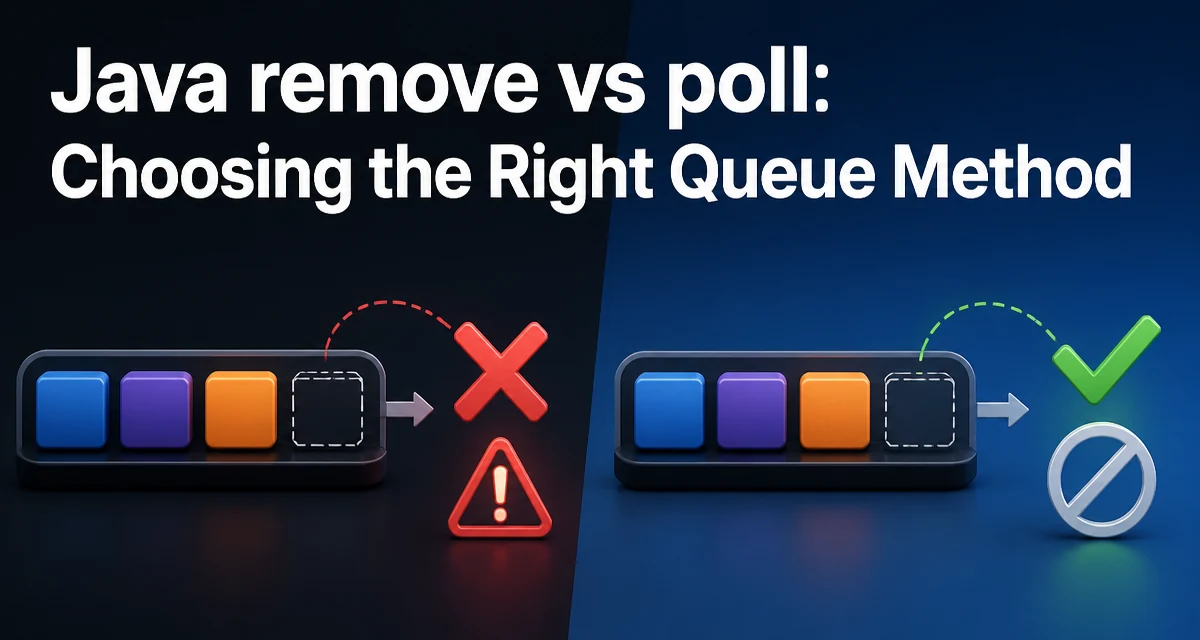
When working with Java's Queue interface, developers frequently need to retrieve and remove the head of the queue. The interface provides two methods for this purpose: remove() and poll(). At first glance they appear interchangeable, but their behavior on an empty queue is fundamentally different. Understanding java remove vs poll is essential for writing robust queue-handling code, especially in producer-consumer scenarios and batch processing.
The core distinction is simple: remove() throws a NoSuchElementException when the queue is empty, while poll() returns null. This difference affects how you handle empty states, how you design your control flow, and how you treat null values in your queue.
Understanding the Queue Interface and Its Removal Methods
The Queue interface, part of java.util, extends Collection and defines a contract for holding elements prior to processing. Besides remove() and poll(), the interface also provides element() and peek() for retrieval without removal. The removal methods are designed to be used when you want to consume the head element.
remove() is inherited from the Collection interface, but Queue redefines it to throw an exception if the queue is empty. poll() is specific to Queue and returns null in the same situation. This is not an implementation detail; it is part of the interface contract. Any class implementing Queue must honor this behavior.
Behavior When the Queue Is Empty
The empty-queue behavior is the primary factor in choosing between these methods. Consider a simple LinkedList used as a queue:
Queue<String> queue = new LinkedList<>();

String item = queue.poll(); // returns null
String another = queue.remove(); // throws NoSuchElementException
When the queue is empty, poll() returns null, allowing the caller to check for that value and handle the absence gracefully. remove() instead signals the problem by throwing an unchecked exception. This means remove() is appropriate when an empty queue is a programming error or an exceptional condition that should fail fast. poll() is better when an empty queue is a normal state, such as when consuming tasks from a work queue that may be temporarily empty.
Code Examples: remove() and poll() in Practice
Let's look at a typical producer-consumer pattern. Suppose you have a queue of messages to process. Using poll():
Queue<Message> messages = new ArrayDeque<>();

Message msg;
while ((msg = messages.poll()) != null) {
    process(msg);
}
This loop continues until the queue is empty, and poll() returning null terminates the loop naturally. If you used remove() instead, the loop would throw an exception on the first empty check, which would require a try-catch block:
Queue<Message> messages = new ArrayDeque<>();

while (!messages.isEmpty()) {
    Message msg = messages.remove();
    process(msg);
}
Here, isEmpty() guards against the exception. The second version is slightly more verbose but makes the empty check explicit. Both are valid, but the poll() version is often more readable because it combines retrieval and emptiness detection.
Handling Null Elements and the Queue Contract
Most Queue implementations, such as LinkedList and ArrayDeque, do not permit null elements. ArrayDeque explicitly forbids nulls and throws NullPointerException on insertion. LinkedList allows nulls, but using null as a sentinel value becomes ambiguous.
Because poll() returns null on an empty queue, you cannot distinguish between an empty queue and a queue whose head element is actually null if your implementation permits nulls. This is why the general Java collections contract discourages null elements in queues. If you need to store null values, you must use a different sentinel or wrap the elements in an Optional. In practice, most queue implementations used in production, such as ArrayBlockingQueue and ConcurrentLinkedQueue, also disallow null elements. Therefore, relying on poll() returning null is safe for the vast majority of real-world queues.
Performance and Thread-Safety Considerations
From a performance standpoint, remove() and poll() are typically equivalent because they perform the same underlying operation: removing the head element. The difference lies only in the empty-queue handling, which is a minor branch. In concurrent queue implementations like ConcurrentLinkedQueue, both methods are thread-safe, but their behavior on an empty queue remains the same: poll() returns null, remove() throws an exception.
When designing concurrent code, consider that remove() throwing an exception can cause a thread to terminate unexpectedly if not caught. poll() allows you to handle the absence of work without exception overhead. For high-throughput systems, avoiding exception creation is beneficial, as exceptions are expensive to construct and fill the stack trace. Thus, poll() is generally preferred in performance-sensitive loops where empty states are expected.
Choosing Between remove() and poll() in Real Code
The decision between remove() and poll() depends on the semantics of your application. Use remove() when:
- An empty queue indicates a bug or an invariant violation.
- You want to fail fast and surface the problem immediately.
- You are using a queue that never becomes empty during normal operation, such as a bounded queue that is always populated before processing.
Use poll() when:
- An empty queue is a normal, expected condition.
- You want to avoid exception handling for a routine case.
- You are writing a loop that continues until the queue is drained.
- You are working in a concurrent environment where the queue may be temporarily empty.
In many cases, poll() is the safer default because it gives you control over the empty state without relying on exception flow. However, if you know that an empty queue should never occur, remove() can act as an assertion and make the code fail early, which is often preferable to silently returning null and propagating a null value through your logic.
Common Mistakes and Edge Cases
A frequent mistake is using remove() in a loop without checking isEmpty(), leading to NoSuchElementException when the queue becomes empty. Another is assuming that poll() never returns null for a queue that contains null elements; as noted, most queues disallow nulls, but if you use a custom implementation that allows them, you must handle the ambiguity.
Another edge case involves the PriorityQueue, which orders elements by natural order or a comparator. Both remove() and poll() remove the head according to that ordering. The empty-queue behavior remains consistent. For Deque implementations, the same methods exist, but remove() and poll() refer to the head of the deque, while removeLast() and pollLast() target the tail. The distinction is the same: remove throws, poll returns null.
When you need to retrieve but not remove the head, use element() (throws) or peek() (returns null). These follow the same pattern as remove() and poll(). Understanding the full set of retrieval methods helps you choose the right tool for each situation.
Finally, consider the contract of the Queue interface: poll() is defined to return null if the queue is empty, but it also returns null if the queue contains a null element. Since most implementations forbid nulls, this is rarely an issue, but you should be aware of it when writing generic code that might operate on a non-standard queue implementation.